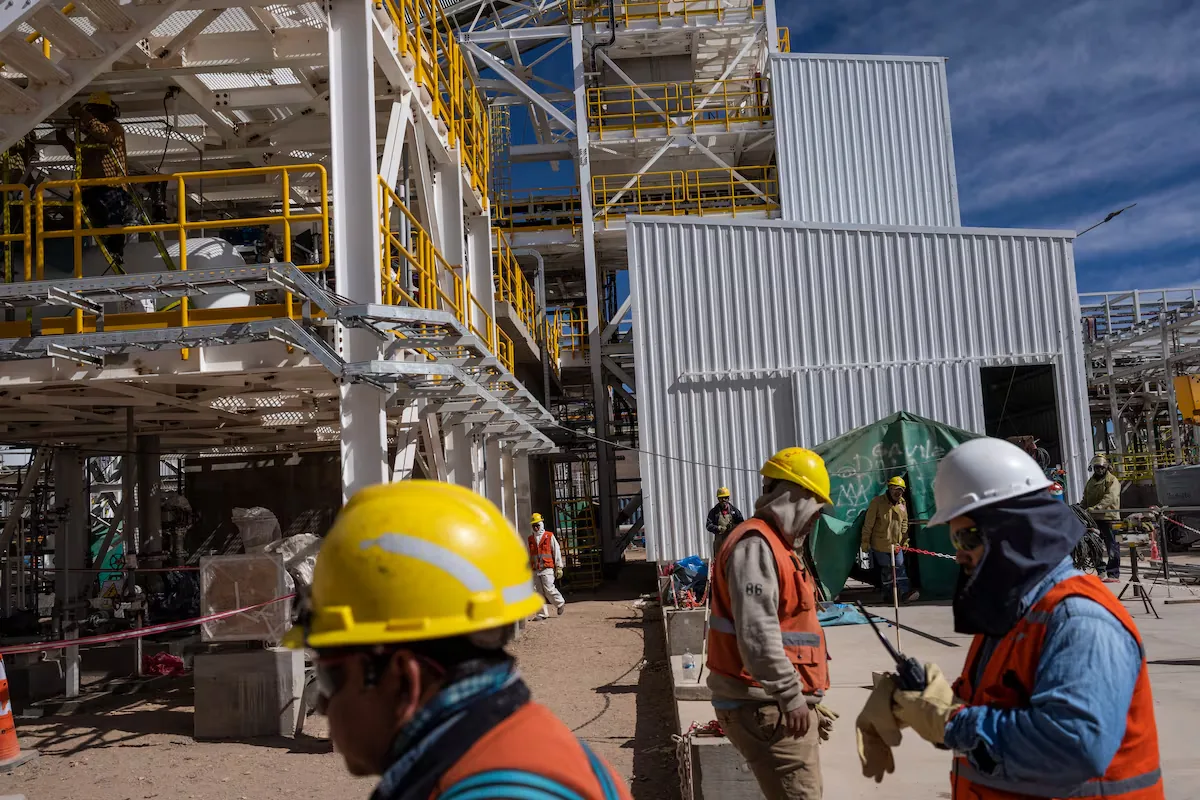
The Argentine industry presents a bleak picture: 40% of the machines are stopped and, since Javier Milei took office in December 2023, there are 87,000 fewer formal employees and more than 4,000 closed companies. These official figures depict the landscape of a sector that has been in crisis for two years and that, for the Government, is part of the inevitable cost of changing the economic model. But a recent figure brought the deterioration back to the forefront: in July alone, manufacturing production plummeted 5% compared to the previous month, its largest month-to-month drop since the collapse caused by the COVID-19 pandemic.
Read more Simeone: “Julián Alvarez’s game was very good, he took charge of the ball from minute one to ninety”
Added to this figure was the 4.6% collapse in construction in July, also reported this Tuesday by the National Institute of Statistics and Censuses (Indec). Compared to a year ago, the drop is 4.9% for industrial activity and 4.5% for construction, but if the time horizon is extended to the last two years, the decline exceeds double digits. These sectors are not marginal within the Argentine economy. Together they represent 25% of registered private salaried employment, so they have a direct impact on the living conditions of a large part of the population.
The new statistical setback also threatens to drag down growth forecasts for the entire year. “Our growth projection was always 2.5% and now we have lowered it to 2.2%,” says Santiago Bulat, chief economist at Invecq. If it has already been ruled out that Milei will meet his annual inflation target (set at 10.1% but already accumulated 19.3% in the first seven months of the year), the GDP growth target, set at 5%, is also far off. The International Monetary Fund, which supports Milei’s adjustment plan, maintains a growth forecast of 3.5% for 2026.
Milei’s Government has refused from the start to offer specific support measures for these two heavily hit sectors, arguing that what is happening is the normal effect of moving from a protectionist model to a more open and competitive one. It has been especially confrontational with the industry, which it accuses of being used to “hunting in the zoo.” The Executive also resists talking about a recession in activity and usually focuses on aggregate indicators, where very productive sectors such as oil, mining, and agriculture push the numbers upward.
Read more The wedding that changed two six-year terms
“These data definitely refute the idea that we have a two-speed economy, with sectors advancing very quickly and others lagging behind. What we have is a two-direction economy, where some sectors grow and have a lot of dynamism and others continuously contract,” observes Matías Maito, director of the Training and Studies Program on Work and Development at the National University of San Martín. For the academic, it is also not a transitional stage. “These sectors fall not for circumstantial reasons, but because of structural aspects of this development model, which implies consumption contraction, indiscriminate opening of imports, rising costs, and more expensive credit,” he adds.
In recent weeks, the Government’s discourse has begun to incorporate the idea of “reactivation” more frequently, after a long time of avoiding admitting that the economy needed an additional boost. The Minister of Economy, Luis Caputo, launched measures aimed at stimulating mortgage credit, with the expectation that financing will restart the real estate market and, behind it, construction.
It may be that Milei’s team has echoed the growing unrest among the population related to wages and employment, but the truth is that generating a recovery of the domestic market has also become a necessity for the government’s numbers. Due to the drop in revenue, it is forced to tighten more and more to uphold its banner of zero fiscal deficit.