









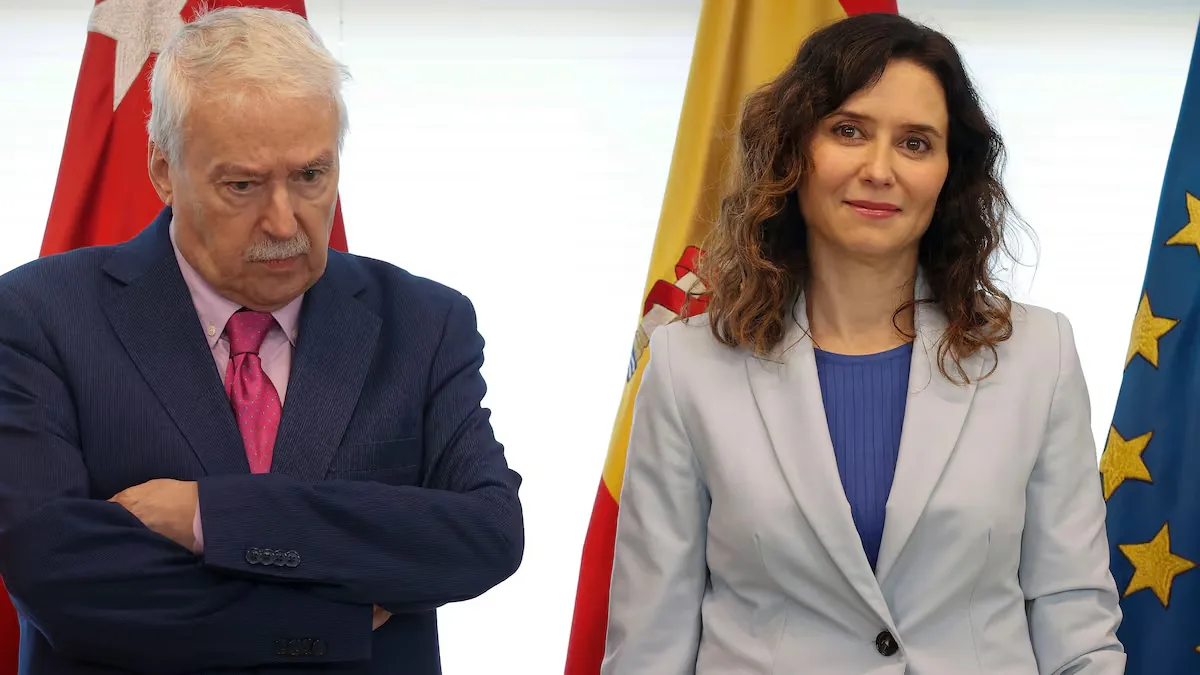
The Constitutional Court will decide whether the rights of Ana Cuartero, Vox deputy in the Madrid Assembly, were violated by the absolute majority of the PP in the regional Parliament’s Board by denying her a request for the appearance of the president of the Court of Auditors, Joaquín Leguina, to explain the audit program for 2025. This is stated in documentation consulted by this newspaper under the transparency law, which again surrounds the figure of the former socialist regional president with controversy. Leguina, who is 85 years old and earns 100,556.52 euros gross annually, was appointed to his current position in 2024 by Isabel Díaz Ayuso (PP). Shortly after, the Court of Auditors hired his partner as secretary. Later, he declined to explain a report in the parliamentary chamber (“My experience in these agreements is zero”). He even asked the opposition not to request so many audit reports on Ayuso’s government: “It is impossible.” And now he is at the center of a legal debate about whether his appearance is properly requested by Vox under the Assembly’s regulations.
Read more Sciammarella revisits García Lorca
“Vox’s objective with the filing of these appeals is to ensure that the Popular Party cannot use the Assembly Board or its absolute majority as instruments to limit, condition, or prevent the normal exercise of parliamentary work by deputies,” says a party spokesperson. “The function of the Board must be governed by criteria of impartiality, respect for the Regulations, and guarantee of the rights of all parliamentary groups, and not become a mechanism at the service of the political majority of the moment,” he emphasizes. “Therefore, this is not a partisan issue, but about defending the proper functioning of the parliamentary institution and respect for democratic rules, understanding that the Madrid Assembly must be a space for debate, control, and political representation.”
This is explained by a spokesperson for the Assembly: “The appearances of the president of the Court of Auditors and its counselors are regulated in the Madrid Assembly regulations (article 236) and the Board has simply applied those criteria.” He adds: “Joaquín Leguina has appeared as president of the Court of Auditors on four occasions.”
Article 236 of the Madrid Assembly regulations establishes that each parliamentary committee, through the parties, “may request the appearance of the president of the Court of Auditors to explain the content of the report or memorandum.” However, the PP has been interpreting this provision restrictively, according to the opposition. That is, any other type of topic is excluded, such as explaining its audit priorities, the changes it wants to make in the examination program, or its personnel policy in the body. All this despite the law regulating the Court of Auditors including in its . However, up to five amparo appeals from the PSOE on this matter have not been admitted by the Constitutional Court, according to the socialists.
In contrast, Vox’s appeal has passed the initial screening, as shown by the fact that the guarantees court has requested the Assembly to send the file related to the challenged agreements and has forwarded the claim so it can appear in the procedure. The far-right party argues that its request was for Leguina to report on the Court of Auditors’ audit program for 2025, and that this was denied despite no problems in 2024 and 2023, although in different committees (the Women’s Committee and the Budget Committee, respectively).
What did the Board argue to reject the request? “Not to call the President of the Court of Auditors of the Community of Madrid to appear for the exercise of the audit function of the Court of Auditors under the terms of article 236.” That is, the request did not fit what was provided for in the regulations. According to the minutes of the meeting where the decision was made, the Vox representative did not oppose.
Read more The relief of returning to routine after a summer with the kids
This is supported by a parliamentary source who knows the regulations in detail: “In my opinion, the object of the appearance can be understood within the regulations, or at least Leguina can stick to that. And in any case, it should not be the Board that limits it.”
Battlefield
The Constitutional Court has become another battleground in the constant struggle between the Madrid PP government and the entire opposition. So far, with results contrary to the interests of Díaz Ayuso’s executive. In 2026 so far, the guarantees court has reproached the Assembly for processing laws in a single reading that allowed it to establish control over Telemadrid in 2021 and 2022. It has also overturned the veto on asking about the powerful chief of staff of the president, Miguel Ángel Rodríguez, or about the businesses of businessman Alberto González Amador, investigated for alleged tax fraud while he was the partner of the baroness and lived with her.
Thus, the entire opposition considers that the Constitutional Court is putting limits on the PP’s absolute majority steamroller in the regional Parliament. And for that reason, it perseveres on that path. For example, two other Vox deputies have recently had amparo appeals admitted for different control initiatives rejected by the Board.
“This appeal is based on the violation of the fundamental right of political participation recognized in article 23 of the Constitution, for illegitimately restricting the exercise of representative and parliamentary control functions,” reads the appeal of the Vox deputy, known to the Assembly during a meeting held this summer. “With an additional infringement, closely connected, of the principles of prohibition of arbitrariness and legal certainty (article 9.3 of the Constitution), as the agreement uses a stereotyped and by reference motivation (“The arguments are reiterated…”) that empties the reconsideration procedure of content and makes it impossible to know the effective reason for the restriction,” it adds. “[The Board] does not limit itself to noting a formal defect in the submission, but goes on to assess, with an obstructive intention, the suitability of the person appearing.”
Arguments whose merit will now be assessed by the Constitutional Court just as the regional elections of spring 2027 already appear on the horizon.