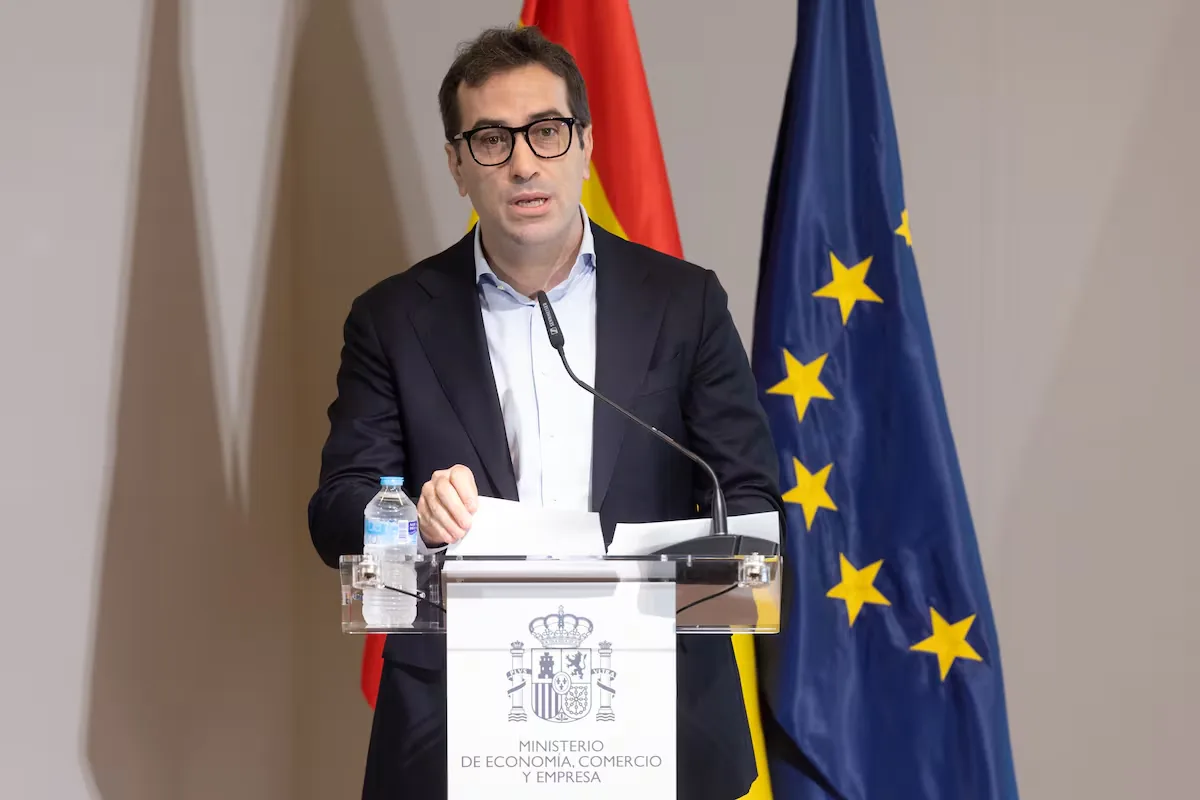
The Minister of Economy, Carlos Cuerpo, confirmed this Wednesday in Brussels that Spain will submit the application for the seventh and final disbursement of the Recovery, Transformation, and Resilience Plan at the end of September. The Government will thus use up the deadline set by the European Union for Member States to claim the last funds due to them, which expires on the 30th of this month.
Read more Iran responds to the United States with new attacks against Bahrain, Jordan, and Kuwait
The request will amount to nearly 26 billion euros: 21.462 billion in non-repayable transfers and 4.4 billion in favorable loans. For the European Commission to authorize this final payment, the Executive must certify compliance with 148 milestones and targets whose execution deadline expired on August 31. From then on, the Administration can no longer incorporate new actions into the program, so the work consists of compiling the documentation and preparing the certification that Brussels will examine to decide whether to grant the last payment and its amount, as it may deduct some items if it considers there are partial breaches of the reforms promised by Spain. For this, it will have until December 31, the date the European calendar marks as the last to make fund transfers.
This will be the last disbursement to Spain from a program that has mobilized an extraordinary amount of European resources. So far, the country has received 78 billion euros in six payments: 61 billion in non-repayable transfers and more than 17 billion in loans that must be repaid. If the European Commission deems the requirements of the seventh tranche fulfilled, Spain will have received more than 100 billion euros from the Recovery and Resilience Mechanism before the end of 2026.
The request for the last final payment closes an exceptional financing cycle that began in July 2020 (although formally the program did not start until spring 2021), in response to the economic crisis generated by the coronavirus pandemic. Beyond the large figures disbursed by Brussels, the issue is that the execution of this money has been uneven depending on the type of financing. While non-repayable grants have progressed at a good pace, the demand for European loans has fallen far short of initial forecasts. In 2023, the Government estimated requesting more than 80 billion euros in loans. The final figure has been reduced to about 21.5 billion, which means giving up around 75% of the available volume.
The justification is that the demand for these loans has been much lower than expected. On the one hand, the Treasury has found a competitive financing route in the markets, which has reduced the appeal of resorting to European credit. On the other hand, companies have found little incentive to apply for loans that, according to critical voices, were accompanied by lengthy bureaucratic procedures.
The parliamentary situation has also forced the Government to lower or modify some of the commitments initially made with the European Commission. An example of this is the increase in diesel taxes to equalize them with gasoline taxes, a commitment made with Brussels that Moncloa has acknowledged it will not fulfill. Now the negotiation with the Commission focuses on closing the program. The Ministry of Economy is working on simplifying the procedures to verify the last milestones and targets, aiming to speed up the review of files and prevent the accumulation of documentation from delaying the last disbursement.
The economic balance of the plan remains a subject of debate. The Government maintains that the funds have contributed to the good performance of the Spanish economy, something certified by analysis centers such as Funcas, according to which European funds explain between 10% and 14% of the average annual growth recorded between 2021 and 2025. Criticism, however, focuses on how the program has been managed. Some analysts and the main opposition party have questioned over time that the autonomous communities and the productive fabric have had a smaller role than they could have played in the execution of the program.
The next unknown will come in 2027, when the extraordinary flow of money injected by European funds disappears. The Government fears that the end of the program will cause a loss of investment momentum just when Spain will have to readjust to fiscal rules again, which limit the growth of public spending and require a gradual reduction of the deficit and debt. Added to this is a still uncertain geopolitical scenario, marked by the war in the Middle East and with no clear prospects for a short-term solution.
To cushion part of that risk and maintain momentum, the Executive has launched España Crece, a public-private co-investment fund managed by the Official Credit Institute. The instrument will initially have 10.5 billion euros from the recovery plan’s leftovers and aims to mobilize up to 120 billion euros over the next decade alongside national and international private investors.