










The President of the Government, Pedro Sánchez, will convene representatives of business organizations and trade unions in the coming weeks to negotiate a tripartite agreement on artificial intelligence. The announcement was made this Wednesday in Santander by the First Vice President and Minister of Economy, Trade and Business, Carlos Cuerpo, during the closing of the 40th Meeting of the Digital Economy and Telecommunications organized by Ametic.
The Executive intends to structure this agreement within a national pact aimed at defining the conditions for the implementation of artificial intelligence in the productive fabric. According to Cuerpo, the initiative seeks to consolidate the economic returns of new technologies and mitigate the risks arising from their adoption in the different sectors of economic activity.
The tripartite negotiation table will constitute the core of the project, to which the Government plans to later incorporate experts, civil society organizations, and representatives from industry, healthcare, and education. The Minister of Economy pointed out that the inclusion of social dialogue in the technological strategy seeks to guarantee an equitable distribution of productivity returns.
Cuerpo specified that the agreement promoted by the Executive will cover regulatory, labor, financial, and infrastructure areas to guide the technological transition, keep citizens’ security “at the center of the process,” and ensure that the benefits of artificial intelligence are distributed “fairly among the citizens.”
Regarding digital governance, the minister stated that the evolution towards a favorable economic scenario will depend on “who will control this technology” and “who will be able to capture the gains” generated by its deployment. Cuerpo added that decisions in this matter constitute “country decisions” that will require a coordinated approach at the European level.
On the other hand, the Minister of Economy did not guarantee that the Council of Ministers will approve the new working hours registry during September, assuring that the Executive will process the regulation “as soon as possible.” He explained that the Ministry is correcting the project of the Second Vice President, Yolanda Díaz, after receiving observations from the Council of State, a measure he described as “key” to effectively implementing the reduction of the working day despite warnings from the CCOO and UGT unions about breaking social dialogue if it is not approved this month.
Morant and Elon Musk
For her part, the Minister of Science, Innovation and Universities, Diana Morant, warned this Wednesday at the same forum in Santander that Europe must strengthen its strategic autonomy in space and communications in the face of the growing concentration of critical infrastructures in the hands of a small number of private actors. “When an infrastructure becomes critical, the question of who controls it also becomes critical,” she said.
Morant placed space at the center of European technological sovereignty and highlighted that around two-thirds of the nearly 16,000 satellites currently in operation belong to a single person, referring to Elon Musk and, although not explicitly named, to SpaceX’s Starlink constellation. In her view, this concentration shows how a global strategic infrastructure can end up in the hands of a very small number of operators. “Europe needs greater own access to space, secure communications, Earth observation, and companies capable of developing strategic technologies,” she argued, calling for own capabilities that allow the continent “not to depend on foreign infrastructure and to be able to decide freely.”
The minister also defended the economic and industrial dimension of this commitment. Spain currently contributes 455 million euros annually to the European Space Agency (ESA), a contribution that, according to Morant, triples that of the previous government and translates into contracts for the national industry. She assured that Spain is already “the fourth power of the ESA,” alongside Germany, France, and Italy, and that the Spanish space industry is experiencing “its best moment.” In this context, she advocated projects such as IRIS2, the future European constellation of secure communications, and emphasized that space generates research, innovative companies, and qualified employment. “Spain no longer accompanies the future of space, but contributes to building it,” she stated.
Read more Russia secretly helps Iran develop supersonic cruise missiles
Quantum Inventory
The Secretary of State for Telecommunications and Digital Infrastructures, Antonio Hernando, identified another technological risk on the horizon: the arrival of quantum computing and its ability to jeopardize current encryption systems. “Our defense data, our intelligence data, the digital signatures you currently use, will be at risk when this develops,” he warned. Hernando called on administrations to prepare an inventory of systems that will need to migrate to post-quantum cryptography and establish a schedule to prioritize the most critical ones. In his opinion, 2030 and 2031 are the years when the migration of these systems should begin, given the risk that encrypted data is already being stored to be decrypted later when sufficiently advanced quantum technology exists.
For his part, the Secretary of State for Science, Innovation and Universities, Juan Cruz Cigudosa, defended the new Deep Tech Strategy 2026-2030, which will mobilize more than 8 billion euros, with 80% directly allocated to companies. The goal, he explained, is for Spain to stop merely adopting technology and start developing companies capable of competing internationally. The strategy focuses on infrastructures and talent, strengthening the business fabric, and new governance, with instruments such as the National Deep Tech Observatory. Cigudosa insisted that deep technologies require “patient capital, long timelines, and tolerance for failure” and assured that Spain “will not be late” to this transformation but aims to lead it. He also highlighted that the country has recovered 23,000 people dedicated to science, compared to the 10,000 it lost during the economic crisis a decade ago.
In the business debate, the General Director of Indra Space, Miguel Ángel Panduro, warned that the space sector is experiencing “a real revolution” and that “a fight to dominate space” is coming. Panduro called for caution regarding the “bubbles” being generated and noted that the sector’s transformation is breaking its traditional value chain, while companies tend to become comprehensive solution providers. In his view, Europe is losing ground despite increased investment and, comparatively, “we are losing this war,” so he called for focusing efforts on defense, security, and own technology. As an example of the new Spanish industrial dimension, he cited Hispasat’s participation in SpaceRISE and IRIS2, with a contract announced for 1.6 billion euros.
The digital sector in Spain grows by 6.4%
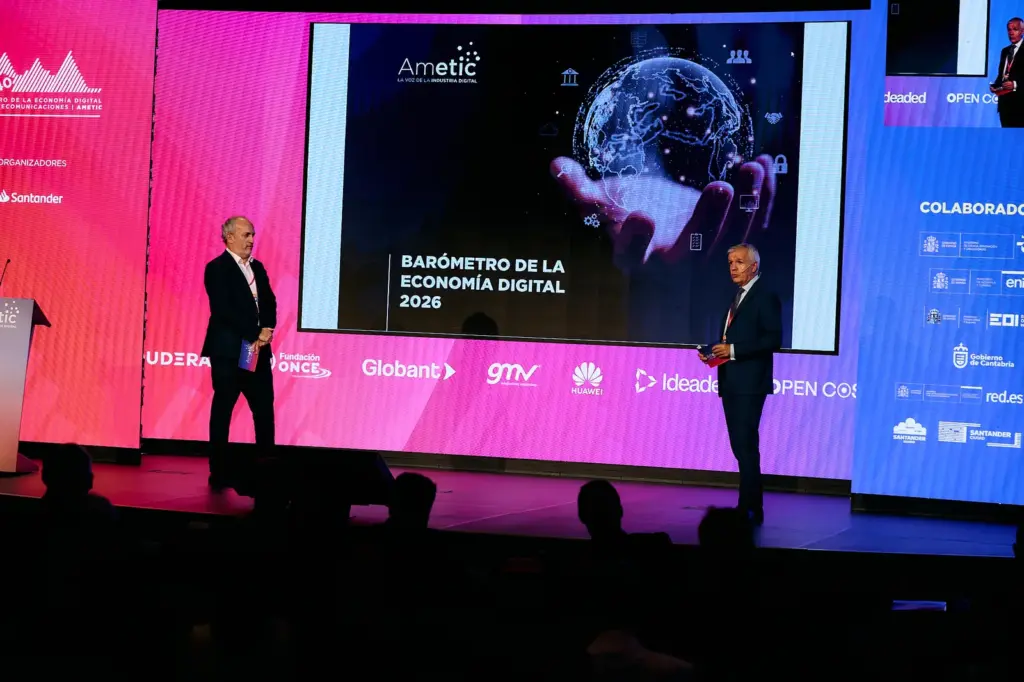
The digital technology sector in Spain invoiced 146.66 billion euros in 2025, an increase of 6.4% compared to the 137.834 billion of the previous year, according to the Digital Economy Barometer presented this Wednesday by the employers’ association Ametic in Santander. With this advance, the industry chains five consecutive years of growth after the 1.8% contraction suffered in 2020. The total impact of the digital economy in the country reached 455.531 billion euros, equivalent to 27% of the Gross Domestic Product (GDP).
The business volume was led by the Information Technologies segment, which registered an increase of 7.9% to 79.486 billion euros. Meanwhile, the Communications area earned 30.035 billion euros, 3% more year-on-year, while digital content advanced 5.2% to reach 20.85 billion. Likewise, e-commerce turnover rose 20.6% in the last year, totaling 114.812 billion euros.
The business fabric of the industry expanded by 0.4% in 2025 to reach 36,851 companies registered with Social Security, with the largest increase corresponding to Information Technologies firms (+0.7%, up to 19,278 companies). In terms of employment, the sector’s workforce rose 2.4% year-on-year, closing the period with 842,596 active workers. Each euro invested in digital activity generated an impact of 3.11 euros in the general economy.
Despite positive results in turnover and employment, the sector’s trade balance recorded an increase in its external deficit of 1.7%, standing at a negative balance of 7.312 billion euros. In parallel, investment in information and communication technologies (ICT) by Public Administrations experienced a contraction of 7.2% compared to 2024 data, for a final expenditure of 6.018 billion euros.
Read more California advances a law to ban the use of stun gloves that ICE will use