









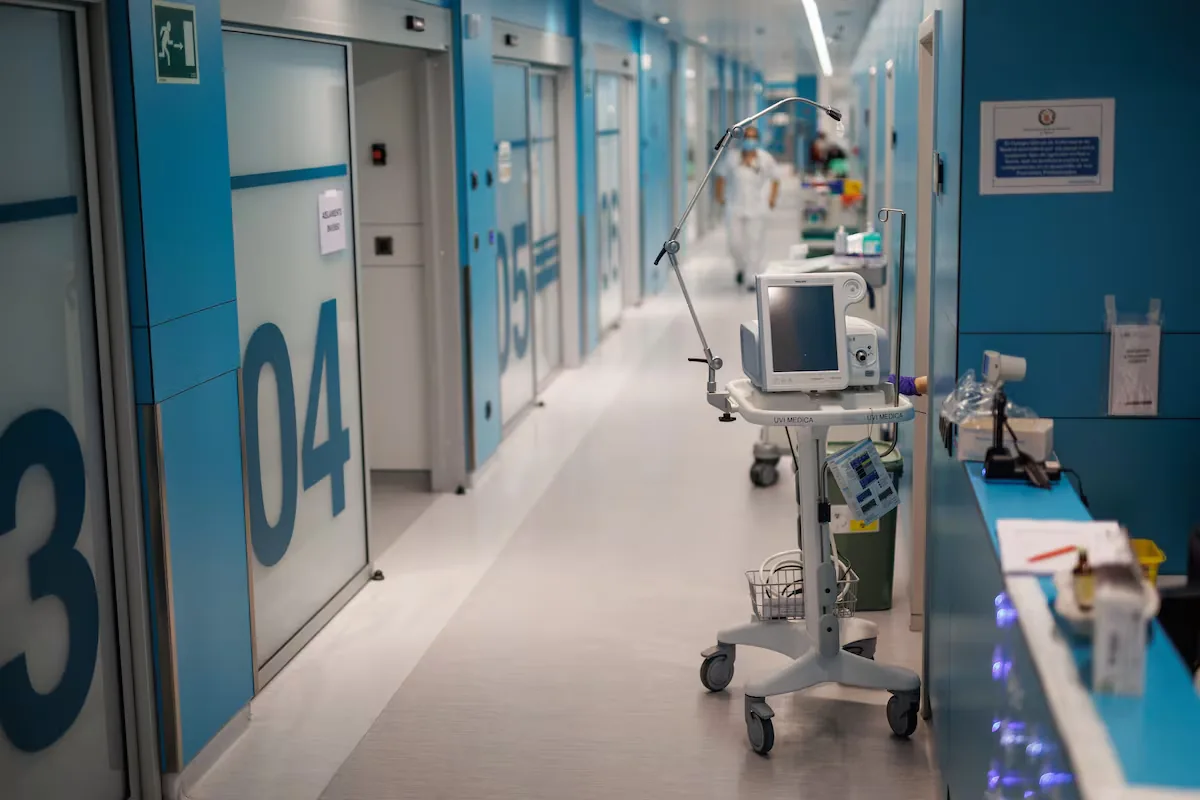
Private healthcare is a booming business that continues to grow in Spain. Much of the reason must be sought in the public sector: its growing waiting lists and care that is perceived to be continuously deteriorating push millions of citizens to purchase insurance. But the public healthcare system itself also transfers more and more money to the private sector through agreements, which in 2024 — the latest available data — amounted to more than 10 billion euros, a little more than double that of 2002.
Read more Next extinction
An anecdotal example shows how intertwined both systems are: even the Ministry of Health, a champion of defending public management under the direction of Mónica García, resorts to groups like Quirón for some diagnostic tests in Ceuta and Melilla, the only territories where it has healthcare provision competencies.
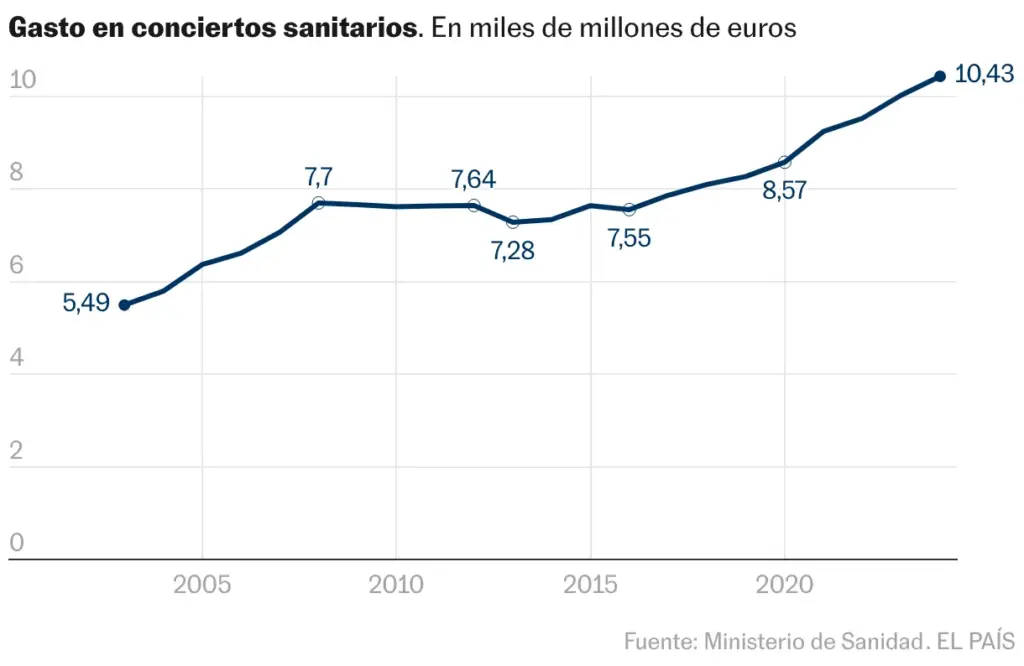
The amount of public healthcare agreements grew by 21% between 2020 and 2024, from about 8.4 billion to over 10 billion. But these contracts do not capture all outsourcing. Services such as cleaning, cooking, maintenance, or IT are accounted for within intermediate consumption, along with medicines, medical supplies, and energy. This category reached 26.624 billion in 2024, although it cannot be fully added to the agreements because it includes many purchases that are not outsourced services.
Behind this scenario are counterintuitive keys: agreements grow in gross terms, but not in percentage. Their weight has remained around 10% of public healthcare spending for more than 20 years, with a slight downward trend. It happens that the public sector also invests more and more. We are at the moment in history when the State spends the most on healthcare, when there are more doctors and nurses in the National Health System (SNS), but also when waiting lists are longer and citizens are more dissatisfied with the system.
Several explanations converge. Part of it could be room for improved efficiency. “The degree of inefficiency is around 15%. We could do the same with 20 billion less,” says Alberto Giménez Artés, president of the Economy and Health Foundation, referring to calculations by the Institute of Economic Studies. However, the reference comes from an indicator on total public spending, not a specific estimate of the National Health System. There is also no evidence that this percentage has increased. What has grown is the complexity of treatments, the price of cutting-edge medicines that did not exist before, and the demand of an increasingly aging population.
To meet it, the public infrastructure is overwhelmed. What the autonomous communities have done in recent years is increasingly rely on the private sector. In 2023, there were 145 private hospitals effectively integrated into the SNS — with more than 80% of their resources or activity linked to the public system — 37% more than in 2011.
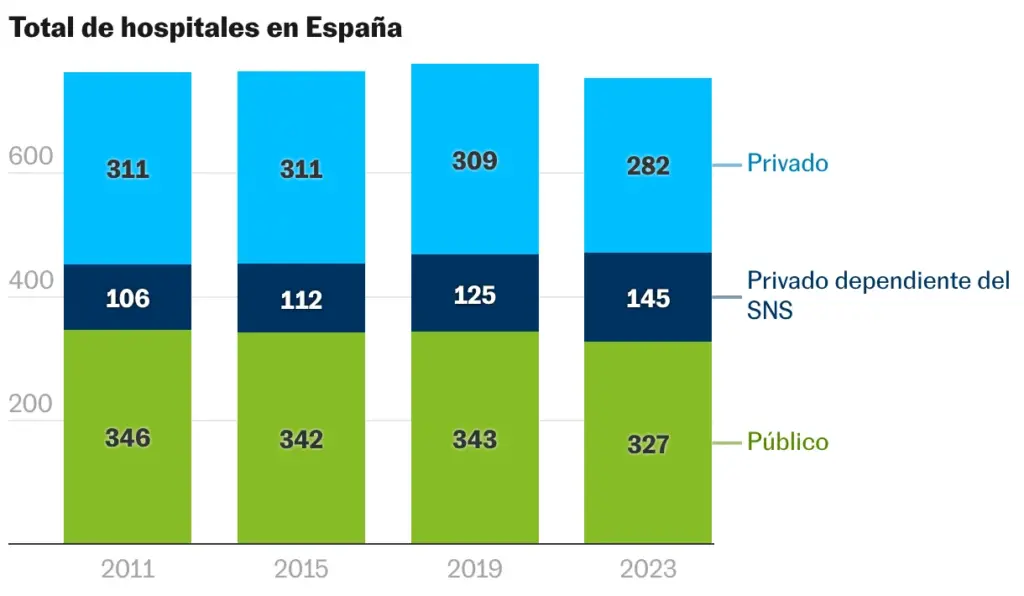
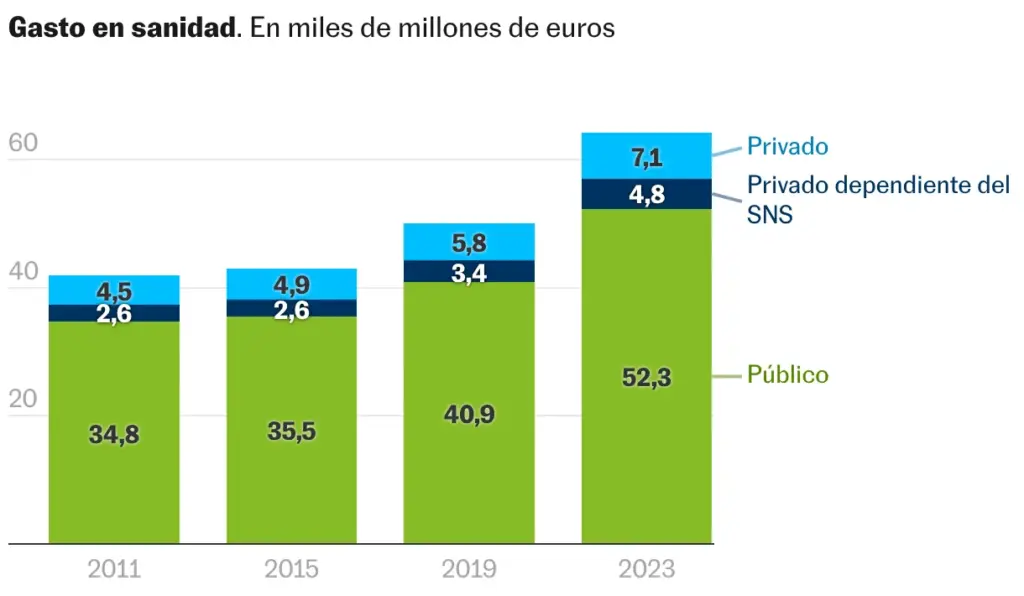
Source: Ministry of Health.
EL PAÍS
Public funding also reaches private centers not integrated into that network, which may have partial agreements: in these, the SNS financed 34.6% of stays and 21% of major outpatient surgery interventions. In private outpatient diagnostic centers not belonging to the SNS, it also paid for 43.7% of the tests.
The figures portray an increasingly porous boundary and an unequal division of labor: the public network continues to assume most emergencies, high complexity, and the most expensive treatments, while the private sector gains ground in consultations, diagnostics, and scheduled activity. The collaboration covers immediate needs and absorbs waiting lists, but consulted experts also point out risks of dependency, professional transfer, loss of own capacity, and inequality in access.
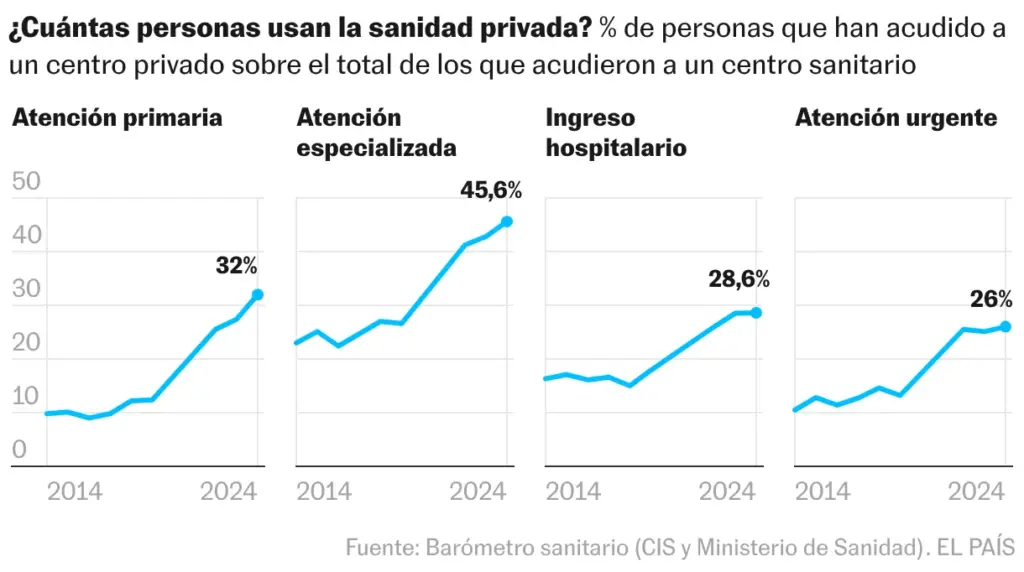
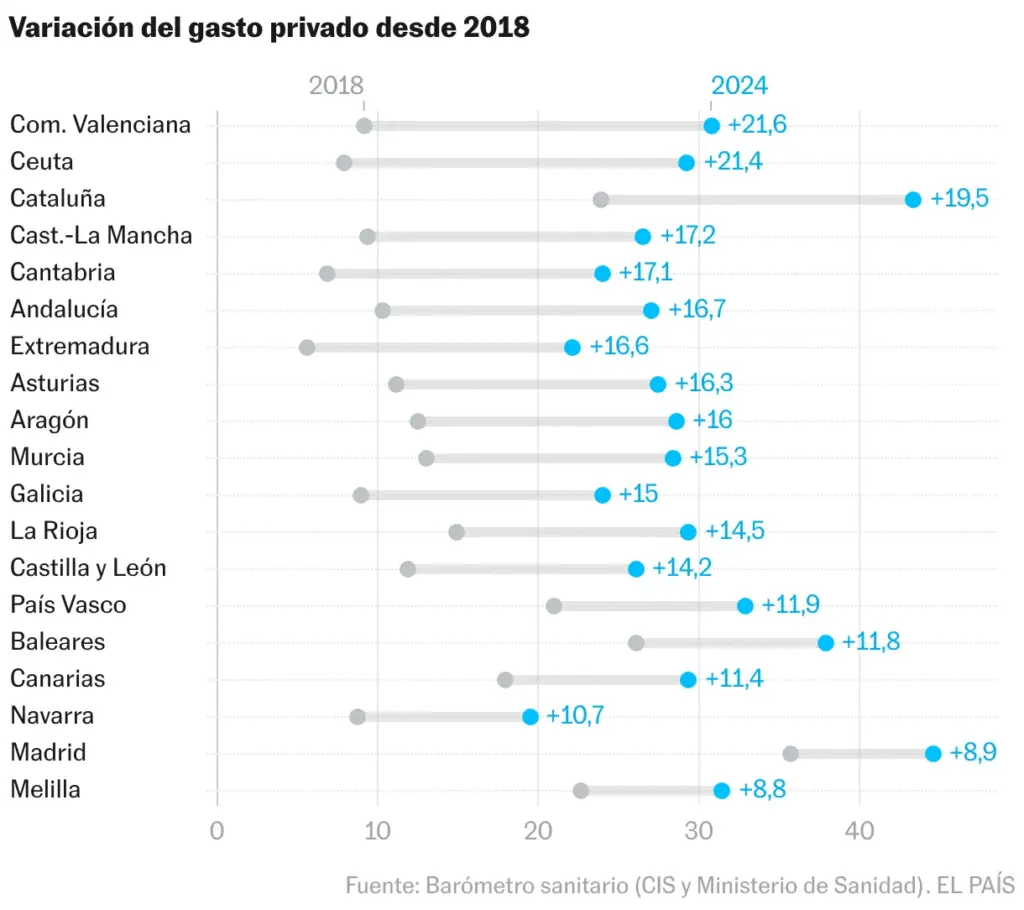
Private demand advances both through insurance contracting and its use. According to the Health Barometer, the population with private coverage almost doubled between 2018 and 2024, from 17.2% to 32.6%. Among those who used some healthcare service, the percentage who went to the private sector for specialized care has doubled in 10 years, reaching 45.6% in 2024. The increase was even greater in primary care, from 9.8% to 32%, and also extended to emergencies and hospital admissions.
This growth is not necessarily positive for the private sector, according to Juan Abarca, president of the HM Hospitals Group and one of the great insiders of the sector. “Obviously, the deterioration of the public sector favors access to the private. Before the pandemic, it was related to that complementarity that a patient might want to have faster access at a given moment, to have more personalized care. And now we see that the deterioration in access to the public sector is causing people, whenever they can, to get health insurance that may have more or fewer benefits depending on its amount. If it has few benefits, the patient gets tests done in the private sector and with that goes to the public. That as a business does not benefit us at all, it causes overcrowding. Where we get the margin is in complexity and the complete process,” he reasons.
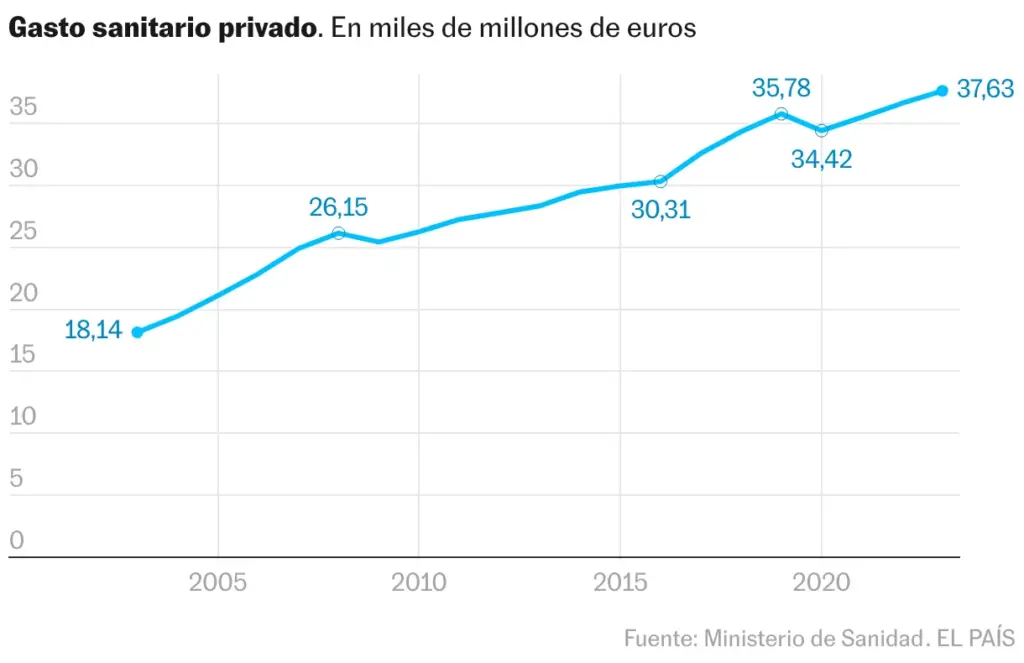
Abarca also points out a problem in access to innovation in the public sector, which causes citizens to pay more and more for treatments out of pocket. To exemplify this, he cites new drugs against Alzheimer’s or obesity. Spending financed by households, insurers, and companies reached 37.628 billion euros in 2023, nearly 10% more than in 2018, although the relative weight fell from 30.7% to 26.4%, due to the large increase in expenditure during and after the pandemic.
José Ramón Repullo, emeritus professor of Health Planning and Economics at the National School of Health, warns that this growing interdependence of public and private sectors can harm care coordination: “Modern medicine is becoming very fragmented. When part of the care jumps to the private sphere, we do not fragment medicine, but the patient: parallel, unsynchronized resources appear. That poses a challenge for quality.”

Diagnostic tests
Public funding of private care has significant weight in diagnostic tests, as Abarca pointed out. In 2023, private outpatient diagnostic centers not belonging to the SNS performed 3.2 million studies, mainly imaging tests and biopsies. The public system paid 43.7%. The proportion was practically the same in 2011, but then only 699,574 tests were financed. That is, the public sector has not increased its relative weight within this segment, but buys twice the activity because the total volume has also doubled.
The phenomenon does not only reflect the expansion of the private business but a change in the care model itself in which doctors increasingly rely on tests for their diagnoses. Even too much. Several studies have yielded a figure of between 20% and 30% of unnecessary tests.
Between 2011 and 2023, MRIs went from 27.7 to 46.5 per 1,000 inhabitants in public hospitals and from 20.1 to 43.6 in non-integrated private ones. CT scans followed a similar trend. Since these tests can be standardized, scheduled, and paid per procedure, they are especially easy to contract externally. The private network thus becomes an extension of the public diagnostic capacity.
“Basically, waits are being outsourced for radiology, MRIs, CT scans, and elective surgery: a relatively standardizable world, more comfortable to do and where the private sector moves well,” summarizes Salvador Peiró, a researcher at Fisabio and specialist in health services. The flip side is public hospitals, more focused on complex cases and highly specialized techniques, which are also present in some private hospitals but are not the routine of most services they provide.
Repullo establishes a hierarchy of risks. Outsourcing coverage of entire populations through mutual funds or concessions has a greater scope than contracting specific processes. “If you have 500 hip operations or 1,000 cataracts, they are very focused, you can outsource them, hold tenders and auctions,” he says. The issue changes when punctual purchasing becomes the ordinary way of providing a service.
For Giménez Artés, the increase responds to a material need. “There is no doubt that public-private collaboration is increasing. The growing healthcare demand and aging population require increasing resources, and those of the public sector are not enough. What we are doing is complementing citizen care through collaboration that is guaranteeing sustainability and optimizing resources.” His thesis is that the debate must be placed “above ideologies” and focus on who can attend the patient better and sooner.
Giménez also emphasizes that management and guarantee are not synonyms: provision can be in private hands without the State giving up financing, regulating, and demanding quality and equity. That is the usual defense of the sector: the installed private capacity absorbs peaks, shortens queues, and allows quick access to technology or professionals that the Administration takes longer to deploy.
Read more F1 Madrid GP Classification, live | Lando Norris achieves the first ‘pole’ at the Madrid circuit
Rosa Urbanos, professor of Applied Economics at the Complutense University and specialist in health economics, does not rule out that utility but shifts the question from how much is outsourced to what is obtained in return. “Beyond whether some communities outsource more or less, the important thing is to know the return they get from that spending. We are increasingly aware that evaluation is necessary, but it is still insufficient and unsystematic.”
The private sector is useful when a waiting list requires increasing supply, Urbanos explains, but not every queue is solved by buying more operations or tests. “In other cases, the literature tells us that it is more effective to develop waiting list management strategies, which include periodic review of patients on the waiting list to assess the appropriateness of the indication and their priority level.” Spain does not have a homogeneous evaluation relating, for the 17 communities, the increase in agreements with the evolution of delays, volume served, own staff, complexity, and clinical outcomes.
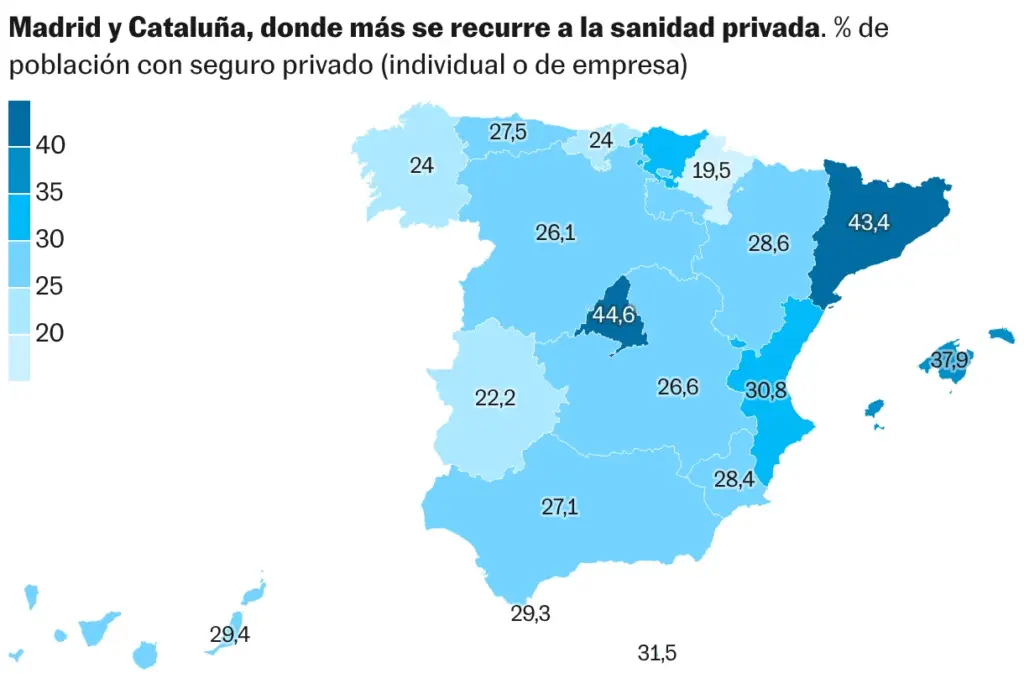
The territorial map shows very different models. Catalonia allocated 21.1% of its public healthcare spending to agreements in 2023 and Madrid 11.4%, compared to 2.9% in Cantabria, 3.1% in La Rioja, or 3.5% in Castilla y León. An estimate obtained by combining rounded ministerial tables concentrates around 61% of the autonomous community contracted spending in Catalonia and Madrid. However, the Catalan figure does not equate to business profit: its public network has integrated hospitals of diverse ownership for decades, including foundations and non-profit entities.
The Ministry of Health has sent a law to Congress to limit agreements to cases where strictly necessary, although the rule has little chance of passing given the parliamentary arithmetic.
Pay for the diagnosis and return to the public system
The coexistence of both networks also opens a less visible path of inequality. A person pays for a policy or a test, obtains an MRI or CT scan earlier, and returns to the SNS with the diagnosis already made to receive complex treatment. The route does not necessarily eliminate anyone from the surgical list but allows overcoming the diagnostic wait and entering the next phase of the circuit sooner.
A study published this year in Gaceta Sanitaria explored this phenomenon with individual data from Catalonia between 2018 and 2023. The researchers identified 9,080 people with an explicitly registered private diagnostic test and constructed another sample of 584,835 private non-surgical and short-stay contacts as an approximation to diagnosis. In the first group, the rate of admissions to public hospitals during the month after the test multiplied by 2.29 that of the previous month. In the broad sample, admissions multiplied by 2.09.
The design is descriptive. It does not prove that the private test causes admission nor quantify if the passage through the private sector reduces diagnostic waits for those remaining in the public system. The increase may also reflect the evolution of the disease that motivated the test. The authors describe the result as “compatible with a process of dualization of access” and not as conclusive proof of queue jumping. Spending grows more than admissions, a pattern suggesting that patients returning to the public system concentrate more complex and costly cases.
Repullo considers that the pattern reflects a shift in balance. “My starting point is that there has always been interdependence. What some call privatization has been an alteration of the traditional balance that does not benefit the general interest and, paradoxically, is not good for the private sector either.” His diagnosis is that the growth of the private sector is not endogenous: “It is the deterioration of public healthcare, which is what must be corrected.” When delays increase, more people buy quick access to consultations and tests; for serious interventions, many maintain their trust in the SNS.
The president of HM Hospitals believes that this type of interdependence is essential. “If you don’t have capacity, you have no other choice. If you want to remove agreements, you first have to build hospitals, and those building them are private,” says Abarca, whose group has four underway.
Outsourcing is less problematic when it covers a peak or a well-defined activity and retains enough capacity within the SNS to plan, supervise, and negotiate. The risk, warn some of the consulted experts, grows when a community buys MRIs, dialysis, laboratories, or surgery from the same providers for years. Companies size their facilities and staff counting on that demand; the Administration stops investing in its own means, and recovering the service later requires equipment, professionals, and time. The immediate solution becomes dependency.
“If you start massively depending on the provision of tests by third parties, you lose market control,” says Repullo. “If all hemodialysis or MRIs were done outside, when you went to negotiate prices, they would impose them on you. Being able to resort to 15% or 20% external contracting does not affect you excessively.” The economist also warns of the loss of professional knowledge: “In a center, you receive the test, go up to talk to the one who requested it, see what they want it for, the predictive value, the specificity. It is not an external supply like gloves. Outsourcing de-professionalizes it.”
Peiró places the main problem in the quality of the public buyer. “Collaboration must be reasonable. The private sector always looks for gaps in the public sector to exploit. Diagnostic technologies are one of them: they are usually very quick to implement, and there are things that take the public sector more time.” When excessive prices, poorly controlled contracts, or dependence on a provider appear, he adds, the failure alone does not prove the superiority or inferiority of private management: it reveals “capture and governance problems,” because the Administration has not regulated or purchased for the benefit of the entire population.
Interdependence also affects professionals. Many specialists combine a morning in the public system, where multidisciplinary teams and high complexity concentrate, with an afternoon of consultations or surgery in the private sector. Dual practice increases income and supply but opens conflicts of interest, self-referrals, and competition for scarce staff. “A specialist’s heaven is a scientifically productive morning and an economically productive afternoon,” jokes Repullo paraphrasing a colleague to describe a model rooted for decades.
Vicente Ortún, emeritus professor at Pompeu Fabra University and member of the Spanish Society of Public Health, proposes also looking at the unused alternative. “When a healthcare center has capacity, facilities, and staff that public funding cannot maintain beyond a few hours a day, isn’t strengthening public hospitals by obtaining private funding that benefits all staff, patients, and the hospital’s organization and finances?” His question points to formulas like BarnaClínic, which uses capacity of a public hospital for private activity, breaking the more frequent scheme of public doctors working later in private centers. It also requires strict controls so that paying patients do not displace publicly funded ones.
Lack of measurement
The main difficulty in measuring the phenomenon is the dispersion of contracts. Agreements appear in the Public Healthcare Spending Statistics; auxiliary services, in intermediate consumption; concessions, in long-term contracts; tests and operations, in framework agreements and based contracts; and part of the activity is included in hospital tariffs or subcontracted by the main contractor. A tender can set a maximum value much higher than the final invoices, and a search by companies does not always reveal who ends up providing the service.
There is also no national statistic relating provider, service, number of patients, cost, and outcome. The sector publishes its general billing but not what part of each large group comes directly or indirectly from administrations. The SNS reports activity and funding but does not systematically compare mortality, complications, readmissions, patient experience, and risk-adjusted outcomes between public and private provision.
That is why there is no single percentage capable of summarizing private penetration. Dependency is budgetary, because one in ten public euros is destined to agreements; structural, because 145 private hospitals effectively operate within the SNS; and operational, because in specific tests and services the public network regularly resorts to external providers. The three dimensions advance differently depending on the territory.