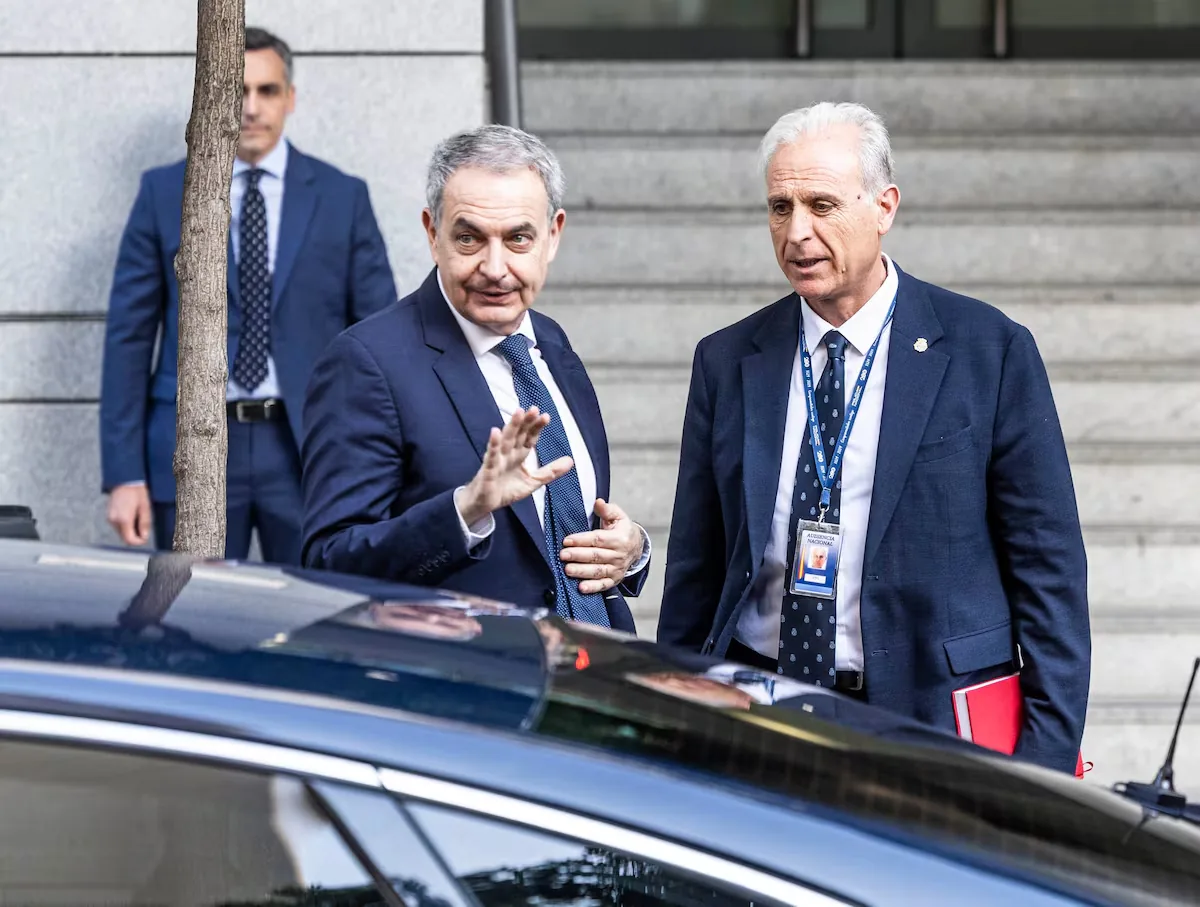
Influence peddling is one of the crimes for which Judge José Luis Calama at the National Court has charged former Prime Minister José Luis Rodríguez Zapatero. The judicial outlook for the former socialist leader has become complicated in the last two months, after the messages recorded in the investigation were joined by the statements of three other suspects in the case ― the businessman and owner of the consulting firm Análisis Relevante, Julio Martínez Martínez; the former president of Plus Ultra, Julio Martínez Sola; and the former CEO of the airline, Roberto Roselli ― who indicate that Zapatero committed to finding a way for the airline to obtain a 53 million euro bailout during COVID. However, no one has yet specified who he could have supposedly influenced or how he did it. The Palau case or the Nóos case address this type of crime that sources from the Supreme Court consider “slippery.”
Read more Spain faces the dilemma of what to do with the gold deposited in the US Federal Reserve
The former Plus Ultra executive confirmed this Monday before the judge that they agreed to pay 1% of the value of the government aid to Zapatero’s friend, in exchange for him successfully managing the processing of the cash injection with which the Government was trying to revive the business fabric most affected after the pandemic. Martínez Sola stated that he never knew how Zapatero acted within the Administration, nor was he interested in knowing what was happening, but he paid because he was interested in the “success.” Something that, presumably, CEO Roberto Roselli will also confirm this Tuesday. The investigation places the former president at the “apex” of an organization allegedly dedicated to using his contact agenda to influence certain operations, and although the reports from the Economic and Fiscal Crime Unit (UDEF) of the Police show messages exchanged among the suspects discussing Zapatero’s moves, the investigators have not been able to find out how, if so, the politician moved within the State Industrial Holdings Company (SEPI) to achieve the bailout.
So far, no official has been called to testify, nor has any other politician with power in the Government to influence the administration been clearly identified. The consulted legal and fiscal sources differ in assessing the need for this point to be proven in black and white to advance the accusation.
Sources from the Supreme Court cite the sentence of the Nóos case as an example, in which the former husband of the Infanta, Iñaki Urdangarín, was convicted precisely for that crime. The sentence, whose rapporteur is the renowned criminal lawyer Antonio del Moral, reviews the type of crime and states that “a mere suggestion or sporadic aseptic recommendation” is not enough, but that “it is necessary,” on the one hand, that the person making it has “a position of certain ascendancy,” which in this case would be a former Prime Minister, and, on the other hand, “that the influence has sufficient entity to be potentially effective due to the prevailing situation of the influencer.”
The high court indicates that it is not enough just to ask about a file or request that it be expedited. “Excluded from the scope of this type of crime are those actions that, although exerting undue moral pressure, are not aimed at obtaining a true resolution, but rather procedural acts, reports, consultations, acceleration of files, information, preparatory data, etc.,” the sentence reads. Even if it is “morally reprehensible” or constitutes other crimes, it would not be influence peddling.
Read more This is the Japanese company that is standing up to Russia in Ukraine with its drones
The mere offer is punishable
And one more thing: it is not necessary for the influence to be consummated; “its capacity for effect” is enough. Article 429 of the Penal Code speaks of the “individual who influences a public official” to “obtain a resolution that may generate them directly or indirectly an economic benefit,” while the following article (430) states that the mere offer is enough: “Those who, offering to carry out the behaviors described in the two previous articles, request gifts or any other remuneration from third parties.” Some of the consulted jurists point out that what is currently described in Zapatero’s investigation could fit more into this last article, which has substantially lighter penalties. If influence peddling ranges from six months to two years, the offer has a maximum of one year.
Sources from the Anti-Corruption Prosecutor’s Office explain that “it is not essential” to know the specific person who was influenced. And along these lines goes another sentence, that of the Palau case, which convicted cultural manager Félix Millet and the former head of the Palau de la Música Catalana Jordi Montull for influence peddling without detailing whom they pressured. The Supreme Court sentence speaks of commissions in exchange for public works awarded that were agreed with the treasurer of CDC, then the hegemonic party in Catalonia, who committed to obtaining the award result for a previously agreed amount. “What in an isolated situation would require proving the specific act of influence over a specific official in a particular resolution, in the described context, negotiated with the treasurer of the hegemonic political party that controls the administration, evidences the influence, the proof of the agreement with that relevant party official, and the proof of its fulfillment,” the judicial ruling reflected.
Other fiscal sources believe it is necessary and relevant to know with whom Zapatero spoke or how the influence could have been executed. “These are two very important factors and they still do not have them,” points out a prosecutor. Supreme Court sources acknowledge that it is a “not very precise” crime that moves without a clear red line. “It is an area where the boundary between serious and less serious depends on many things,” they point out. In any case, all voices agree on the need to wait for the case to progress. Much electronic material seized during the raids remains to be analyzed, both in the offices of Zapatero’s daughters and his own; and various suspects and witnesses remain to be called to testify, such as the former president’s secretary or his daughters. In addition, there are also separate secret pieces that, according to these sources, may still provide more information to clarify the case, as well as the path of nullity chosen by the former president, which will have to be seen if it soon reaches the Constitutional Court.
Read more Why AfD’s victory in Germany is a win for Trump’s plan to destabilize Europe