









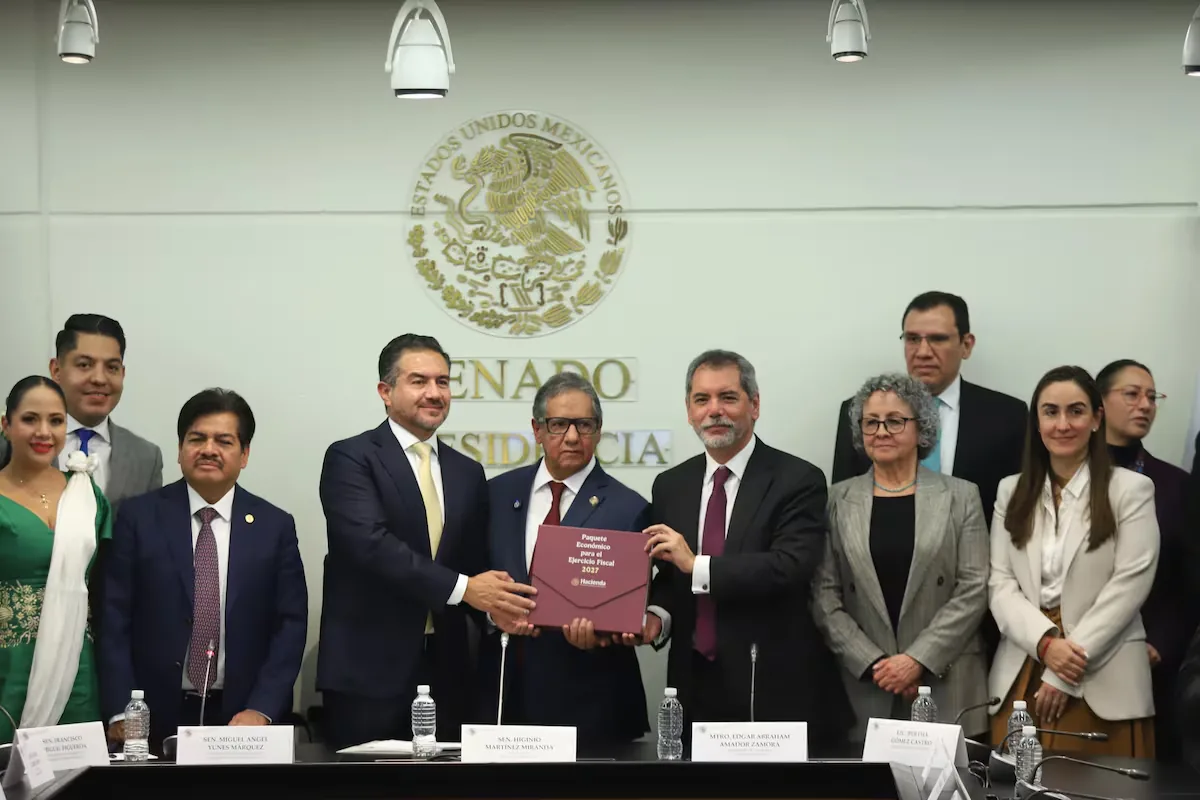
The legislative analysis process for the expenditure and revenue budgets for the coming year begins. The government of President Claudia Sheinbaum has proposed expanding the taxpayer base through a redesign of the Income Tax Law, aimed particularly at small businesses and self-employed workers. The proposal, presented as one of the pillars of the 2027 Economic Package, suggests raising the income limit to pay taxes under the Simplified Trust Regime (Resico) with the goal of incorporating more individuals engaged in business activities: a category that includes most microbusinesses, restaurants, family diners, small shops, grocery stores, and independent professionals who currently operate fully or partially outside the tax system.
Read more Barcelona will carry out prevention at the points in the city where there are more suicide attempts
The proposal comes at a time when the economy maintains moderate dynamism, tax collection stagnates, and the public finance maneuvering room shrinks due to higher spending ahead of an election year. In this context, the fiscal strategy for 2027 aims to act on two fronts: strengthen oversight to combat evasion among those already paying taxes and facilitate the formalization of small businesses and self-employed workers through a simplified regime like Resico. SMEs represent more than 99% of the country’s businesses, although many face financial costs and administrative burdens that hinder their incorporation and permanence in the tax system.
The Ministry of Finance and Public Credit (SHCP) forecasts public revenues of 9.1 trillion pesos, equivalent to 23.2% of Gross Domestic Product (GDP), a real annual increase of 3.9%. The increase in non-oil revenues, estimated at 6.6%, will partially offset the expected 14.4% decline in oil revenues. Meanwhile, spending will rise to 10.6 trillion pesos, with a budget deficit of around 1.3 trillion, equivalent to 3.9% of GDP. “A figure consistent with a responsible fiscal policy that ensures debt sustainability in the medium term,” said Secretary Édgar Amador Zamora.
“This package will strengthen the public revenue base without creating new taxes or increasing general rates,” adds the proposal presented by the office to the Chamber of Deputies. The initiative must be discussed and is expected to be approved in October.
The government expects tax revenues to reach 15.9% of GDP in 2027, compared to 15.4% projected for the end of this year. To achieve this, the strategy is not limited to income tax and proposes updating various federal fees and charges to increase non-tax revenues, including those related to migration services, railway infrastructure, health procedures, environmental protection, and airspace use.
Likewise, it also seeks to close loopholes for tax evasion and avoidance. The initiative includes mechanisms to limit the use of simulated operations as a way to artificially reduce the tax burden, known as invoicing schemes. Among the measures is a mechanism to standardize the maximum authorized deductions that certain taxpayers can apply in each fiscal year.
Moderate growth
The government expects the Mexican economy to close 2026 with growth between 1% and 2% and projects an expansion between 1.5% and 2.5% for 2027. Offering an optimistic outlook, Finance expects economic performance to be supported by greater dynamism in consumption and investment, as well as a larger contribution from the external sector, in an environment of greater trade certainty and more favorable financial conditions.
Read more La 080 Barcelona Fashion returns to the port of Barcelona in its autumn edition
However, fixed investment has remained weak in recent months, in a context marked by uncertainty around the review of the USMCA, the free trade agreement between Mexico, the United States, and Canada, and the volatility of President Donald Trump’s tariff policy. The package includes tax incentives for sectors considered strategic, aiming to stimulate new investments.
The government also plans to increase spending compared to 2026 in areas such as education (10.7%), science (13%), health (11.3%), and security (11.5%). The administration’s flagship, social programs, will represent 2.6% of GDP and reach about 43 million people. A similar proportion will be allocated to physical investment, including the construction of trains, roads, highways, hydraulic works, and energy infrastructure.
Gradual fiscal consolidation
The market will be watching the pace of deficit reduction and the borrowing program to be approved in the coming weeks as part of the initiative. In line with what the president previously stated, Finance bets on gradual fiscal consolidation. “In 2027, we will continue with the fiscal consolidation path we started at the beginning of the administration. This process will continue strategically without compromising resources allocated to social programs or investment projects,” Amador said.
The strategy comes after major rating agencies have warned about the deterioration of Mexico’s public accounts, marked by increased debt, lower revenues, and sustained financial support to Pemex. “The conversation should not be limited to whether macro forecasts are aligned; we know in advance there is an incentive to be optimistic, but also to be aware that debt does not disappear, it accumulates over years paying interest, and today’s lack of fiscal consolidation means future interest for generations to come,” says Ramsé Gutiérrez, co-director of Investments at asset manager Franklin Templeton.
To finance the deficit, the government requests authorization to contract domestic debt up to 1.7 trillion pesos and external debt of 13.5 billion dollars. At the same time, the government has confirmed it will maintain financial support to Pemex, although on a substantially smaller scale. The expenditure budget includes a federal transfer of 81.1 billion pesos to the state oil company, 70% less than planned the previous year.