









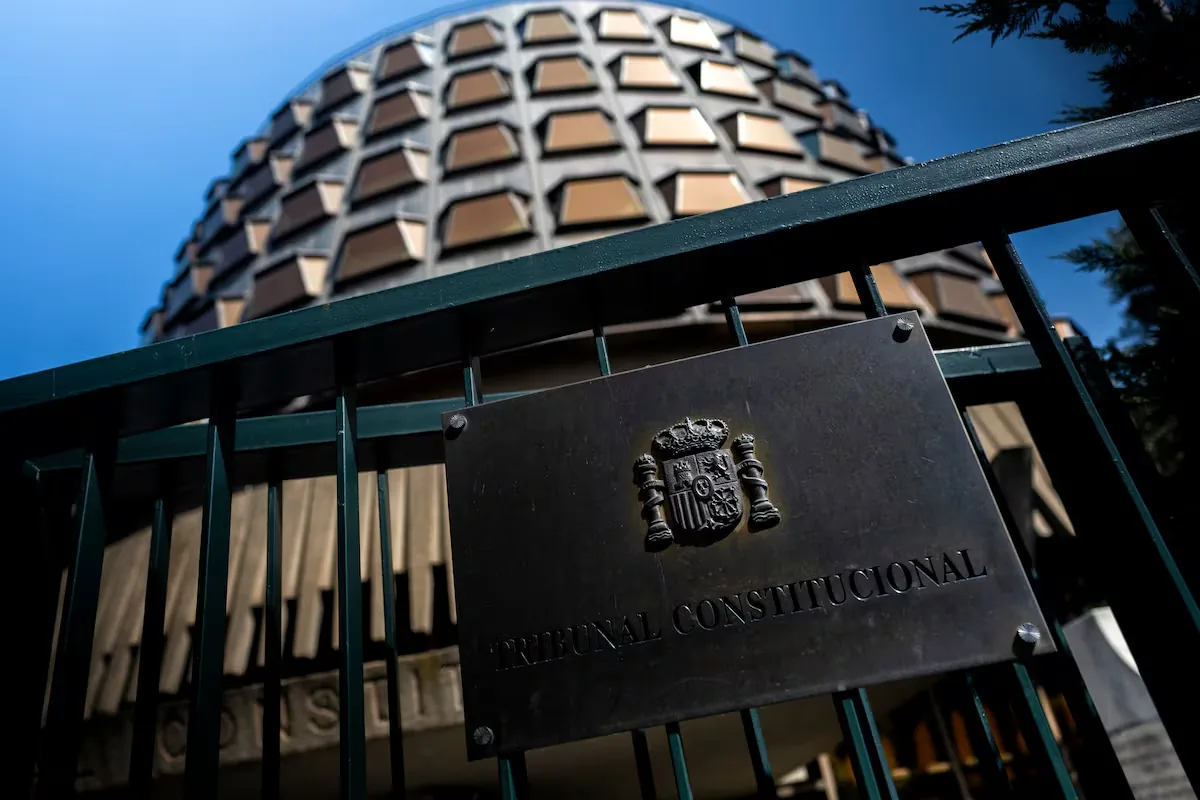
The Plenary Session of the Constitutional Court has agreed to dismiss the appeal of unconstitutionality filed by the Junta de Extremadura, presided over by the popular María Guardiola, against the amnesty law. In a press release issued this Friday, the court of guarantees indicates that, with this decision, it concludes all actions brought before it regarding the norm: 16 appeals and six questions of unconstitutionality. The Court of Justice of the European Union endorsed the law last Thursday.
The ruling refers to its already established doctrine, according to which the Constitution does not prohibit amnesty. Likewise, it recalls that the legislator did not act arbitrarily in approving the law because its purpose is to reduce the social and political tensions generated by the so-called independence process in Catalonia. The court also states that the law does not violate the reservation of jurisdiction or the principles of separation of powers and legal certainty. Nor is it contrary to the right to judicial protection or does it constitute a self-amnesty, they conclude.
But the work of the court of guarantees on the amnesty does not end here. The body has to respond to the seven appeals for protection presented by the pro-independence leaders whom the Supreme Court has refused to grant the measure of grace, considering that the crime of embezzlement attributed to them is not covered by the law promoted by the Government, ERC, and Junts.
The plenary session of the body presided over by Cándido Conde-Pumpido will deliberate on September 22, after the summer, on the first of the appeals presented by the convicted leaders of the procés: that of Jordi Turull, exconseller of the Generalitat. In successive plenary sessions, the Constitutional Court will decide on the other requests, including that of expresident Carles Puigdemont.
Read more The incredible story of the man who built a fake Roman theater in Italy and sold tickets to visit it
Sources from the court of guarantees already indicated after the Luxembourg decision that the forecast was to bring the first ruling, related to the appeal presented by former minister Jordi Turull, to one of the two plenary sessions scheduled for September. However, the ruling may be delayed because the report on this case has fallen to conservative magistrate José María Macías, one of the most critical of the measure of grace, so, unless the TJUE’s pronouncement has made him change his mind, it is foreseeable that his proposal will be to reject the pro-independence leader’s appeal.
In the event that the majority considers that protection should be granted, a new rapporteur will have to be appointed to draft a judgment with that ruling. Court sources indicate that, in that case, the response to Turull’s appeal could arrive in October. The doctrine established will be valid both for those convicted of embezzlement (the aforementioned Turull, Oriol Junqueras, Raül Romeva, and Dolors Bassa) and for those prosecuted in absentia (Puigdemont, Toni Comín, and Lluís Puig), so these sources consider that the Supreme Court would have to apply it ex officio to all of them. Otherwise, the Constitutional Court will respond one by one to the seven appeals for protection.