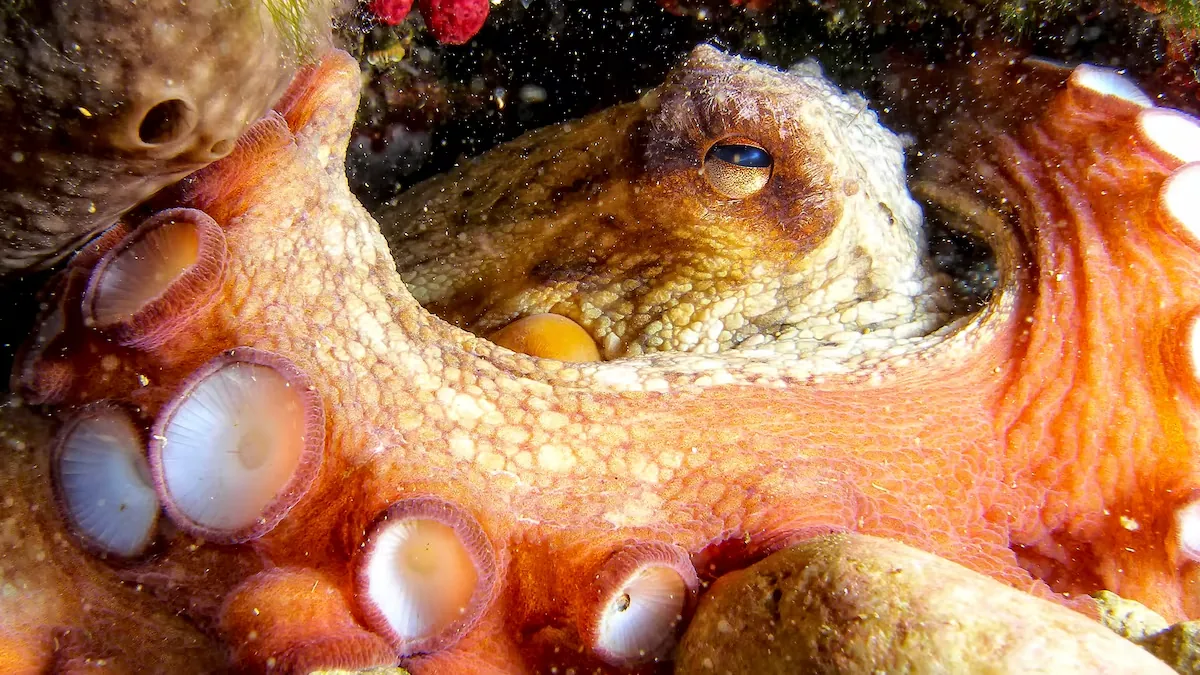









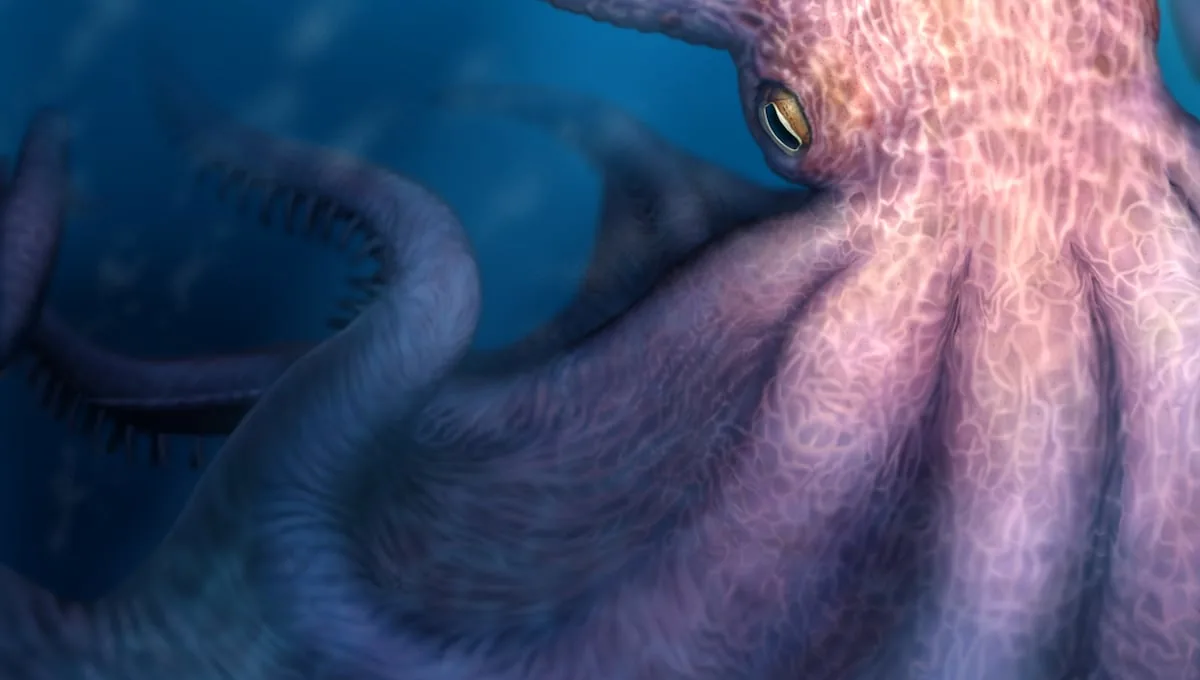
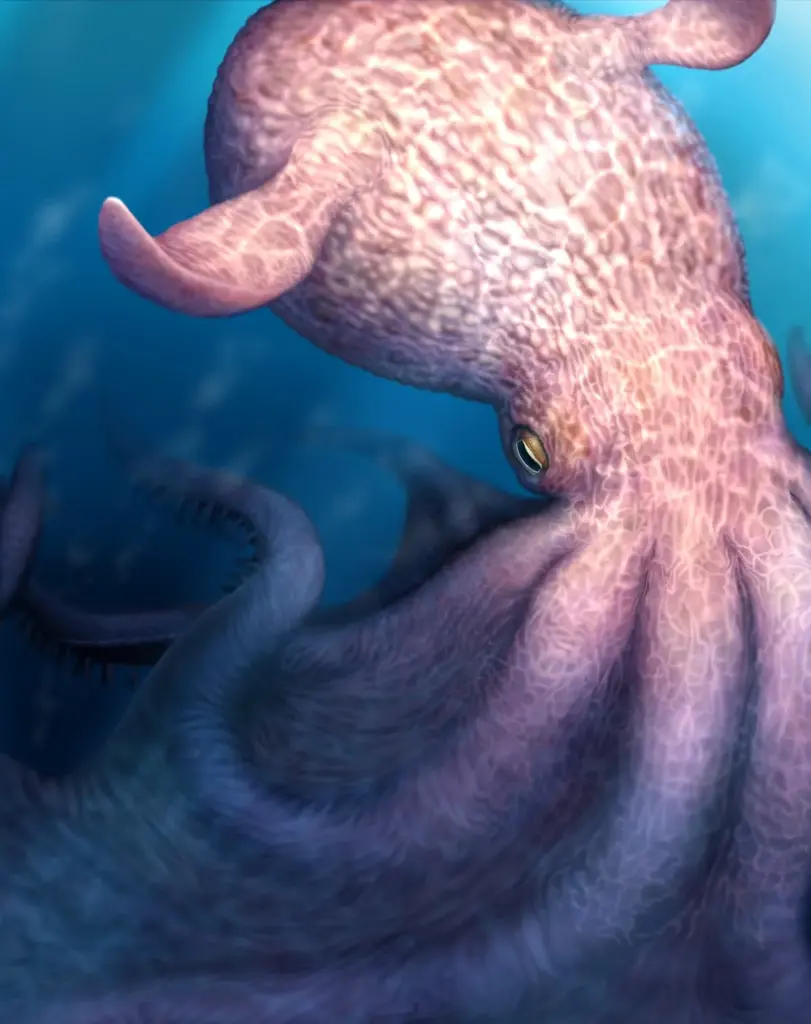
For centuries, the kraken was a creature born of human imagination, the giant octopus that wrapped itself around ships and dragged them to the bottom of the sea to devour their sailors, according to legends. A study published this Thursday in the journal Science shows that the legend had an astonishing paleontological basis: in the oceans of the late Cretaceous, between 100 and 72 million years ago, there existed giant octopuses with fins that could reach 19 meters in length, which were carnivorous and occupied the top of the food chain, competing with the large marine reptiles that until now were considered the sole masters of those seas.
Read more Amélie Nothomb and Han Kang: a Sant Jordi between champagne and roses
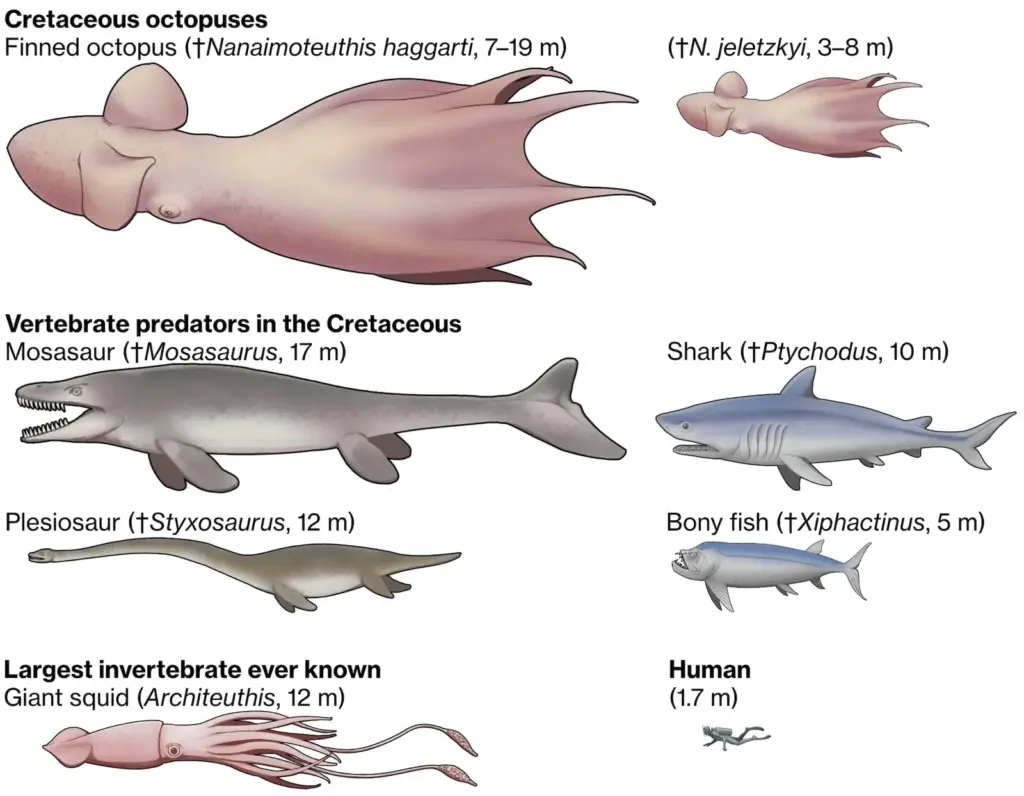
The scientific team that made this discovery, led by Shin Ikegami of Hokkaido University (Japan), identified two extinct cephalopod species —Nanaimoteuthis jeletzkyi and N. haggarti— from the analysis of 27 fossilized jaws recovered from marine sediments in Japan and Vancouver Island, Canada. The larger species, N. haggarti, would have reached between 7 and 19 meters in total length, figures that place it among the largest invertebrates ever described in the fossil record, and put it on par with mosasaurs, the gigantic marine reptiles of the Cretaceous, and plesiosaurs.
Octopuses have always been very difficult to study in the fossil record because they are invertebrates. Unlike dinosaurs, they don’t leave bones, and unlike ammonites, they don’t leave shells. What does endure are their jaws, hard structures that scientists call “beaks” due to their resemblance to those of birds of prey. And these beaks, when well preserved, tell many stories: they not only allow us to calculate the size of the animal, but also what it ate. The wear on the jaws is the key to the study. Cephalopods that feed on hard-shelled prey —crustaceans, mollusks, bony fish— develop characteristic wear on the edge and tip of the beak, which erodes with repeated use. It’s the same principle as a knife being sharpened against stones: the tool retains the memory of its work.
In adult specimens of Nanaimoteuthis, wear removed up to 10% of the total jaw length, more than in any known modern cephalopod, suggesting intense and sustained predatory activity throughout the animal’s life.
Regarding the robustness of these estimates, Ikegami is cautious but firm: “N. haggarti was comparable in size to the modern giant squid, and many estimates exceed it. The conclusion that it was among the largest invertebrates in Earth’s history is robust,” says the researcher.
Furthermore, there is an even more revealing detail: the wear is not symmetrical. The right edge of the jaw appears more worn than the left in both species. This lateralization, meaning the tendency to preferentially use one of the two sides of the body, is associated in modern animals with more developed brains and more complex cognitive behaviors. Modern octopuses exhibit it, and their intelligence, documented in numerous studies, is comparable to that of many vertebrates. The finding suggests that octopuses were already intelligent animals 100 million years ago.
Specifically, the late Cretaceous, between 100 and 66 million years ago, is the period that ends with the great impact that extinguished the dinosaurs. It was a world of warm, shallow seas that covered large areas of today’s continents. In those seas reigned, according to scientific consensus, large vertebrates: mosasaurs up to 17 meters, plesiosaurs up to 12, shell-crushing sharks like Ptychodus, up to 10 meters. Invertebrates were, in that narrative, the victims; organisms that developed increasingly thick and elaborate shells as an evolutionary response to the predatory pressure of vertebrates.
The new study turns that narrative upside down. Nanaimoteuthis haggarti was not a victim: it was a competitor. With its 7 to 19 meters in length, its powerful jaws, its long flexible arms —the hunting strategy of octopuses does not require an enormous mouth, but rather limbs that catch and hold while the beak dismembers— and its probable intelligence, these giant cephalopods likely occupied the same level in the food chain as mosasaurs. If they crossed paths, no one knows yet. But the possibility of an octopus the size of an articulated bus hunting marine reptiles is no longer science fiction. And, in any case, vertebrates and cephalopods reached the same point —being large, intelligent predators— by different, but surprisingly parallel, paths. Vertebrates lost their armor plates and reduced their scales to gain speed and agility. Cephalopods, finally, eliminated their external shell to become soft-bodied animals, faster, with better vision and greater cognitive capacity. Both groups developed powerful jaws.
Ikegami admits that intelligence cannot be measured in a fossil, but it can be inferred: “Asymmetrical wear does not directly demonstrate intelligence, but it suggests that Nanaimoteuthis was not just a large and powerful predator: it may also have had advanced behavior and even individual behaviors, similar in some ways to modern octopuses.”
An inevitable question is where they lived. Modern giant octopuses inhabit abyssal depths. But Ikegami rules out Nanaimoteuthis having that lifestyle: “It was not a coastal environment, but neither was it the type of deep-water environment where many giant octopuses live today. It was a relatively open sea environment, with diverse marine life. Nanaimoteuthis was probably a large predator; it used its long arms, powerful jaws, large body, and enormous mobility to capture and devour prey such as ammonites, large bivalves, fish, and other cephalopods.”
An AI that digs into stone
A fundamental part of the study was methodological. A dozen of the 27 analyzed jaws were not found with pick and hammer, but with what the authors call “digital fossil mining”: a combination of high-resolution tomography —which generates images of cross-sections of the rock at a microscopic scale— and an artificial intelligence model, trained to detect organic structures, i.e., animal remains, in enormous sets of images.
The technique, developed by the team itself, allowed them to find jaws that would have gone completely unnoticed with conventional methods, they say, and to visualize them as digital three-dimensional models without needing to damage the rock containing them.
Read more What is the ‘Fair Rent Law’ against gentrification in Mexico City?