






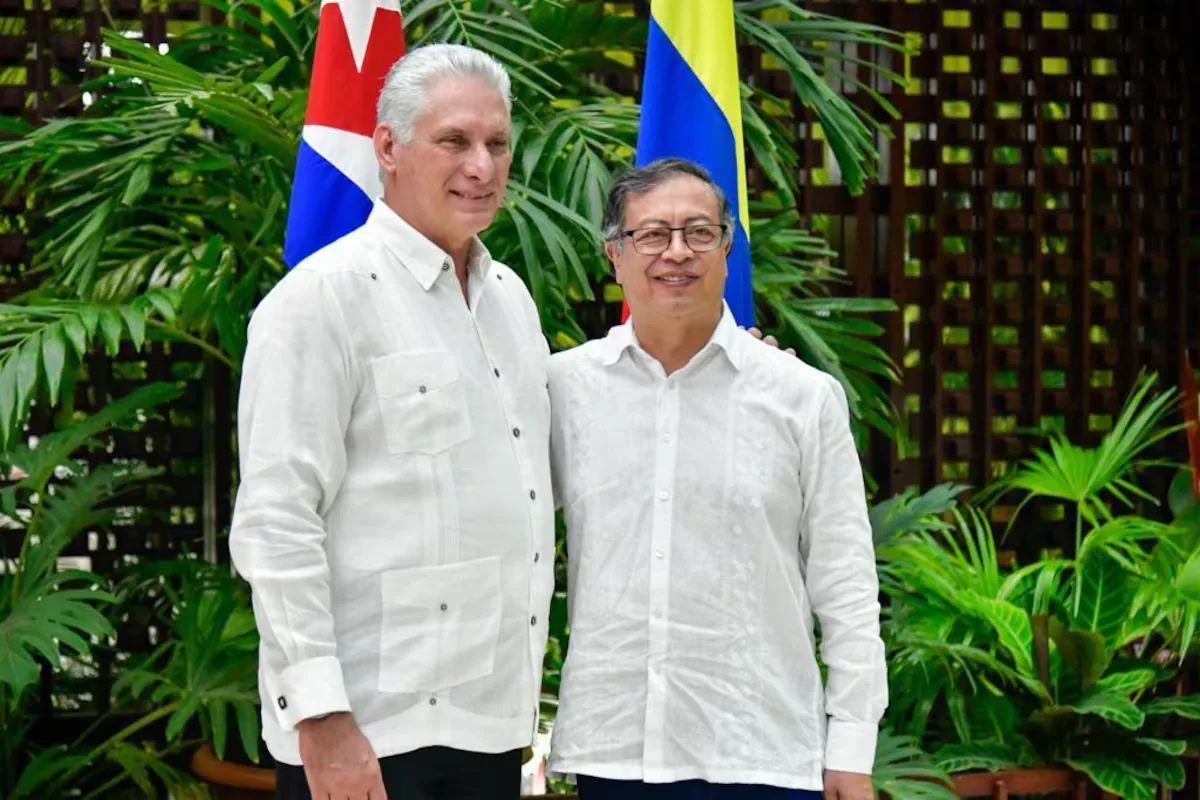
Gustavo Petro’s last international trip as president of Colombia will be to Cuba, where he will meet with Miguel Díaz-Canel with the announced purpose of sending a message of solidarity. One week before handing over power to Abelardo de la Espriella, and after having last-minute canceled an agenda in the United States the previous week, the South American head of state will travel this Friday to the Caribbean island for about 48 hours, according to Colombian press and confirmed by the Presidency of the Republic, but still without a public agenda.
Read more That afternoon with Manolo
The leftist leader had already declared that purpose last Monday, although without many concrete details. “I replaced it with a place I consider vital for national sovereignty and the fight for life in the Caribbean: the attacked Cuba,” he had written on his social networks about the cancellation of the planned trip to Washington and New York.
“Since now the Colombian diplomatic agenda will be reduced to the dictates of Tel Aviv that say with whom we have diplomatic relations according to the convenience of the genocidal, then Colombia will be isolated to the small circle of friends of genocide because humanity is against the human holocaust in Gaza,” he added in that long message on X, his preferred communication channel. Without mentioning it by name, he was referring to the sharp turn in foreign policy proposed by De la Espriella, who advocates a close alliance with U.S. President Donald Trump as the axis of Colombian diplomacy and also places great importance on the restoration of relations with Israel.
The incoming president of Colombia, who takes office on Friday, August 7, has announced that he will close embassies in 14 countries. The main ones in that package are precisely those of Cuba and Nicaragua, countries with which he anticipates breaking relations. “In my government, there will be no ties with tyrannies,” he assured in one of the video statements, in the style of presidential addresses, that he already usually broadcasts on weekends. The list also includes countries in Africa, the Caribbean, Eastern Europe, and Asia, as part, in theory, of an austerity program. The announcement, in any case, is framed in his ideological disputes with the Petro government, which had opened embassies in Africa, the Middle East, and Eastern Europe as part of its efforts to diversify the foreign policy of a country that has traditionally been an ally of the United States.
The Cuban Ministry of Foreign Affairs had already rejected that announcement. “These are statements that depart from the historic relations of friendship and brotherhood between Cuba and Colombia,” it said in a statement. “If this decision is carried out, which has no justification whatsoever and does not respond to Colombian national interests, it would clearly show the next Colombian government’s subordination to the policy of division and confrontation between our nations, always promoted by the United States,” it warned.
Read more The cultural manager Natalio Grueso leaves prison after the Government’s pardon
Since the restoration of bilateral diplomatic relations in 1993, Cuba has played a role for decades in the negotiation processes initiated by various Colombian presidents with the guerrillas. Havana was the venue and guarantor of the negotiations between the government of Juan Manuel Santos (2010-2018) and the FARC, which culminated in the peace agreement sealed at the end of 2016. It also hosted cycles of talks of the failed dialogues with the ELN, the last armed guerrilla, already under the Petro government, which had previously taken place in Caracas and Mexico City.
At least since the government of the liberal César Gaviria, between 1990 and 1994, Colombia has maintained good relations with Cuba. Even under Andrés Pastrana (1998-2022), a conservative politician, and also during the two terms of Álvaro Uribe (2002-2010), the great reference of the right, when Havana played a vital role in overcoming crises with Venezuela and tried to mediate in the release of hostages. The only exception so far has been the diplomatic hostility that characterized Iván Duque’s four-year term (2018-2022), who coincided with the first Trump in the White House and was a parenthesis in Colombian diplomatic tradition, never closing the embassy.
While Petro put that Colombian diplomacy at the service of his search for “total peace,” the withered policy with which he proposed to dialogue with all armed groups simultaneously, De la Espriella, with a militaristic accent, promises a hard line on security and has closed the door to any peace negotiation.
Read more The death of a giraffe and 11 other animals exposes the management of the León zoo