









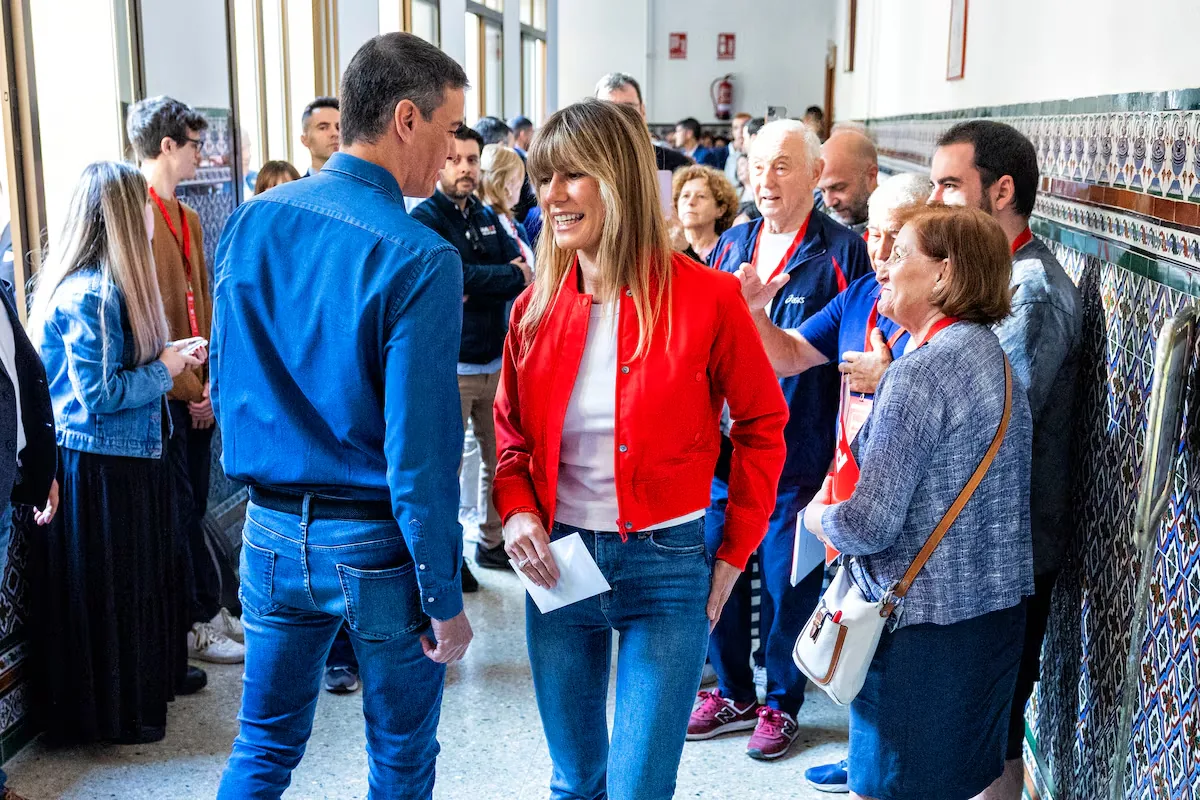
The Provincial Court of Madrid has given the green light for the popular jury trial against Begoña Gómez, wife of Pedro Sánchez, to proceed for two crimes: influence peddling and embezzlement. The court thus partially endorses the decision of Judge Juan Carlos Peinado to send the partner of the Prime Minister to trial, to whom he attributed four crimes (in addition to the previous ones, corruption in business and misappropriation). The chamber also agrees to return the passport to the wife of the PSOE leader and to her assistant at La Moncloa, Cristina Álvarez, after the magistrate had taken them away and prohibited them from leaving the country and forced them to appear twice a month before his court — measures also annulled by this higher instance —.
This resolution is known after Judge Peinado, who initiated the case against Begoña Gómez in April 2024 after receiving a complaint from the pseudo-union Manos Limpias, ordered on June 20 to open an oral trial against her; against Cristina Álvarez; and against businessman Juan Carlos Barrabés. The magistrate concluded his investigations into Sánchez’s wife and agreed to put her on trial for four crimes, considering that she took advantage of her husband’s position to advance her career at the Complutense University of Madrid (UCM), where she co-directed an extraordinary chair (within which software was developed). The popular accusation — led by the ultra-Catholic association Hazte Oír — was asking for 24 years in prison.
Among other arguments, the defenses argued that Peinado did not “motivate” his decision sufficiently. A thesis that the provincial court has accepted on previous occasions (such as when, earlier this year, it overturned for the first time the transformation of the case into a jury trial), but now rejects with these words: “The challenged order, although it may present a limited degree of development or a foundation by reference, contains a sufficient exposition of the facts under investigation and their possible fit into the considered criminal types, allowing the parties to know the reasons for the decision and to articulate the appropriate means of challenge against it, as has in fact occurred.”
The resolution, dated last Monday, was signed this Thursday by the five magistrates who make up section 23 of the Madrid Court: María del Rosario Esteban, José Sierra, Jesús Gómez Angulo, Enrique Jesús Berges, and Carlos Prat. Although on other occasions only three judges were convened for deliberation, the court decided to meet this time in full, due to the importance of the ruling, according to legal sources.
Thus, after the debate, the five magistrates conclude that, “at this procedural stage” and without entering into an “anticipated assessment proper to the oral trial,” the case contains sufficient “rational indications of criminality” to proceed against Begoña Gómez for two crimes. Thus, regarding influence peddling, the court emphasizes the following: “It seems perfectly plausible that the investigated party achieved the influence exerted from her privileged position as the wife of the Prime Minister, not only to obtain the granting of the chair, but to do so almost immediately and without verifying a minimum control over the consistency of the proposed project.”
Read more Comedian Quequé arrested in Salamanca due to a judicial claim in Madrid
“The mere relationship of kinship by marital bond with the highest authority of the government of the nation, in certain contexts and circumstances, such as those analyzed here, can entail an efficient moral pressure for the purposes of constituting the crime of influence peddling,” the Court stresses, recalling the Supreme Court ruling against Iñaki Urdangarin in the Nóos case, which established that the husband of Infanta Cristina de Borbón made use of “the kinship relationship acquired by marital bond with the daughter of the monarch” Juan Carlos I.
The Court adds that Peinado has gathered “numerous indications” and points out: “It does not seem that it can be denied with full certainty that […] sufficient moral pressure was exerted to move the will of the academic authority of the UCM, obtaining the decision not only to create the chair but to appoint her director, thus allowing her to fund with public financing the development project of a digital measurement tool that was intended for personal or private use and ownership.” At this point, the magistrates emphasize that, in their opinion, important indications are the “nonexistence of any teaching or research team,” as well as the “financing with money and human teams from the most cutting-edge technological companies in this country to develop the personal project of the investigated party.”
After the provincial court’s resolution became known, the PSOE has attacked the endorsement granted to the case: “Begoña Gómez is innocent. The investigation is a political cause based on false news to harass and persecute the wife of the Prime Minister. Harassment and obsession,” the party’s profile tweeted. Days earlier, socialist sources were already very cautious about the position the Court could take and recalled that three of its members had previously promoted a question of unconstitutionality against the Amnesty Law.
[Breaking news. Update forthcoming]