









The amnesty for those prosecuted in the Catalan independence process, the measure on which the foundations of the legislature in the Congress of Deputies were laid, received on Thursday the backing of European justice after three years of heated legal and political debates following Pedro Sánchez’s concession to approve a law that would close all judicial cases linked to the procés. The Court of Justice of the European Union (CJEU) has broadly endorsed the amnesty law regarding community law, considering that the regulation neither conflicts with the financial interests of the European Union nor is contrary to the directive on terrorism. The ruling has been received by the Government as recognition of its policy in Catalonia, where leaders and activists who have not yet benefited from the measure hope that the Spanish courts will take action.
Read more Comedian Quequé arrested in Salamanca due to a judicial claim in Madrid
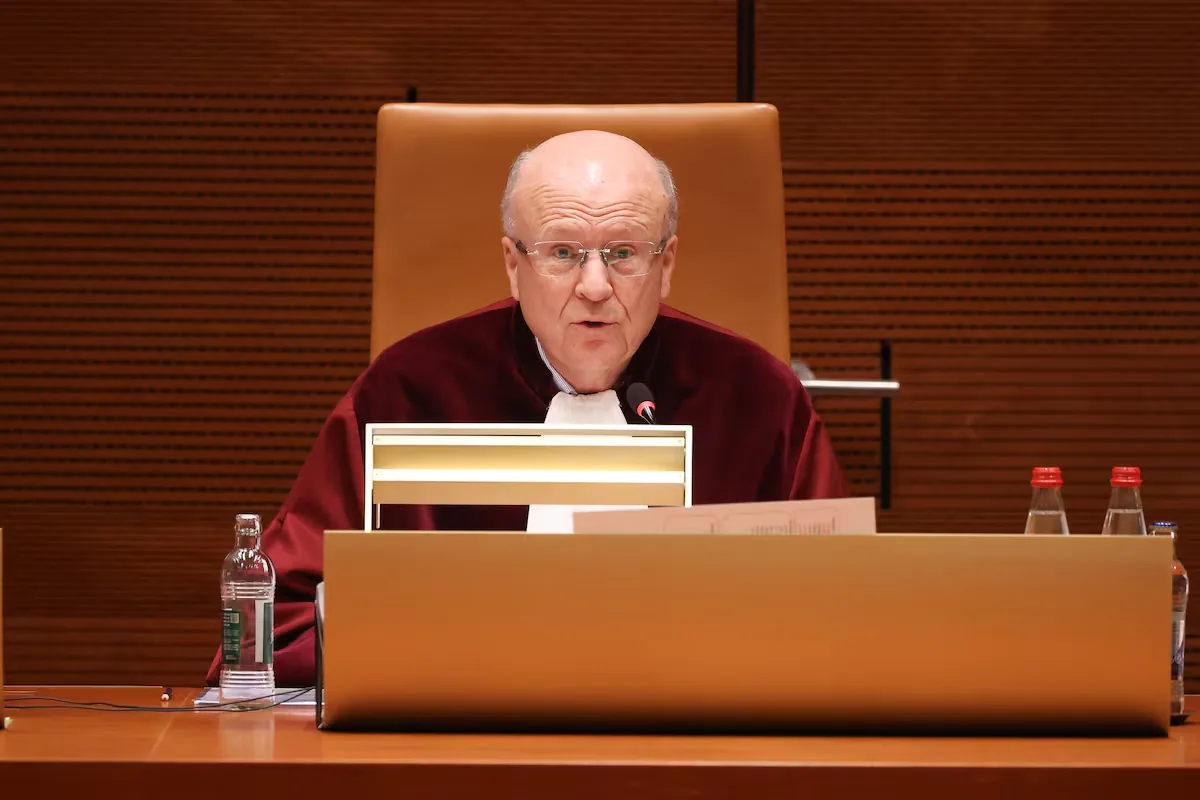
“Union law does not oppose the law granting amnesty,” whose purpose is “to reduce institutional and political tensions, as well as to facilitate a scenario of reconciliation,” stated the president of the CJEU, Belgian judge Koens Lenaert, in the explanation of the judges’ rulings from Luxembourg after their reading in room 3 of the European court.
The amnesty began after the general elections, when Junts’ seven seats became necessary for Pedro Sánchez’s investiture. The PSOE then opened up to negotiations that culminated in the entry into force in June 2024 of a law linked to the independence process to promote “institutional, political, and social normalization in Catalonia.” Two years later, the measure has benefited more than 300 people including politicians, citizens, and police officers investigated or convicted for acts linked to the procés between 2011 and 2023, but not all courts have applied it with the same criteria. In fact, the Supreme Court maintains an active arrest warrant after concluding that the embezzlement charge for which former president Carles Puigdemont was prosecuted is not amnestied.
The European justice ruling responds to two preliminary questions sent by the Court of Auditors and the National Court. The judges from Luxembourg have thus confirmed the opinion expressed by the CJEU Advocate General last November: although the law was approved under very particular political conditions, as a trade-off for the investiture, and without consulting European justice, the regulation was approved “in a real context of political and social reconciliation” and does not constitute a “self-amnesty.”
“The approval of an amnesty law is, in principle, within the prerogative of each Member State, especially for the purpose of national reconciliation or seeking a political compromise, not to prosecute certain specific acts, even constituting serious crimes, and the amnesty granted in this way can be conceived as an appropriate instrument to appease a major social or political conflict,” the CJEU elaborates in its final ruling. It also agrees with the formulation of the law and its scope: “The LOA objectively and abstractly determines, according to the terms used in its preamble, the scope of application of the amnesty.” Regarding the use of abstract formulas, it specifies: “A legislative technique consisting of resorting to abstract formulations or general categories, instead of exhaustive lists, does not undermine the principle of legal certainty, provided that their interpretation is reasonably foreseeable.”
The judges also reasoned on the issue of embezzlement, stating that “it cannot be considered that the financial interests of the Union are affected by the mere decrease in gross national income that could potentially result from the secession of part of the national territory.” The ruling, the first by these magistrates on amnesty, could have a domino effect, desired by independence leaders, that forces the Supreme Court to amnesty former president Carles Puigdemont and the other leaders prosecuted or convicted for embezzlement. In fact, all of them consider that the high court is violating their fundamental rights and appealed to the Constitutional Court, which was awaiting the CJEU’s response.
For Puigdemont, the decision on embezzlement was especially important because the Supreme Court maintains an arrest warrant against him, considering that the amnesty does not apply to the embezzlement charge and that the use of public funds to pay for the procés expenses is also a form of personal enrichment, a point firmly rejected by the defense of the Junts leader.
European law “does not oppose a national regulation that grants amnesty for acts determining accounting responsibility, carried out in the context of political activities aimed at achieving the independence of part of the national territory of a Member State and relating to funds that do not come from the European Union budget nor are intended for it, on the grounds that such independence could have caused a reduction in the Union’s own resources made up of the contribution of that Member State based on gross national income,” the ruling argues on this point, read in Spanish by Lenaerts.
According to the European court, the amnesty law is also compatible with the guarantee of effective judicial protection, another issue raised by the Court of Auditors. It explains that “in an area that is the competence of the Member States,” the CJEU’s role as guardian of effective judicial protection “is limited to problems of such magnitude that they present a systemic character capable of compromising the proper functioning of the national judicial system in areas covered by Union law.”
An aspect that, the CJEU considers, does not occur in this case: “Given the nature of the amnesty law and its well-defined scope, the Court of Justice considers that the procedural regulation of this law regarding the application period, the examination of allegations and evidence, as well as the right to be heard, cannot give rise to such systemic problems,” Lenaerts explained.
Clarification on deadlines
Where the judges do not fully agree, as the Advocate General had already pointed out, is on the issue of deadlines established by the law, specifically when there are unresolved preliminary questions. In this regard, they point out that “they oppose the provisions of a national amnesty law that impose on national courts the obligation to issue a ruling extinguishing accounting responsibility and lifting precautionary measures agreed upon in an earlier phase of the procedure within a maximum period of two months, even when the Court of Justice has not yet ruled on a request for a preliminary ruling submitted to it.”
“The provisions of the amnesty law that could have this effect must be discarded,” Lenaerts emphasized in his commentary on the rulings.
The second ruling, on terrorism, will affect the dozen members of the so-called Committees for the Defense of the Republic (CDR), the pickets that emerged in Catalonia to impose secession after the illegal referendum, who have been prosecuted by the National Court for terrorism offenses. Also in this case, the judges from Luxembourg say they see no contradiction with European law with a regulation very limited to very specific cases that do not affect “serious violations” of human rights: “The Spanish amnesty law does not undermine the effectiveness of the directive on combating terrorism (…) since it only establishes afterwards that terrorist offenses committed exclusively in the specific context of the Catalan independence movement will not be prosecuted, except for those that have intentionally caused serious human rights violations,” the judges explain.
Specifically, the CJEU “does not oppose” a national amnesty law “that, to reduce institutional and political tensions and facilitate a scenario of reconciliation, establishes the extinction of criminal liability of any person who has committed, in a limited period and in the context of an independence process of part of the national territory of a Member State, acts covered by this [European] Directive that have not intentionally caused serious human rights violations, whose exact nature and threshold of severity are not specified in that law, when the competent courts are able to determine the terrorist offenses excluded from the amnesty,” the ruling reasons.
Read more Search engine for the best roadside bars and restaurants to stop at