







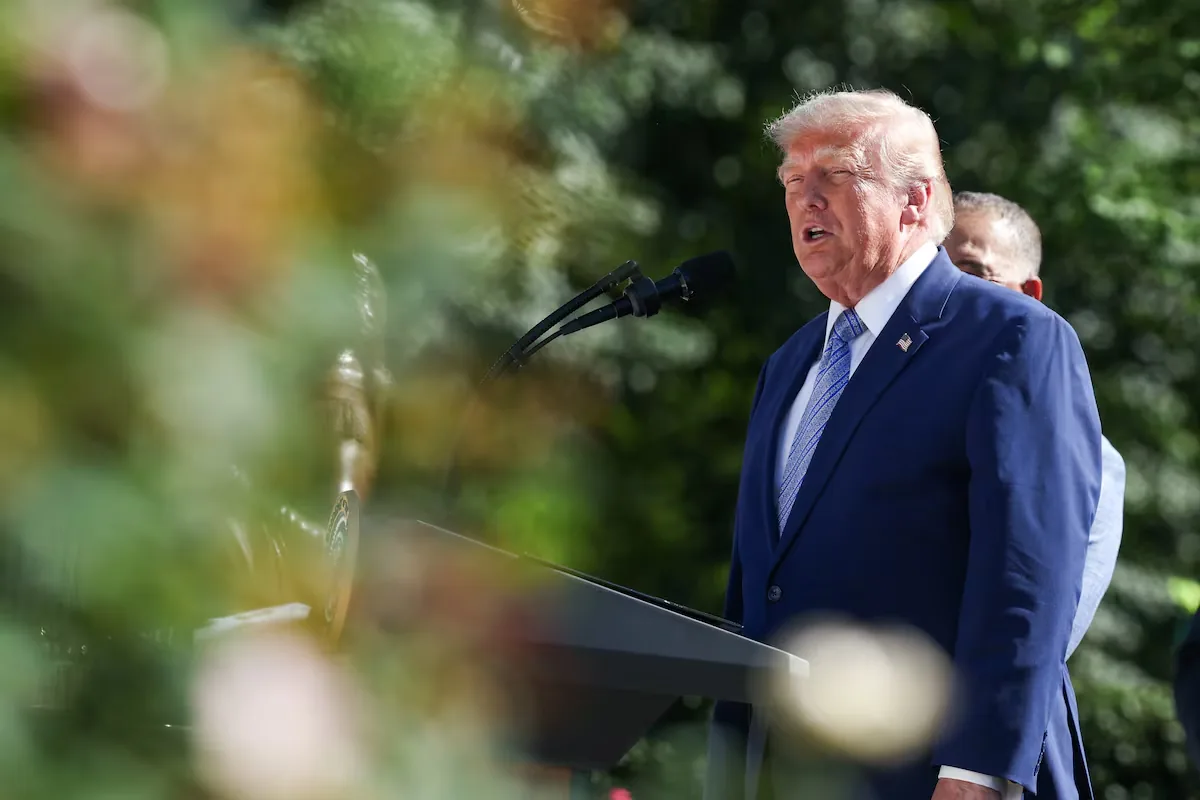
Like Sisyphus pushing the rock up the mountain, Donald Trump rebuilds a tariff barrier again and again despite continuous setbacks from the courts. The US president has erected an amorphous, chaotic, and hole-ridden wall with the third round of tariffs.
Read more Gregorio Casamayor: “I would give anything to understand string theory”
The United States approved a new trade framework this Thursday, establishing tariffs of between 10% and 12.5% on more than 60 economies, arguing that they violate rules on the import of forced labor. These new taxes on product imports came into effect this midnight at 00:01, as specified by the executive order signed by Trump on Thursday.
This system, approved under Section 301 of the Trade Act of 1974, seeks to avoid a legal loophole because the previous universal 10% tariff, in force since last January, expired this Friday. This, in turn, replaced the so-called reciprocal tariffs of Trump’s first trade offensive, on the so-called Liberation Day of April 2, 2025, which were declared unconstitutional by the Supreme Court.
Legal Shielding
The White House’s main objective with this latest trade strategy is to resist future judicial attacks, as happened with the two previous rounds. So the new scheme not only changes trade policy but also the legal architecture to try and shield it from possible legal challenges.
The executive order signed by President Trump this Thursday specifies that it is based on 60 separate and distinct investigations; it is full of caveats and precise details to justify the measures and insists that, if a court annuls one of its parts, the others will remain in force.
The White House’s insistence on these terms is no coincidence. It has suffered several judicial setbacks. The Supreme Court declared Trump’s first attempt to impose reciprocal tariffs illegal, invoking the International Emergency Economic Powers Act (IEEPA), intended for other circumstances. Furthermore, it reminded the president that he cannot circumvent congressional oversight to impose these measures. Months later, the US Court of International Trade also annulled the universal 10% tariff with which he replaced those overturned by the Supreme Court but maintained its validity while appeals were being resolved.
Now, the Administration has strived to build a legal framework that judicially protects the new framework. To do this, it has relied on Section 301, which empowers the president to impose tariffs on countries that engage in “unfair, unjustifiable, or discriminatory” practices.
Complex and Chaotic System
But the scheme it has built is complex, chaotic. Trump’s executive order is accompanied by a 55-page annex containing multiple tariff rules, numerous exemptions by products and sectors, special regimes, and differentiated treatments by country.
The legal text leaves ample discretion to the US Administration to establish other exceptions in the case of “products that could cause economy-wide disruptions if subject to these tariffs; raw materials that could lead to a lack of domestic supply availability; and products that cannot be grown or produced in sufficient quantities in the United States.”
Read more Anti-corruption asks the judge to expand the information about Zapatero’s jewels
In reality, if EU countries are counted individually, the new wave affects 91 countries. It introduces specific treatments for partners with whom trade agreements have already been reached, such as the EU, Japan, South Korea, or Switzerland. It includes exemptions for semiconductors, pharmaceutical products, steel, aluminum, automobiles, civil aircraft, and information materials, among others.
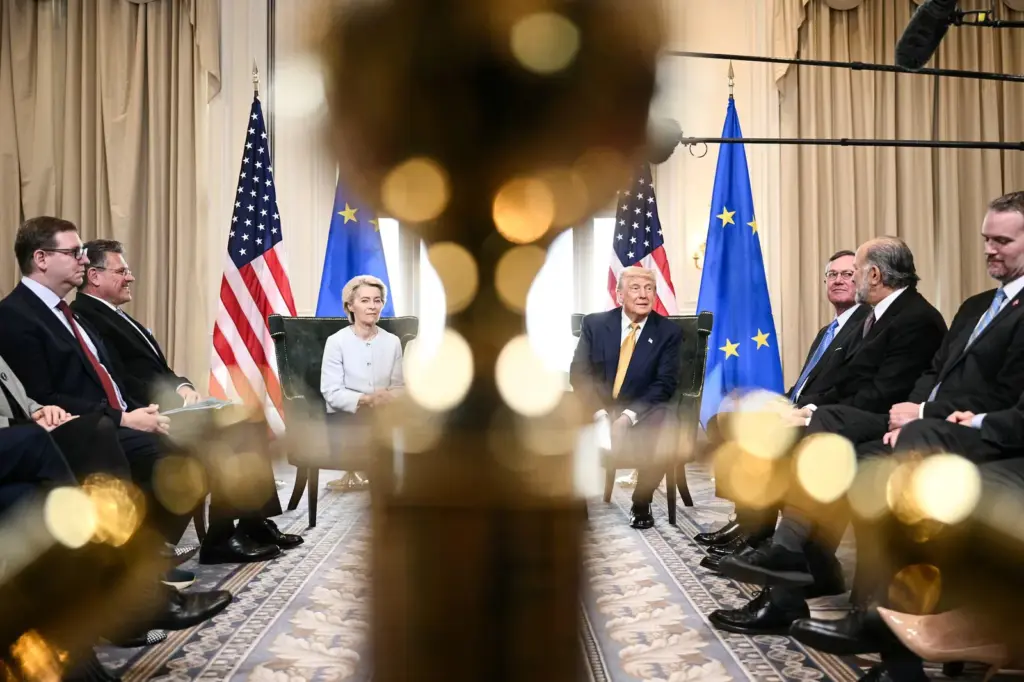
The executive order does not refer to the trade agreement reached between the United States and the European Union last summer in Turnberry (Scotland), which set a 15% tariff, then considered preferential, and now could leave the community bloc at a disadvantage compared to the rest of the countries that will pay 10%. However, the legal text explains that products imported from the European Union, Japan, Korea, Switzerland, or Taiwan “will be net of Most Favored Nation (MFN) tariffs,” a type of customs duty that guarantees non-discrimination among trading partners by requiring that any advantage, low tariff granted to one country automatically extends to all other members of the system. Thus, in principle, the EU will only see tariffs increased for those products that currently have a tariff lower than 10%. Although Trump has already threatened to raise them up to 100% for countries that impose the Google tax.
Forced Labor
It is paradoxical that the United States imposes tariffs on the European Union, one of the most advanced blocs in labor matters, and on 64 other economies for failing to comply with forced labor import rules. In reality, the Office of the United States Trade Representative (USTR), responsible for the investigations supporting the tariffs, accuses these economies of not having prohibited or effectively enforced rules prohibiting the import of goods produced in territories where forced labor exists, which causes harm to American companies.
That is, it argues that, although the EU has rules prohibiting forced labor, it does not adequately enforce them. The legal text does not specify what it means by forced labor, nor in which countries these practices occur. Nor does it reveal the result of the investigation that justifies Brussels not monitoring this prohibition.
The Office of the United States Trade Representative (USTR) explains that it proposes tariffs to eliminate “punishable acts, policies, and practices” in each investigation based on forced labor under Section 301. It specifies that there are economies, for which 10% tariffs are set, “that impose a forced labor import ban but do not yet effectively enforce it (Canada, Ecuador, the European Union, Indonesia, Mexico, and Pakistan).” There are also others that have committed to approving such regulations to prohibit these practices (Argentina, Bangladesh, Cambodia, Ecuador, El Salvador, Guatemala, Indonesia, Malaysia, and Taiwan); other countries that have a partial but insufficient regime (United Kingdom); and another bloc of economies that directly have no regulation on the matter.
“The rule includes a mechanism for the textile sector that would allow a certain volume of clothing and textile imports to enter the United States with a 0% tariff,” a measure that seems aimed at favoring China.
This third round of tariffs, moreover, seems far from Trump’s initial goal of correcting trade imbalances. It is based on a tangential argument that, despite attempts to shield them, affected US companies are likely to take to court again.