








Taiwan, an Asian island with 23 million inhabitants, is the epicenter of a technological revolution measured in nanometers, a unit of length equivalent to one millionth of a millimeter. Its territory has become the global factory for next-generation chips used by major tech companies like Apple, Nvidia, and AMD. Thanks to an industrial policy developed since the 1980s, Taiwan manufactures 90% of the world’s advanced semiconductors, and the vast majority of this supply comes from a single company: Taiwan Semiconductor Manufacturing (TSMC). In just the first half of the year, TSMC — the world’s largest contractor for microprocessor manufacturing — reported revenues of 75 billion dollars.
Read more The audios that corner Verónica Alcocer: frontmen, cash, and luxury in Europe
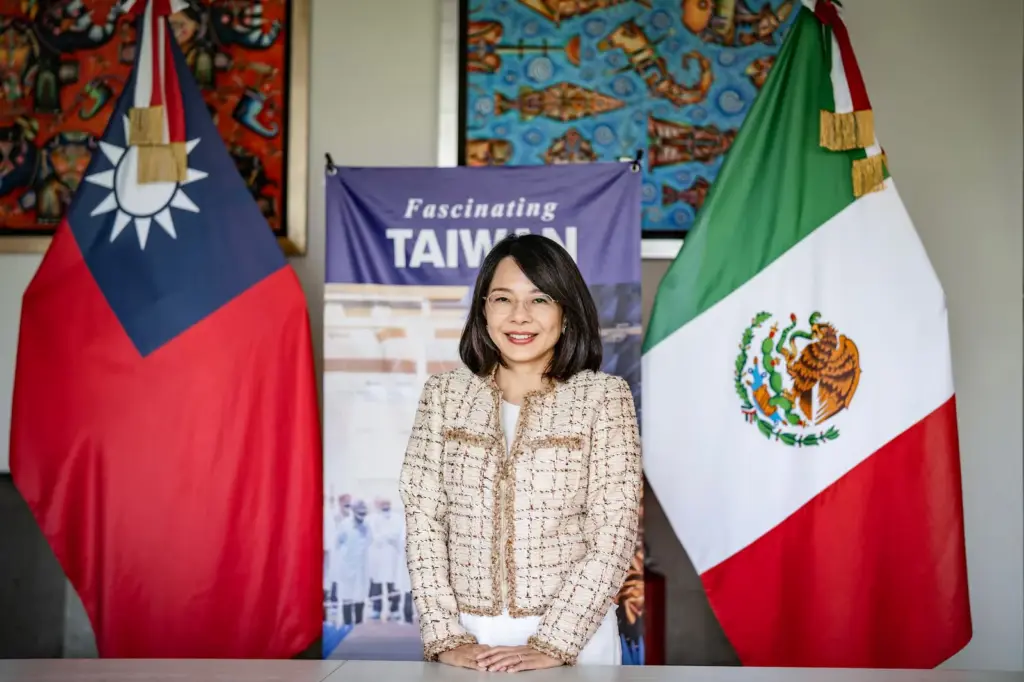
Amid this new technological paradigm and a global commercial geopolitical reconfiguration, the Asian island seeks to strengthen economic and trade ties with Latin America. The interest is not accidental; it is supported by figures: in the last five months of the year, Taiwanese imports to Mexico grew by more than 200% compared to the same period in 2025. Taiwanese shipments to Mexican territory rose from 10.767 billion dollars to almost 36 billion dollars so far in 2026. Among the 300 Taiwanese companies operating in Mexico are Foxconn, Quanta Computer, Inventec, Pegatron, among others. Violeta S. H. Hsu, representative of the Taipei Economic and Cultural Office in Mexico (49 years old, Taipei), acknowledges that the potential exists, but greater dialogue with Claudia Sheinbaum’s government is necessary.
Question. What is the current state of the economic relationship between Mexico and Taiwan?
Answer. For many years, Taiwanese companies have been present in Mexico in the automotive and computer sectors, but now most have shifted towards artificial intelligence. Currently, we have more than 300 Taiwanese companies in Mexico, generating more than 70,000 direct jobs. They are located in states such as Guanajuato, Chihuahua, Jalisco, Puebla, among others.
Q. How has the global uncertainty caused by Trump’s protectionist measures affected the interest of Taiwanese companies in Mexico?
A. Previously, Taiwanese companies asked many questions and came to directly see Mexico’s business environment, but now, as the country is in the middle of reviewing the trade agreement, the USMCA, everything is resolved only through emails or calls. In general, businesspeople are evaluating whether the USMCA will continue to be beneficial for them and for Mexico. If the USMCA issue is resolved, more investment in artificial intelligence will surely come because demand continues to grow at a dizzying pace.

Q. So far this year, Taiwanese imports to Mexico have grown exponentially, more than 200%. To what do you attribute this growth?
A. In one year, we went from being Mexico’s seventh trading partner to now the third. First, of course, is the trade dispute between the United States and China, as Trump imposed very high tariffs on China, so many electronic products have been purchased from Taiwan, and many electronic components for computers and electronics arrive in Mexico, are assembled here, and then sent to the United States. The second reason is the growth of the artificial intelligence sector. Worldwide, Taiwan is a leader in advanced semiconductor manufacturing.
Q. Do you have any specific strategy for Mexico and Latin America?
A. I believe Mexico can host one of the main artificial intelligence science parks in Latin America. First, because it has a privileged geographic position, very close to the United States, and because those artificial intelligence companies already operate here. We have spoken with the Government of Sonora to build a science park in that state, with the collaboration of Taiwanese companies, which is very close to Arizona (United States), where the company TSMC already manufactures chips. We want this project to be a model and, if successful, replicate it in other states like Jalisco.
Q. What would you ask the Mexican government to launch projects of this type?
A. There is a lot of interest from Taiwanese businesspeople in Mexico, the proximity to the United States, and the availability of labor in the country is very good, but we do need some facilities, for example, we do not need a visa to enter the United States, but in Mexico, we do require a visa, so we want to request the Mexican government some kind of facilitation in this regard,
Right now, the door with the federal government is very narrow. We need to have direct contact with the Mexican government because Taiwan’s political situation is very delicate due to our conflict with China, so many authorities do not approach us because of this issue, but we have to separate politics from business, from trade and the opportunity for exchange.
Read more We pick for you the Amazon bestsellers in July that you can’t miss
Q. How have the tariffs recently imposed by Sheinbaum’s government on a thousand imports with which Mexico has no trade agreements, including those from Taiwan, affected you?
A. Taiwanese companies here are in artificial intelligence, computers, servers; those types of components do not have tariffs, so it does not affect us. In some categories, perhaps components for automobiles or textiles, there is some effect, but so far these tariffs practically do not affect us.
Q. Is the uncertainty about the relationship with the United States and the USMCA a cause for concern for upcoming investments?
A. Right now, at the moment, we are fine, but we also wonder what will happen if tomorrow the situation with Trump changes. Every semester, we hold a meeting with businesspeople to explain the business situation.
Q. What kind of companies are interested in investing in Mexico in the coming months?
A. The companies interested in coming to Mexico are in the upstream area — components like chips, data centers, cloud computing — and in the midstream (platforms and tools) of artificial intelligence.
Q. Do you know if there is interest from any Taiwanese company in building a data center in Mexico?
A. Yes, some companies are asking, but the problem is the energy supply; this type of infrastructure requires a lot of energy, and these companies also evaluate other countries like the United States.
Q. What does Mexico have to learn from Taiwan?
A. Between Mexico and Taiwan, there has to be a point of economic cooperation. My country has resources, finances, and training courses, and we are very interested in offering those courses in Mexico. Companies can come here, but without the right people, it does not work. That is why we are helping Sonora and Ciudad Juárez (Chihuahua) with training. Taiwan wants to be a strategic ally of Mexico; we are here with open arms.
Q. What goal would you like to achieve in the short term in this relationship between Mexico and Taiwan?
A. I believe we will finalize this technology park project in Sonora before the end of this year, and once this plan starts, we will surely double the figure of 70,000 direct jobs we currently have because we do need high-level labor. I hope that later with the federal Government of Mexico, we can have more contact on economic issues; we want a win-win alliance, our companies win, but also the people here.
Read more The Caribbean, the new El Dorado