










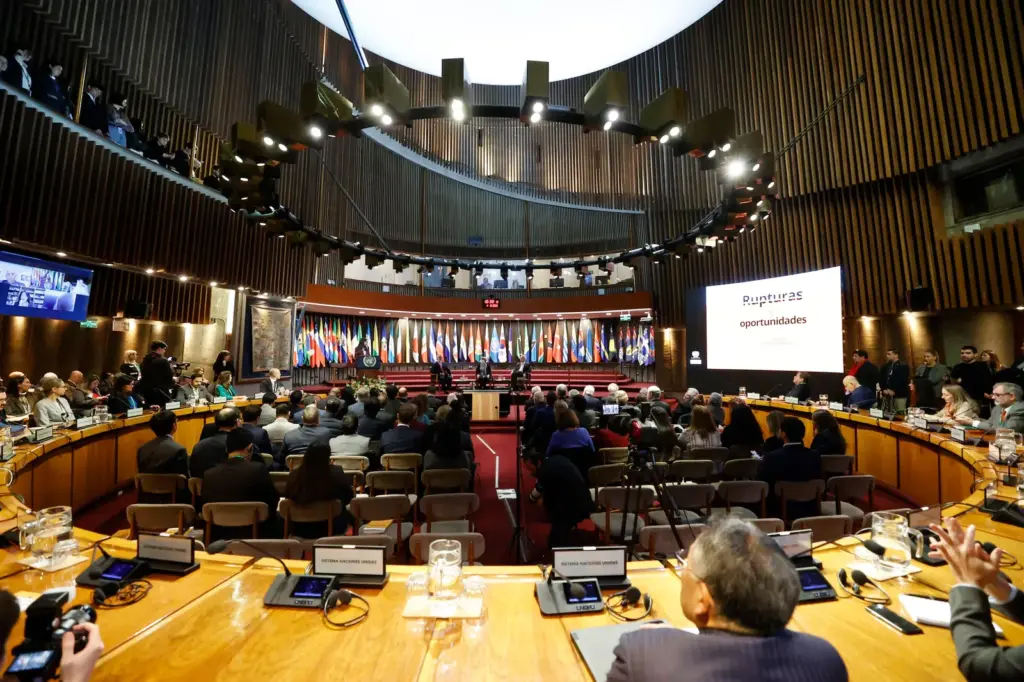
The Economic Commission for Latin America and the Caribbean (ECLAC) has prepared the report Breaks and Opportunities: Proposals for Latin America and the Caribbean to Prosper in the New Geopolitical Era. This has been promoted by José Manuel Salazar-Xirinachs, Executive Secretary of ECLAC, and co-chaired by Michelle Bachelet, former President of Chile, and Iván Duque, former President of Colombia, who, along with 10 other high-profile figures, have formed a very high-level working group, making the report an indispensable tool for interpreting both the vulnerabilities and potentialities of Latin America and the Caribbean.
Starting from the fact that the contemporary international scenario is undergoing a profound metamorphosis: hyperconnected globalization is giving way to a multipolar geoeconomic fragmentation, the report proposes the need to adopt an “active non-alignment” — that is, to avoid rigid alignments — and to strengthen cooperation and regional integration in the face of growing multipolar fragmentation. It also emphasizes the importance of leveraging the region’s strategic assets, such as minerals linked to the energy transition and digitalization, through the incorporation of added value and not through traditional primary-export patterns.
This perspective dialogues with the structuralist tradition promoted by Raúl Prebisch, architect and intellectual leader of ECLAC, who advocated for the transformation of Latin America’s productive structure, the reduction of external dependence, and the application of macroeconomic policies capable of cushioning international cycles. This line was later enriched by Enrique V. Iglesias and José Antonio Ocampo from institutional and neo-structuralist approaches.
The report’s diagnosis reactivates the structuralist tradition by reminding that the challenges of the 21st century cannot be addressed without understanding the historical asymmetries of the international system. Its goal is to show how the region can transform current instability into an opportunity to build its own development model, supported by its wealth, productive capacities, and strategic position within the new geoeconomic and geopolitical context.
To understand it in its breadth and depth, it is useful to start from Raúl Prebisch’s theses, who in the mid-20th century revolutionized economic theory by demonstrating that international trade did not necessarily tend toward equilibrium, but rather polarization through the center-periphery model. His warning about the deterioration of terms of trade explained why raw material-exporting nations lagged behind industrialized centers.
Today, ECLAC updates this approach by warning that the energy transition and digital revolution can reproduce the old international division of labor. Latin America has critical resources — lithium, copper, green hydrogen, and biodiversity — but mere possession of natural resources does not guarantee development if they are exported without added value. Here, Celso Furtado’s contribution gains critical relevance. For Furtado, underdevelopment was not a stage prior to development, but a branched and self-sustained structure due to technological dependence and income concentration. The report revisits this concern by warning about breaks in global supply chains: if the region limits itself to providing strategic minerals to the disputing powers, it will deepen the structural dualism that Furtado identified.
The report’s response to this risk is the adoption of an “active non-alignment.” This stance does not equate to passive neutrality, but to a pragmatic strategy aimed at productive diversification, technological sovereignty, and expanding the international maneuvering margin. In Prebischian terms, it means reinterpreting industrialization and productive transformation to adapt them to the era of artificial intelligence, green markets, and multipolar geoeconomic fragmentation.
This new situation has led to a tripartite architecture marked by the spheres of influence of the United States and China, while the European Union tries to consolidate itself as a third bloc. This competition redefines global trade and investment flows and demands that Latin America strengthen its institutions to negotiate with greater autonomy.
At this point, Enrique V. Iglesias’s contributions regain strategic value. From his management at ECLAC and the Inter-American Development Bank, Iglesias maintained that economic development requires strong, transparent, and resilient institutions in the face of external shocks. In the current geoeconomic fragmentation, these institutions must not only be efficient but also capable of avoiding subordination to financial logics.
Read more Weather alert for precipitation in northern Chile: how long will the rains last
Faced with financial logics, exchange rate volatility, imported inflation, and debt crises associated with the recomposition of global interest rates, José Antonio Ocampo’s macroeconomic approach is indispensable. Ocampo has historically defended the need to apply countercyclical policies and regulate capital accounts to protect peripheral economies from international speculative swings.
Currently, applying Ocampo’s theses means overcoming procyclical orthodox adjustment policies and moving toward macroeconomic stabilization mechanisms. The report converges with this vision by emphasizing the urgency of creating stabilization funds and regional financial safety nets that cushion external shocks derived from the commercial and technological dispute between Washington and Beijing.
Consequently, the confrontation between the United States and China forces Latin America to design an intelligent and pragmatic international insertion. The United States seeks to secure production chains and contain Chinese technological advancement in its historical zone of influence. China, for its part, continues expanding through infrastructure investments and trade. The European Union, meanwhile, tries to act as a balancing bloc through environmental sustainability and digitalization standards, although with less financial and military weight.
Faced with this polarization, as Josep Borrell, former High Representative of the Union for Foreign Affairs and Security Policy and Vice-President of the European Commission, has pointed out, the regional response requires advancing toward greater integration, although it cannot depend exclusively on political consensuses among current governments, often fragile or opposed, but must rely on concrete projects and actors capable of executing them.
Now from the corporate reality where traditional globalization rules have been replaced by the relocation of production chains, political affinities, and national security as central criteria of trade and investment, multilatinas play a decisive role. Their presence in several countries in the region, as well as in Spain and Europe, gives them operational flexibility to lead regional value chains in sectors such as agribusiness, advanced manufacturing, renewable energies, pharmaceuticals, aeronautics, electronics, fintech, and technological unicorns.
Coordinated with the public sector, these companies can become practical executors of “active non-alignment.” Their ability to operate simultaneously with the U.S. and European markets, attract Chinese investments, and incorporate environmental and digital demands from the European Union expands the region’s maneuvering margin and reduces the risk of new dependency, increasing the viability of sovereign development proposals that will depend not only on the quality of the diagnosis but on governments’ capacity to translate it into a concrete, coordinated, and sustained agenda.
As the report well shows, the region has strategic assets revalued by the new geopolitical context — energy, food, critical minerals, biodiversity, productive capacities, and talent — but these assets will only become development if there are clear strategies, strong institutions, and effective regional governance mechanisms based on three pillars:
- Pragmatic integration: regional integration does not require political unanimity, but functional agreements between countries that share concrete interests in areas such as energy, infrastructure, digitalization, science, innovation, and regional value chains.
- Business protagonism: multilatinas and the set of innovative companies in manufacturing, agribusiness, pharmaceuticals, aeronautics, electronics, fintech, and technological unicorns can act as practical engines of productive integration.
- Active non-alignment: faced with opposing influence pressures from the United States, China, and the European Union, this strategy ceases to be a rhetorical formulation to become a necessity for economic survival, technological autonomy, and international negotiating capacity.
In short, according to the report’s postulates, leveraging multipolar geoeconomic fragmentation to transform it into opportunities for diversification and productive innovation, institutional strengthening, and digital insertion is the most consistent path for Latin America to leave behind the historical cycle of dependency. Only through a combination of strategic vision, intelligent integration, business dynamism, public-private cooperation, and balanced international alliances can the region advance toward more equitable, competitive, and truly sustainable development that creates social well-being.
Read more These Bosch refrigerators combine direct discount and cashback to save more