The curve depicting the rise in housing prices in Spain over the last decade resembles more a long ascent than a roller coaster. The statistics leave little room for doubt: according to the Housing Price Index (HPI) from the INE, since early 2014, houses have continuously appreciated for 48 consecutive quarters, based on year-on-year variation. Since then, the indicator has always remained in positive territory, crossing economic cycles, interest rate changes, and episodes of uncertainty. The result is a streak of twelve years of uninterrupted appreciation that has transformed the Spanish residential market. During this period, housing prices have soared in much of the country, causing the index to more than double. In other words: houses are now worth more than twice what they were when they bottomed out during the Great Recession.
Read more The inner border of Ceuta
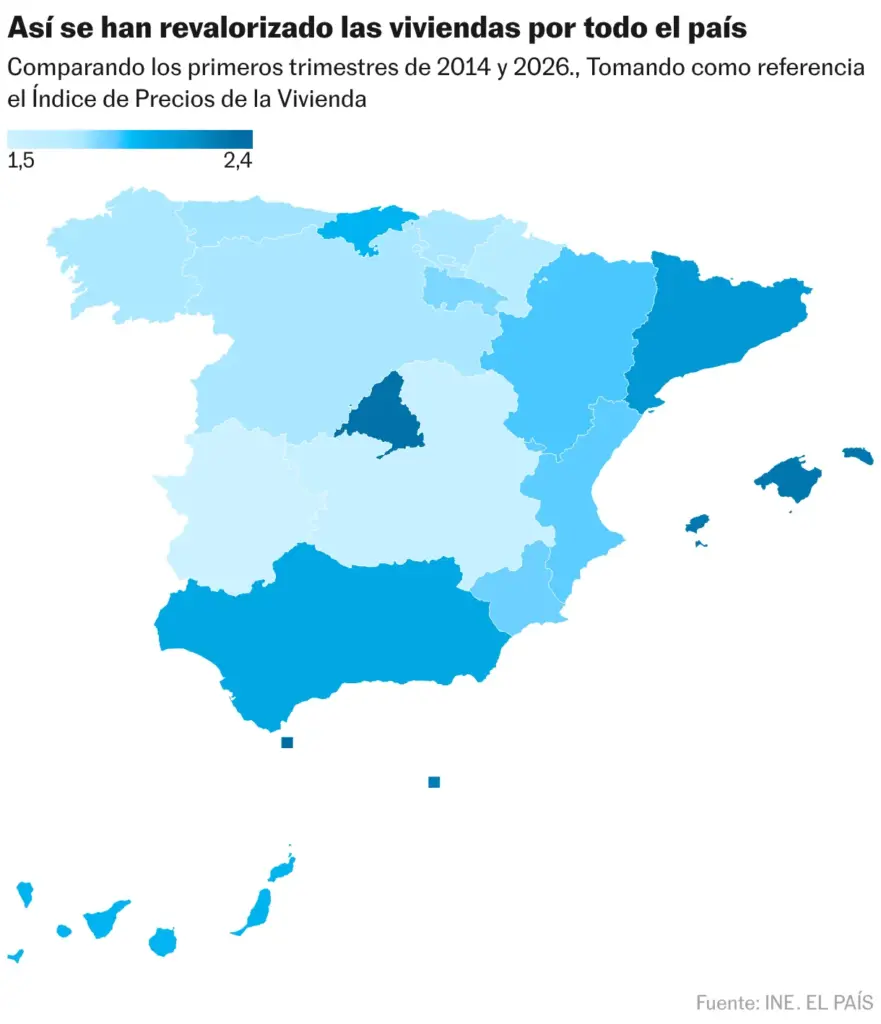
Although recently prices have reached historic highs in numerous autonomous communities, the evolution has not been uniform across the territory. Since the last downturn experienced by the real estate market in the first quarter of 2014, all territories except Navarra have recovered the value lost between the early-century bubble peak and its burst.
But in some, the rebound has been especially intense. Madrid is the most extreme case among the large regions: the price index is now 2.3 times higher than at the start of 2014. The Balearic Islands (2.26 times), Catalonia (2.13), and Andalusia (2.03) have also doubled their value. At the other end are Extremadura (1.52 times), Castilla-La Mancha (1.57), and Navarra (1.73), where appreciation has been more moderate, although that does not prevent houses from also being more expensive than ever, according to the INE statistical series. The Chartered Community, however, is an exception, as prices are higher today than in 2014, but it remains the only community that has not yet fully recovered the losses recorded after the bubble burst.
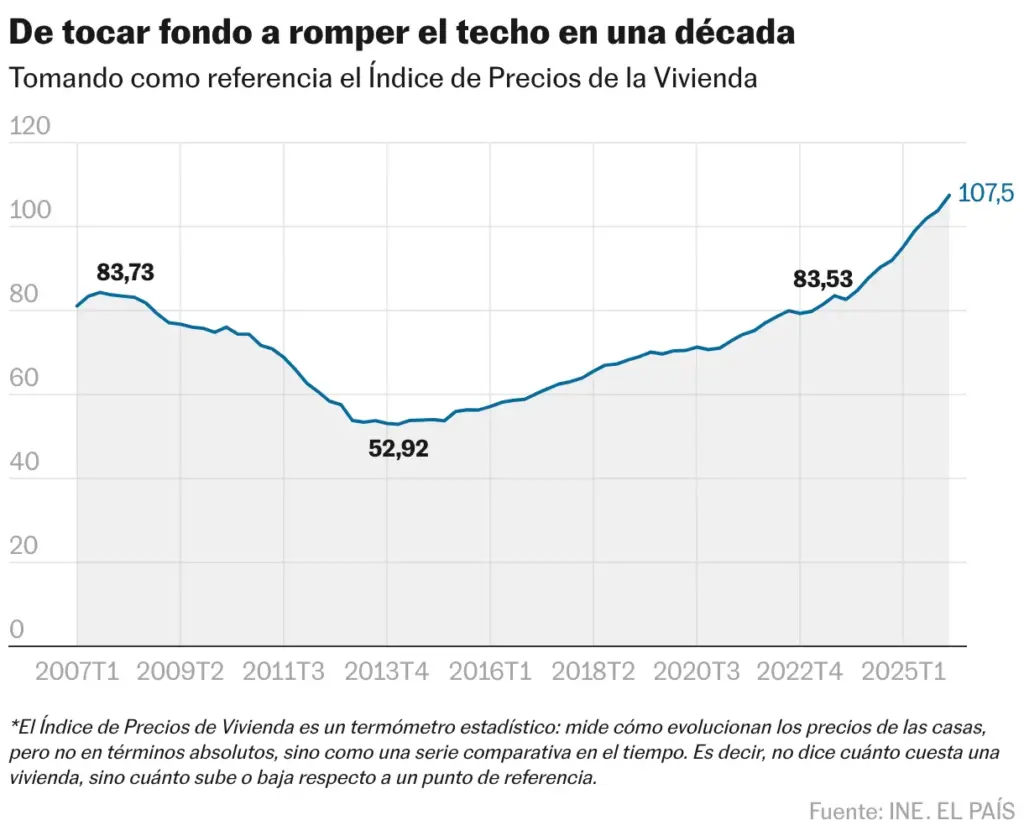
The explanation must be sought in a long decade of almost uninterrupted increases that have accelerated in recent years. After a timid start between 2014 and 2016, communities like Madrid, Catalonia, or the Balearic Islands began to register sustained annual advances between 6% and 12%, driven by economic recovery and the return of demand. From 2024, the pace gained even more speed, resulting in Andalusia closing that year with a year-on-year increase of 13.4%; Madrid, 10.3%; the Valencian Community, 12.2%; and Murcia, 11.7%. In 2025 and early 2026, many regions have chained double-digit increases above 10%, consolidating a rise that has led several of them to comfortably double the value they had in the past decade.
For Ignacio Ezquiaga, economist and real estate expert, the current price climb cannot be understood as a phenomenon independent of that experienced during the housing bubble. “They are very much related,” he points out. In his view, the correction following the financial crisis burst was insufficient to return the market to a trajectory more linked to households’ economic capacity. “It was a missed opportunity to return to a more normal path of housing prices,” he warns.
Ezquiaga also identifies a growing disconnection between the residential market and average incomes. “High incomes may still have room in the current market, but all the others have been left behind,” he explains. In his opinion, the market has increasingly oriented itself towards buyers with greater purchasing power, while access to housing becomes more complicated for a growing part of the population. “No one can buy a house now and almost no one can even rent one,” the expert asserts, considering it difficult for such a dynamic to continue indefinitely without causing economic and social tensions.
For his part, Óscar Martínez, president of the Professional Association of Real Estate Experts (Apei), adds that the intense price climb is even complicating the work of valuing properties, as owners have increasingly high expectations. “They come with prices in mind, you propose another, and they keep asking for more because they believe their homes are worth much more,” he explains by phone. Martínez also believes the trend will continue upward as long as the imbalance between supply and demand persists. He recalls that about 100,000 homes are being built annually, while some estimates suggest double that number is needed, a shortage that will continue to push prices up.
Pau A. Montserrat, professor of Financial Economics at the University of the Balearic Islands (UIB), acknowledges the strong rise in housing prices over the last decade, although he nuances that its relevance depends on the buyer’s profile. “If you buy your home to live in, price statistics shouldn’t worry you too much,” he argues, considering that the decision should be analyzed, as long as it can be afforded, with horizons of “40, 50, or 60 years.” In his view, the primary residence has a “use value” that transcends its market price and, therefore, its purchase can still be reasonable even at times of high prices. The case is different for those who acquire a second home or a property to rent out: in those cases, he warns, the timing of the real estate cycle becomes crucial.
Relentless
For Montserrat, the origin of the problem lies in a “textbook supply crisis.” That is why he rejects recipes aimed at artificially containing prices and advocates acting on the structural market imbalance. “Price is information, a thermometer reflecting the lack of available housing,” he points out. From his perspective, the solution involves increasing residential supply, promoting the construction of more homes, encouraging developments adapted to new housing needs, and providing greater legal security to both developers and owners.
The professor also calls for speeding up urban planning procedures and reducing delays in granting permits, while advocating for more stable rules for those investing in housing. Only then, he argues, will it be possible to reduce the accumulated property deficit and gradually ease pressure on prices. A need increasingly shared by experts in a market where supply scarcity has become, for many, the main explanation for current tensions.
For now, the data do not point in that direction. According to the latest report from Tinsa, the country’s largest appraiser, the average housing price accelerated again in July, with a year-on-year increase of 15.5%, already standing 1.8% above the highs recorded during the bubble. The advance is even more intense in metropolitan areas (17.9%), capitals and large cities (17.3%), and the Mediterranean coast (16.9%); while the Balearic Islands and Canary Islands register an increase of 11.2% and other municipalities, 10.1%.
After twelve years of almost uninterrupted appreciation, the Spanish residential market continues to advance with hardly any resistance. With supply far from meeting demand and prices already above bubble highs in much of the country, the big question is no longer how much housing prices have risen, but how much longer they can continue to do so.
If you have questions, suggestions, or simply want to share your case, you can send us an email at vivienda@elpais.es.
The data you provide will be processed by EDICIONES EL PAÍS, S.L.U., (C/ Miguel Yuste, 40, 28037-Madrid), for the purpose of managing your questions and/or testimonies and producing informative content. You may exercise your data protection rights through the address dpo@prisa.com by proving your identity and identifying the right you wish to exercise. For more information, please consult the Privacy Policy.
Read more The Flick brand prevails at Barça, who crush Elche in their League debut