About fifty people demonstrate on one of the most vibrant streets in Washington. They carry signs that read “Troops out of D.C.”, “Freedom for D.C. Let the troops go home”, “We want to be a State, now.” A young woman shouts slogans through a megaphone against Donald Trump’s government. It is humid and hot, and the sky threatens storms. The protest coincides with the first anniversary of the controversial announcement by the U.S. president to deploy National Guard soldiers to the capital in order to “liberate the city” from homeless people and crime.
Read more The long climb of housing: houses double in price after 12 years of uninterrupted increases
“Our city has been taken over by violent gangs and bloodthirsty criminals,” said the Republican leader in mid-August 2025, in a description far from reality. Crime statistics were at their lowest level in the last 30 years. “Crime, savagery, filth, and scum will disappear,” he wrote that day on Truth, his social network, with that hyperbolic verbiage that characterizes him. Violent crimes in the U.S. capital decreased by 35% in 2024, just the year before Trump returned to the Oval Office, according to Metropolitan Police data.
But Trump returned to the White House in January 2025 with the idea of conquering Washington — a city where he never felt completely comfortable, with 90% Democratic voters — and taking revenge on his enemies. So he used the attempted assault on an official to carry out his plan. In early August last year, Edward Coristine, a worker at the Department of Government Efficiency (DOGE), then led by Elon Musk to cut public spending, was attacked and assaulted when someone tried to steal his car. It was the perfect excuse for Trump to announce the mobilization of the army in Washington.
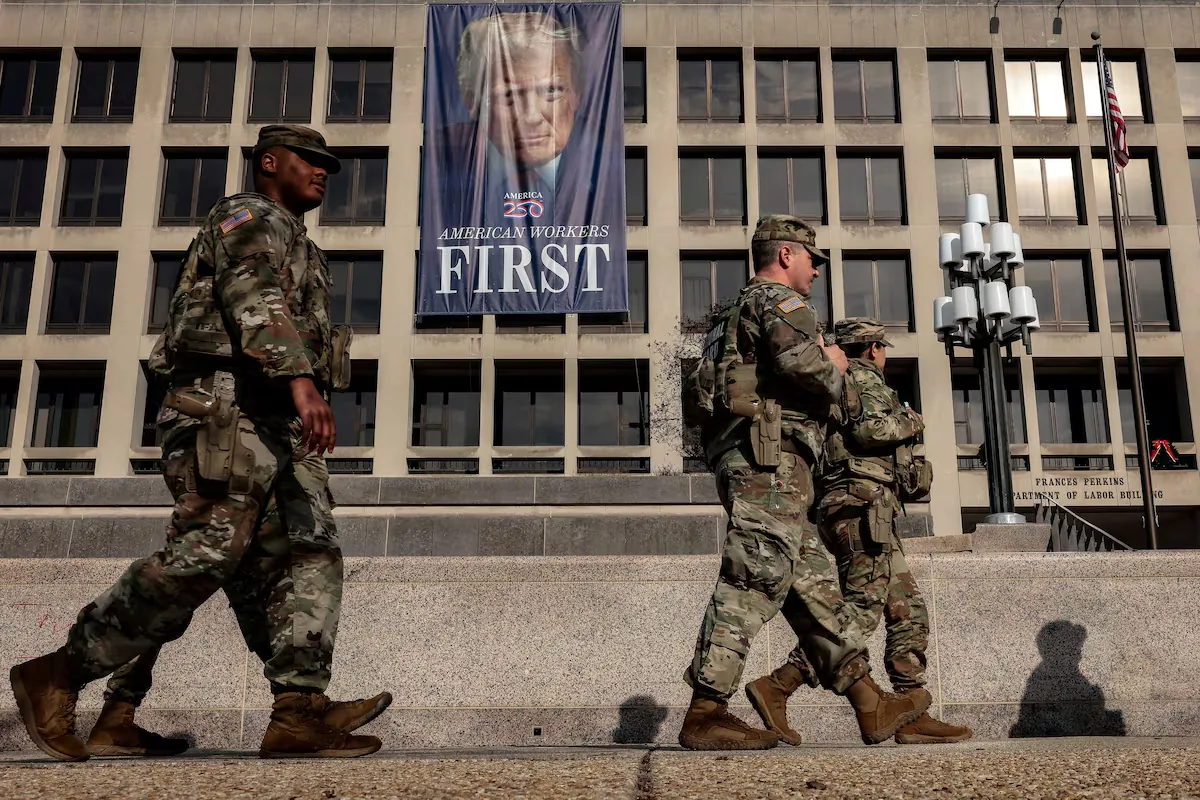
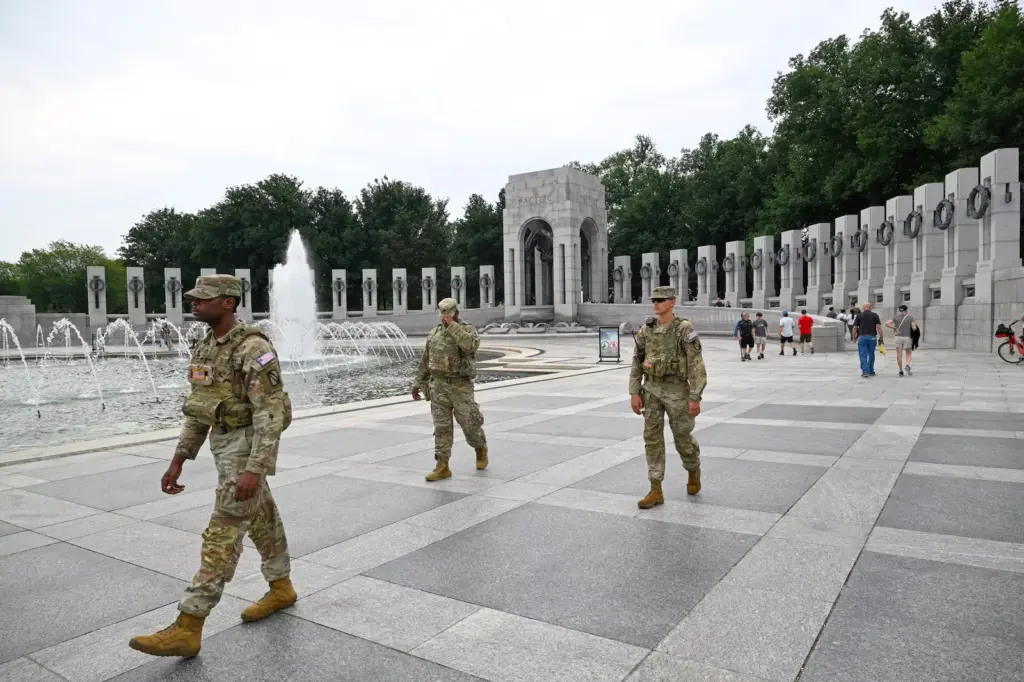
Since then, groups of young soldiers barely sporting the mustache that seems to be in fashion among them have patrolled the main avenues, the busiest streets, stationed themselves at metro stations, and marched in military formation through the city’s tourist spots, such as the National Mall, the large green meadow that connects Washington’s centers of power with the symbols of its history. They greet politely and smile, but barely intervene to ensure security. They wear military attire and carry pistols, handcuffs, and other gadgets, but do not intervene if an altercation occurs. They are deterrent agents. And their presence displeases many residents, who feel intimidated. 79% of the capital’s residents reject the measure, according to a survey published by The Washington Post.
“It marks one year since the invasion of the city. This demonstration is important to draw attention to the opposition of Washington residents to the occupation by military troops, federal agents, and the migra [immigration police],” explains Benjamin Zinevich Rodríguez, a 29-year-old who acts as spokesperson for the protesters demonstrating at the corner of 14th Street and U Street, one of the capital’s nerve centers.
While his companions shout slogans, Zinevich says the group he represents is called the Party for Socialism and Liberation. He works, he says, for Washington to achieve statehood to have more powers. The country’s capital is actually a federal district, and its powers are divided among the City Council, Congress, and the White House, in a strange power-sharing arrangement devised during the country’s founding to prevent the capital from having too much influence.
A year after the troop deployment in the city, around 4,500 soldiers patrol Washington, compared to 3,800 Metropolitan Police officers. An analysis by the Niskanen Center, a conservative think tank, calculated that the government spends $607 (519 euros) per soldier per day, compared to $384 for a police officer. “If they really want to improve security in the District of Columbia, give $100 million to the Police Department to hire competent, qualified, and properly trained officers,” demanded Delaware Democratic Senator Chris Coons.
The U.S. president also sent more troops to other cities governed by Democrats such as Los Angeles, Chicago, or Portland, but a court order forced him to withdraw them at the end of last year.
The White House has recently issued an order to keep them on the streets until the end of Trump’s term in January 2029, a decision estimated to cost $1.4 billion. The Congressional Budget Office estimated that the military deployment in Washington cost $225 million during 2025 and that each additional month would add $55 million more. According to their calculations, the military operation in the capital will have cost nearly $3 billion by the end of Trump’s presidential term. The Pentagon has approved a budget of nearly $300 million to find apartment buildings to house them instead of paying for hotel rooms, which is more expensive, a measure that highlights the mission’s duration.
“National Guard troops should only be deployed in cases of true emergency, such as natural disasters or Capitol riots attempting to disrupt the presidential power transfer. Our country’s Armed Forces should not be a political instrument,” says Monica Hopkins, head of the American Civil Liberties Union of DC (ACLU-DC).
Hopkins warns about the risk of normalizing the army’s presence on the streets. “We cannot become desensitized to the presence of military patrolling our neighborhoods. We cannot allow the military deployment on U.S. streets to become normalized or accepted as part of everyday life, neither here nor anywhere else,” she adds.
Read more The inner border of Ceuta
The operation in Washington is unprecedented in its magnitude and duration. Until the Iran war, the military operation in the U.S. capital has been the most important carried out by the Pentagon. It has had more than 5,000 soldiers mobilized from 18 states, almost all Republican, during the week of the 250th anniversary independence celebrations.
“The idea that the Armed Forces replace civilian authorities for any reason, however temporary, is simply incompatible with our constitutional system,” writes José Nunn, in an article for the Brennan Center for Justice, a liberal think tank.
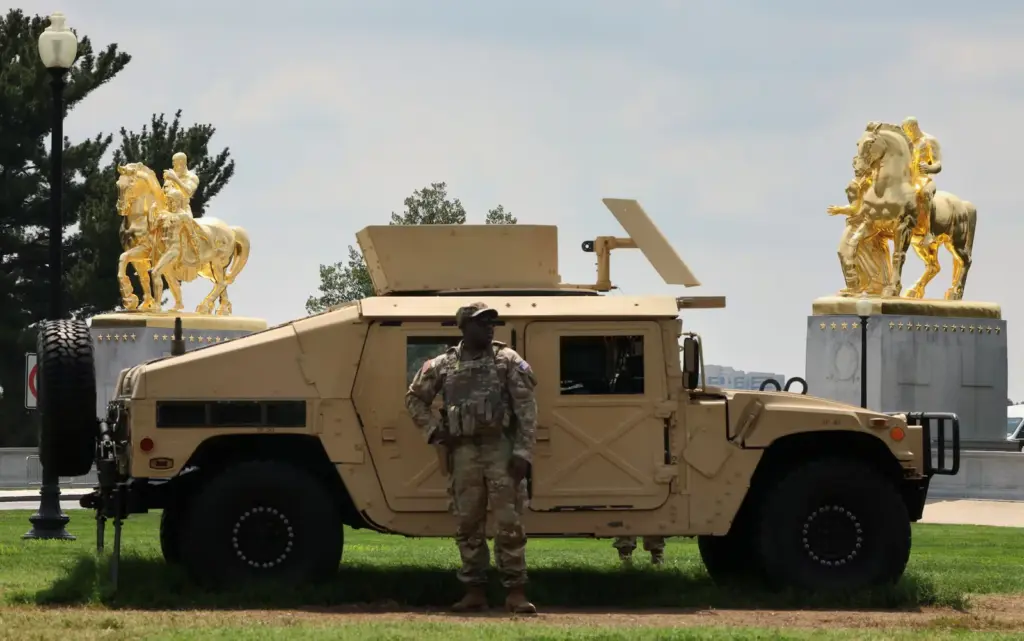
It has been 365 days since the military have roamed the city, and the truth is that security has improved and crime has decreased, but experts are not sure it is because of the deployment of the National Guard and Trump’s federal agents. Crimes have decreased nationwide.
A study by the Niskanen Center concludes that the presence of troops in the city may have affected opportunistic crimes, such as petty thefts or minor robberies, but not more violent crimes. “While the National Guard deployment reduced the incidence of specific crimes, it was (and remains) an imprecise and costly instrument,” it points out.
Trump, however, boasts about his decision. “Crime has dropped 84% in Washington, and I achieved it in a short period of time,” he said this week from the Oval Office.
An analysis by Reuters of 16,000 court files revealed that the National Guard only handled minor incidents in wealthier neighborhoods, mostly white populations with lower crime rates. Troops have barely been seen in southeast neighborhoods, such as Anacostia, where some of the city’s most troubled areas are located.
“The unchecked activity of ICE in U.S. cities and the presence of National Guard troops from other states in the District of Columbia remain problematic,” said the capital’s mayor, Muriel Bowser, a few days ago. “We have demonstrated practically and politically that there was no need for prolonged federal emergency action,” she added.
The soldiers have military training to participate in conflicts abroad, but have little training as police officers or urban security agents, which require different techniques and skills. The Trump administration enabled them as marshals to intervene, but a judge prevented them from making arrests without a prior court order. So they can detain suspects, but do not have to call the police to formalize the arrest. That is why, during the first months of the mission, members of the National Guard were seen cleaning trash bins, doing gardening tasks, clearing parks, or shoveling snow in winter.
“When I arrived here, it was a very dangerous capital,” Trump said this week to boast about the reduction in crime in Washington. “Now you can walk down the street. You can enter calmly. We had one of the worst cities, one of the most unsafe in the country. People will no longer be mugged, raped, beaten to exhaustion, or shot and killed in Washington, one of the safest places in the world.”