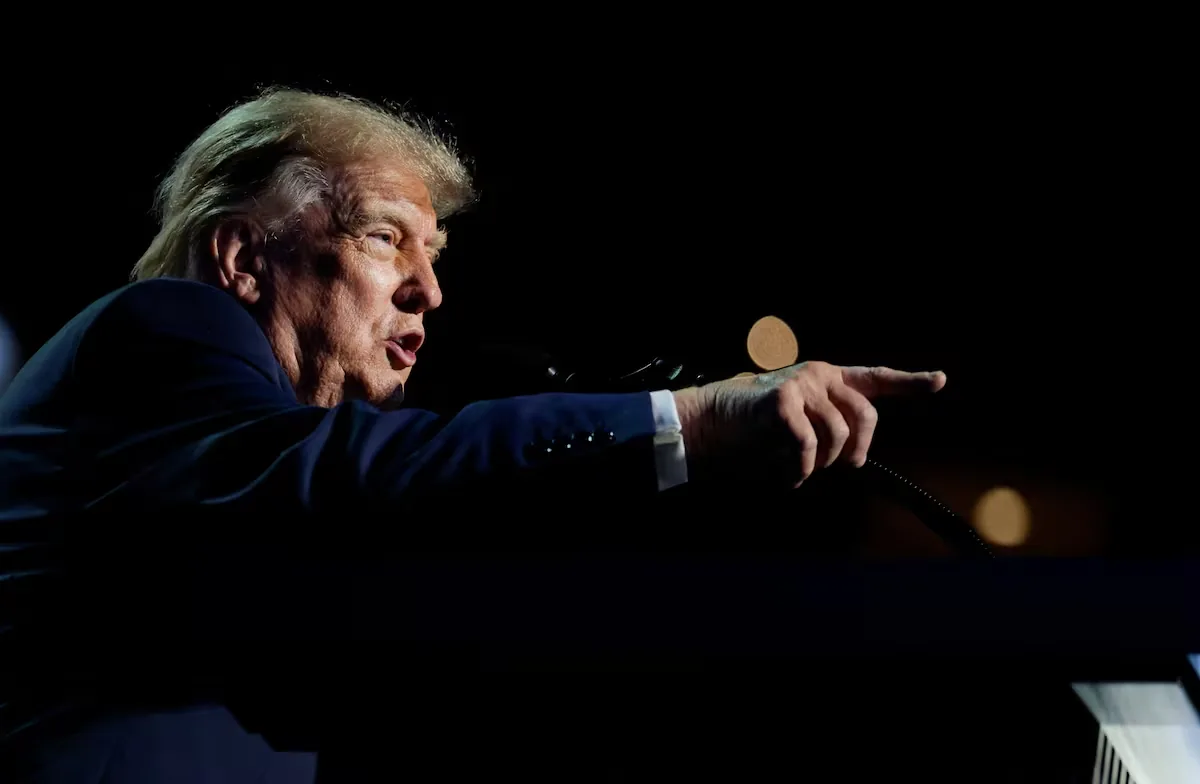
President Donald Trump put a price on the Republican effort to maintain control of Congress in the midterm elections next November. At the close of the first day of an unprecedented party convention in Texas, the president once again donned the businessman hat by promising a “dividend” of $5,000 to every adult U.S. citizen if it comes to fruition.
“If the Republicans win [control] of the House of Representatives and the Senate, both, due to our enormous economic success (…) I will issue a dividend of $5,000 to every adult citizen in the United States,” Trump said amid cheers at the Republican event in Dallas. “It will be very similar to what a successful company would do by distributing its profits to shareholders. (…) It will be called the ‘Trump dividend’,” he added.
This is not the first time Trump has promised money for what he considers extraordinary economic performance with plans that generate controversy, both for their form and for the possibility of implementing them. Beyond what was said last night for a minute and a half at the convention, there have been no details so far about the president’s new proposal. Vice President JD Vance seemed to narrow the scope of who would receive such payment in statements given shortly after to Fox News. “What the president is talking about is a dividend for American workers” due to the “extraordinary amount of revenue” of the United States, he told that outlet.
This is what we know so far about Trump’s promise:
How many people could receive the payment proposed by Trump?
The president spoke of “every adult citizen of the United States,” which would include about 245 million people, according to Census data. The cost of the promise would then rise to $1.23 trillion. That amount would double what the Committee for a Responsible Federal Budget (CRFB) estimated last year when Trump promised a payment of $2,000 to each person, thanks to the revenues flowing from his broad tariffs. In that proposal, the president stated that high-income individuals would not be included. “Assuming those dividends are designed like the ‘economic impact payments’ from the covid times, which were delivered to both adults and children, we estimate that each round of payments would cost about $600 billion,” the CRFB analysis specified at that time.
That so-called $2,000 dividend never materialized. In Congress, there was no push to authorize payments again like those sent during the pandemic in 2020 and 2021. Nor did a similar initiative by Republican Senator John Hawley of Missouri, for a much smaller amount of $600 per adult and minor dependent in a household, prosper.
Does Congress have to authorize these payments?
This type of payment usually must receive Congress’s approval because that branch has the power to set taxes and authorize public spending. The usual process is that a bill is introduced, evaluated in the relevant committees, and approved in both Chambers. Republican Senator from Ohio, Bernie Moreno, wrote on X that he will work on a legislative proposal so that the ‘Trump dividend’ can be approved immediately after the November 3 elections.
Read more The tension that does not cease
At this point, it is unclear how much support the proposal could receive amid a growing fiscal deficit. For example, when the Committee for a Responsible Federal Budget analyzed Trump’s previous $2,000 promise, it estimated it would generate a $6 trillion deficit over a decade, assuming they were paid annually with money from tariffs that were later stopped by the Supreme Court.
Currently, the U.S. fiscal deficit stands at $1.8 trillion and the country’s debt recently surpassed the psychological barrier of $40 trillion, according to official data. This is amid growing concern about rising financing costs. In fact, covering debt interest payments equals the cost of the Medicare program, with both ranking second in public spending items. Only the very important cost of Social Security exceeds them, according to official information.
Is it legal to promise these payments?
Federal laws prohibit allocating money to influence voting. However, Trump framed his $5,000 payment as a proposal that would materialize after the November elections.
There is a parallel: in 1982, the Supreme Court ruled in a case in favor of a candidate in Kentucky who promised to reduce the salary of local commissioners if he won the elections. That candidate subsequently won the elections, leading to a legal battle that escalated to the Supreme Court. Ultimately, that Court determined he had been elected “fairly” and that his right to free expression under the First Amendment of the Constitution should be protected.
Read more Ken Paxton, Trump’s riskiest bet to not lose Texas to Democrat Talarico