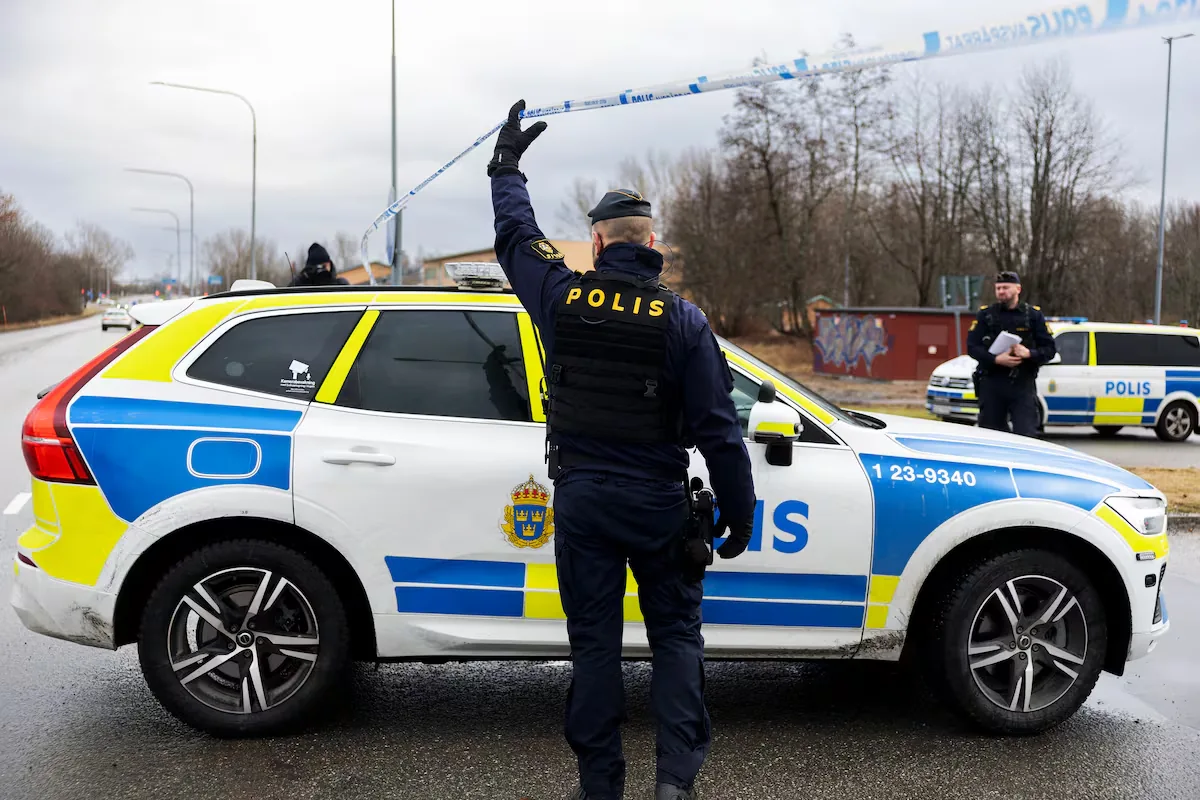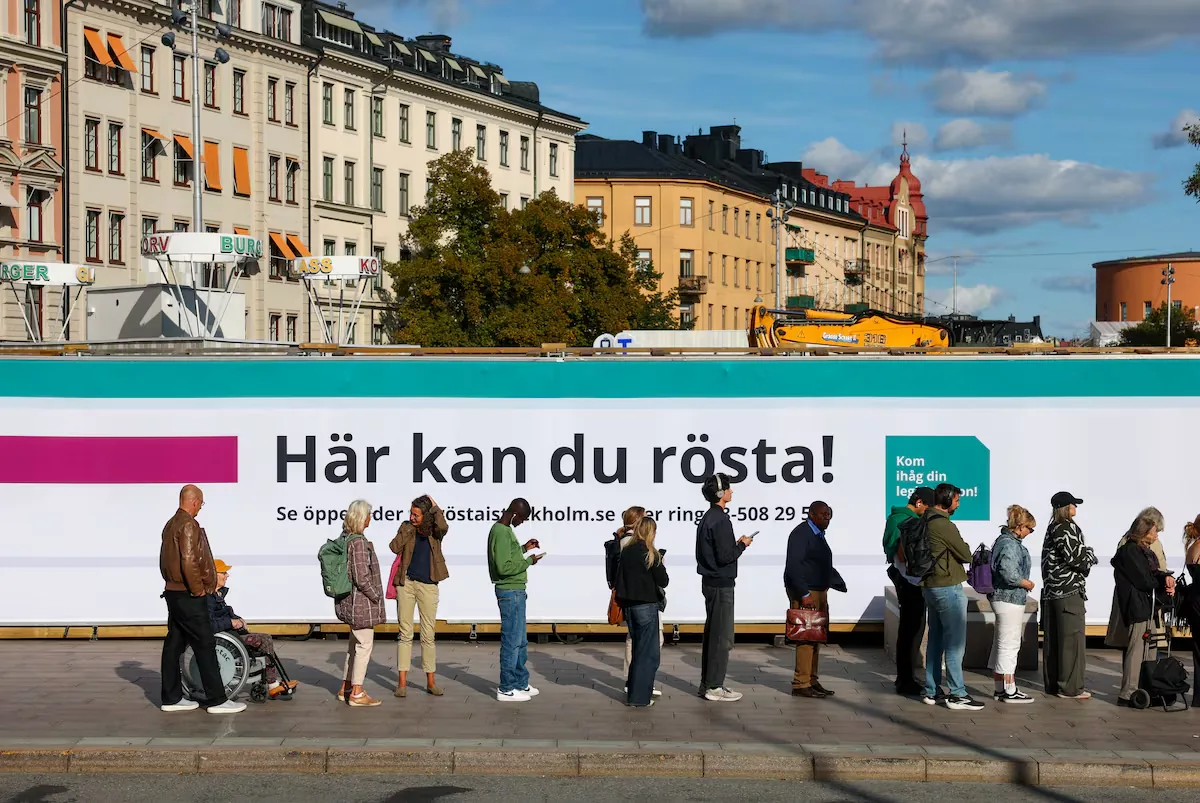
A few kilometers from Stockholm, the city of Södertälje experienced a very unusual start to the school year on August 17. At the doors of a high school, a shooting left a teenager injured and two 14-year-old girls arrested. The incident, yet another linked to gangs in a town deeply marked by violence, has shaken the campaign for this Sunday’s elections.
“The government boasts that the situation has improved a lot across the country, but I live in as much fear as I did four years ago,” says Maryam Sasveir, 33, near the educational center. “In March, a bomb exploded at dawn less than 20 meters from my house. I woke up in genuine panic and couldn’t sleep at all for the next two nights.”

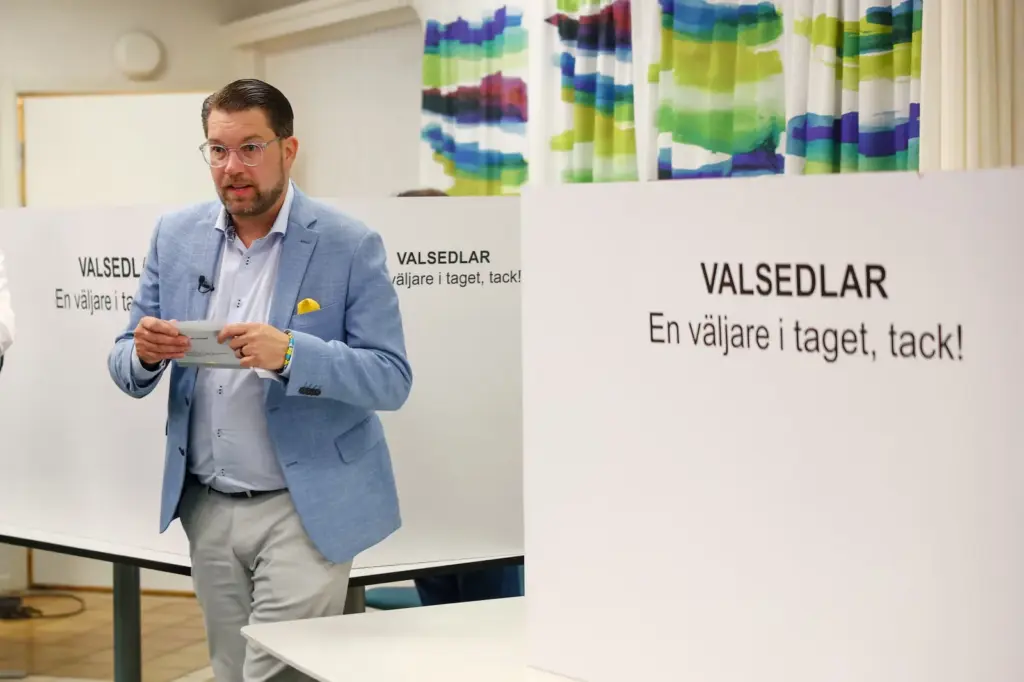
Shortly after the shooting, the Minister of Justice, conservative Gunnar Strömmer, declared: “Although we have reduced shootings by 80%, the violence is still there, bubbling under the surface.” The next day, the leader of the far-right Sweden Democrats, Jimmie Akesson, showed up in Södertälje to capitalize on social unrest. “I leave with the feeling that the situation has improved and is no longer as chaotic as in 2022, but there is still much to be done.”
After the elections four years ago, a right-wing coalition government was formed, made up of conservatives, Christian Democrats, and liberals, with essential support from the Sweden Democrats — the second parliamentary force, behind the Social Democrats. One of their major promises was to reduce the levels of violence that had the Scandinavian country on edge. The figures support the government: although Sweden is still the EU member with the highest rate of firearm homicides, in 2022 there were 391 shootings resulting in 62 deaths; in the first eight months of this year, there have been 48 firearm attacks and 12 fatalities.
While the government boasts about the success of its measures, the reality remains alarming. In Södertälje, a city of 100,000 inhabitants, five people have died from gunshot wounds since they took power; and this year there have been about ten bomb or grenade explosions.
At Södertälje City Hall, Social Democrat councilor Elof Hansjons warns that measuring the power of mafias by shooting statistics is a miscalculation. “The strongest criminal organizations are not interested in violence because it attracts attention,” he says. “Many people assume that fewer shootings automatically mean less organized crime. That is not necessarily true. Criminal organizations may actually be becoming stronger economically.”
His advisor, Nasif Kasarji, highlights the transformation of criminal gangs. “They no longer focus on drug trafficking or prostitution; now they are more interested in money laundering, social fraud, or the black real estate market,” he explains. “The national debate focuses on shootings, but we talk much less about economic crime, even though it is the fundamental engine of criminal gangs,” Kasarji laments. For him, institutional denial is the first failure: “The biggest mistake a municipality can make is pretending the problem doesn’t exist there. There isn’t one in the whole country that isn’t affected by organized crime.”
A police report from last November estimates that 67,500 people in the Nordic country have some type of link to criminal gangs (one in every 157 inhabitants). Of the total, 17,500 would be “active members.” These numbers have not stopped growing since 2022. “When we focus only on shootings, we are actually just treating the symptoms of the disease,” summarizes Rickard Holz, police inspector and head of the joint operation of about ten agencies — Tax Agency, Social Security, employment service, among others — against parallel structures and organized crime in Södertälje.
“The most sophisticated criminal gangs try to corrupt or infiltrate local institutions,” Holz says. “If we want to weaken them, we have to follow the money trail and prevent them from receiving public funds illegally. The police cannot solve this problem alone, which is why they work together with authorities responsible for taxation, customs, or economic crimes.” That collaboration is not limited to headquarters: for several years, the police have regularly attended meetings with the local government of Södertälje to share information about what is happening on the ground.
Holz emphasizes that recent legislative reforms also allow for stronger action against mafias. The right-wing government has toughened the penal code, expanded the police’s ability to intercept communications, increased the number of officers, and provided the force with a larger budget. Additionally, last Thursday the reduction of the age of criminal responsibility to 14 years came into effect.
The case of the two teenage girls arrested in August in Södertälje is not an isolated episode. “What has radically changed in the last three to five years is the role of digital platforms in gang recruitment,” he explains. Previously, recruiting young people into the criminal structure required physical proximity and time; now, a screen is enough: “Today they can recruit a minor from another part of the country through social networks, offer them money, and convince them to commit a murder or an explosive attack.”
Migration policy
For the government, containing organized crime is inseparable from a drastic revision of immigration policies. In June, Parliament approved a law allowing authorities to deny or revoke residence permits of immigrants retroactively for vague criteria included in the general definition of “misconduct,” which includes having outstanding debts or working off the books. That same day, another law was passed requiring public officials from the Public Employment Service, Social Security, Prison and Probation Service, Pension Agency, or Tax Agency to report anyone suspected of not having papers.
The links between crime and immigration are supported by research such as that of liberal-conservative analyst Nima Sanandaji. In June, he published a study analyzing the correlation in the 290 Swedish municipalities between violence and foreign-born population. The areas of the country with a higher proportion of foreigners are those with higher crime rates, while those with fewer crimes have a higher percentage of population born in Sweden. However, Sanandaji himself admits by email that crime is related to unemployment, low education, and dependence on social benefits.
Until a few months ago, polls clearly indicated that the right-wing government would not remain in power after Sunday’s elections despite having significantly reduced shooting figures. However, in recent weeks the Social Democrats’ voting intention has plummeted, and the chances that conservatives, Christian Democrats, and liberals will continue governing have multiplied. If they finally succeed, it will be with a new condition: the Sweden Democrats have already warned that this time they will not be satisfied with supporting the coalition from Parliament, as before, but will demand to be part of the government.
Read more Trump refuses to assist Saudi Arabia in the Red Sea despite the closure of a key pipeline