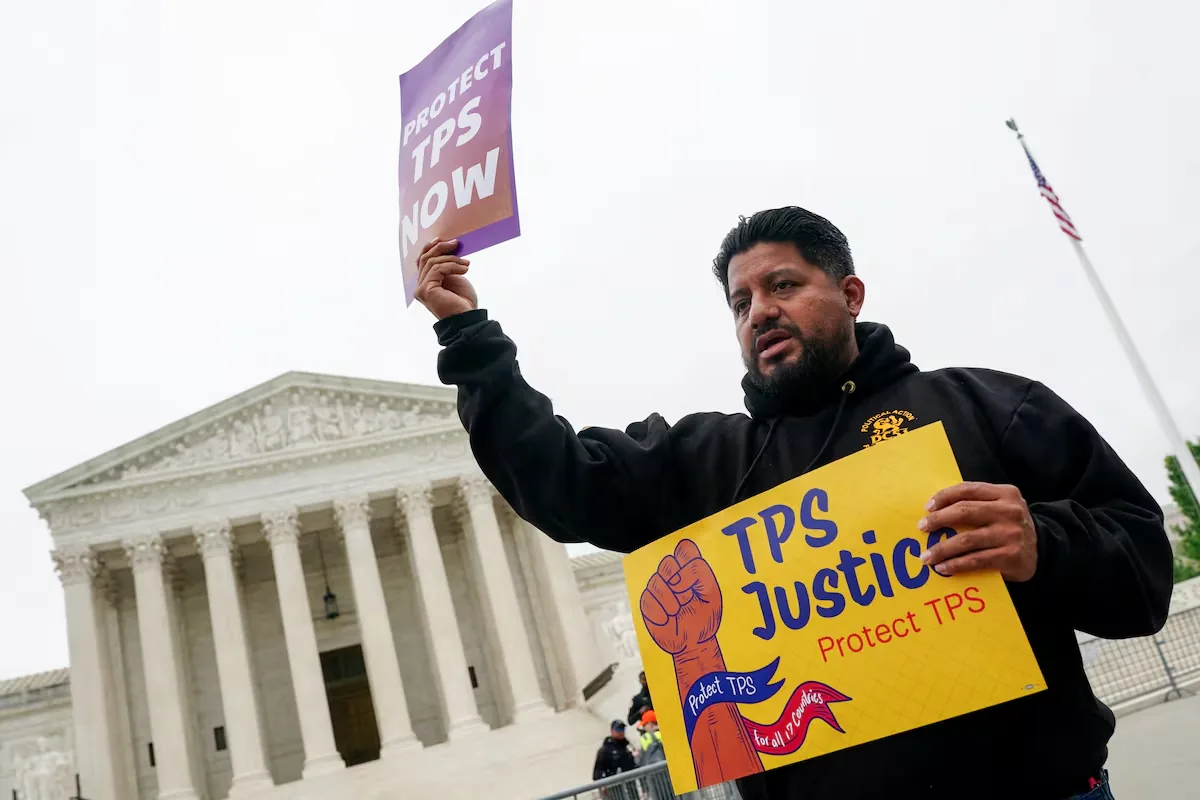
The 170,000 Salvadorans residing in the United States under the Temporary Protected Status (TPS) program maintain their permit for now. On Wednesday, September 9, the deadline for the Donald Trump Administration to decide whether to renew the program that protects them from deportation expired, but no decision was made. According to the statute that regulates it, silence implies an automatic renewal for six months.
Read more The tension that does not cease
Salvadorans can, for the moment, continue working, but the brief message given by the Government does not guarantee much. The Department of Homeland Security (DHS) said in a statement that there would be an announcement regarding the status of Salvadorans “at the appropriate time” and that until then, “Salvadoran individuals present in the United States under TPS retain protection.”
“Let’s say we can breathe, but it is not an ideal situation,” points out Francisco Semião, president of the National Salvadoran American Association (NSAA). In his opinion, the fact that the Government did not want to clearly announce the renewal leaves doubts about its intentions and does not end the uncertainty of the hundreds of thousands of people whose lives depend on a resolution.
In limbo
From the National TPS Alliance, the organization that has been fighting for the rights of tepesianos for decades, they also warn that the situation of Salvadorans remains in limbo. “They mention in their statement that for now we remain protected, but I don’t know until when, which means that this is not the final decision,” explains José Palma, its general coordinator to EL PAÍS. “We have entered a gray area, legally speaking, and for now we can only wait for the official announcement,” he insists.
Palma believes that the Government could even announce its end in the coming days. “Honduras was notified of its termination two or three days after the deadline expired. The Government’s interpretation of the law is that they are obliged to decide 60 days before the program expires, but not to make it public,” explains Palma.
The Trump Administration has eliminated TPS for 13 of the 17 countries that had it as part of its campaign against immigration, one of the pillars of its second term. They argue that TPS is a temporary, not permanent, program, and that conditions in the migrants’ countries of origin have improved, allowing their return, a debatable justification in Haiti, Syria, or Venezuela, countries that have lost it.
Read more Ken Paxton, Trump’s riskiest bet to not lose Texas to Democrat Talarico
The TPS program was created to grant temporary residence to citizens of countries experiencing extreme violence, armed conflict, or natural disaster.
El Salvador first obtained it due to the civil war the country suffered between 1979 and 1992 and later in 2001 in response to two earthquakes that devastated the country. Those who benefited from TPS have been in the United States for 25 years, a country they already consider their own. Congress has not offered them a path to permanent residence or citizenship, so they have not been able to improve their immigration status. They have started businesses, acquired homes, formed families, and their children are American. The prospect of having to leave everything behind is a nightmare from which the brief DHS statement has not freed them. “We don’t know what to do, whether to sell the business, the house, or so many other things we have built,” expresses Semião.
The TPS program grants a residence and work permit for 18 months, renewable. The Salvadorans benefiting have been processing it and paying fees for more than two decades. Trump already tried to end the program in his first term, but the courts stopped him. In this second term, he has eliminated protection for hundreds of thousands of people, whom he is deporting, and Salvadorans remain on a tightrope.
Semião trusts that the proximity of the midterm elections (midterms) will work in their favor. The president’s popularity is at a low partly due to the aggressiveness of his immigration policy. The war in Iran, with no signs of ending, the high cost of living, and the rise in gasoline prices have eroded the support of voters who voted for him in 2024. Polls indicate that on November 3, he could lose control of both Chambers of Congress, in which the Republican Party currently holds a majority. “I don’t think he will make a decision against TPS before the election; it wouldn’t favor him,” Semião opines. For now, the 170,000 Salvadorans under TPS remain protected from deportation, but it is temporary.