









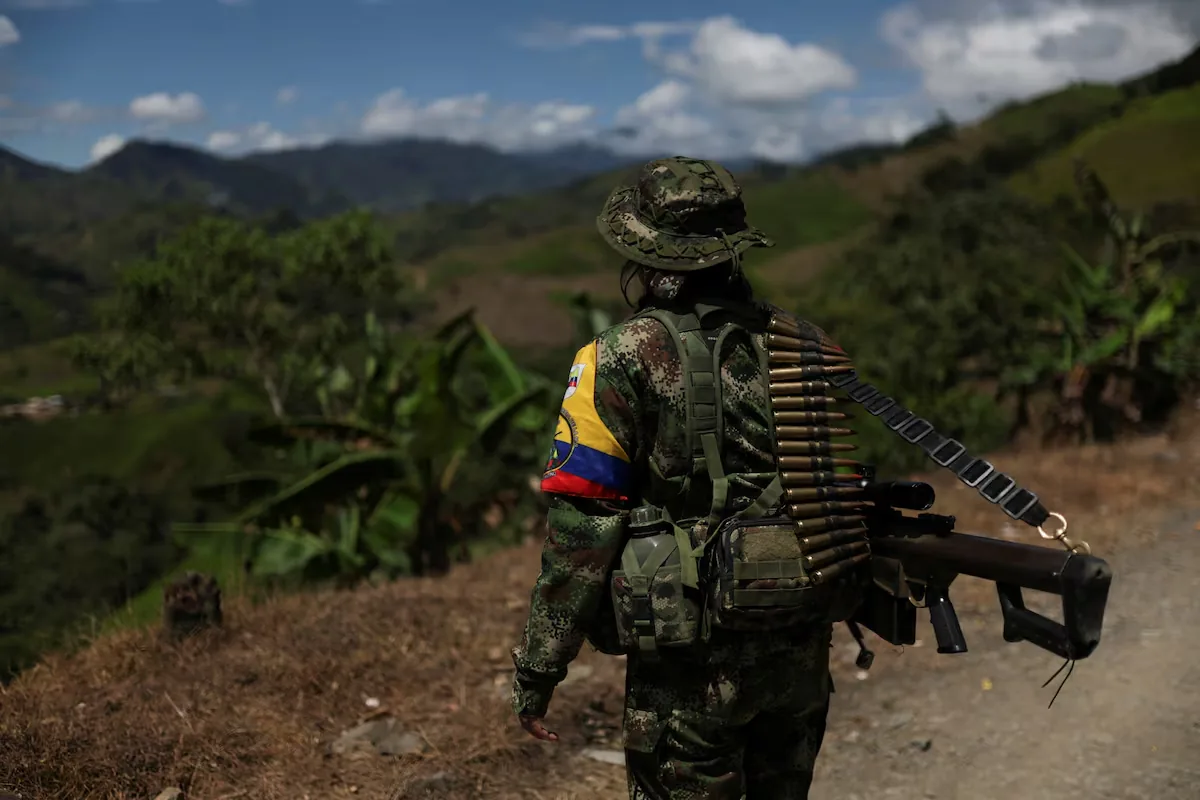
President Abelardo de la Espriella continues dismantling the decisions made by his predecessor, Gustavo Petro, with the ambitious goal of achieving simultaneous peace agreements with the various illegal armed groups in Colombia. On the night of this Wednesday, he ordered the definitive closure of the area where 99 dissidents of the former FARC who laid down their arms remain, in the biggest advance of the total peace policy. It is a rural area in the municipality of Valle del Guamuez, in the Amazonian department of Putumayo, where on June 18 members of the Border Commands, a structure that is part of the alliance known as the National Coordinator Bolivarian Army (CNEB), gathered.
The decision prematurely ends a protection that initially lasted until December and raises doubts about the future of the people who were transitioning to civilian life in that Temporary Location Zone or ZUT. The presidential resolution leaves in the hands of the Agency for Reincorporation and Normalization or ARN, the state entity responsible for accompanying people who lay down arms, to maintain that process, but individually and outside the physical space. This directive faces a difficulty: the ARN is experiencing a crisis due to the freezing of resources by the same Government.
This is a continuity based on the fact that the process with the Border Commands is framed within submission to justice, a procedure that De la Espriella has indicated will be maintained in his Government and that applies to anyone who leaves any armed group. This method differs from bilateral negotiations in which the State and a group agree on a collective treatment with sui generis conditions.
The ARN had warned that the early closure of the location zone implied risks for the reincorporation process. In a document sent on September 9 to the guarantor countries of that dialogue process (Switzerland, the Netherlands, Venezuela, Norway, and Uruguay) and accompanying organizations such as the UN, MAPP-OAS, and the Episcopal Conference, it alerted about a “significant risk in guarantees of rights and security” and “of recidivism of this population, as well as institutional credibility of the Colombian State regarding demobilization and submission processes.” The entity also pointed out that there are legal, security, documentation, migratory regularization, and financial system access barriers affecting those concentrated in the ZUT.
The ARN sent a similar letter on Wednesday to the Ombudsman, Iris Marín, and the Attorney General, Gregorio Eljach.
Of the 99 ex-combatants who entered, 86 had formally entered the ARN reintegration route and were registered in its system to access initial benefits.
Read more $5,000 per person? The dubious viability of Trump’s latest promise
“Here we are, those of us who stayed”
In a video released Wednesday night, several ex-combatants state that they will remain in the area despite the announced closure and confirm that others have already left the place. “We have made a brave decision. We feel very sorry for the comrades who left the ZUT, each one is responsible for their actions. Here we are, those of us who stayed and continue on this path,” says one of the men.
According to sources close to that process, 43 of the 99 remain in the place.
In the recording, the ex-guerrillas call on the ARN to maintain its presence in the area. It is a demand that coincides with a concern that the ARN conveyed to the high Government in another document dated Monday, September 7, when it asked the Office of the Peace Commissioner, the Administrative Department of the Presidency (Dapre), and the Colombia in Peace Fund to inform it of the procedure for the closure and, in particular, how the decision would be communicated to the 99 people, their lawyers, the communities, local authorities, and indigenous councils of the area.
Armando Novoa, Petro Government negotiator in that negotiation, questioned the Executive’s decision to close the area without having a clear roadmap for the ex-combatants. “It surprises me because this new Government maintains the rhetoric that the option of treatment with these armed groups is a submission strategy, but with this resolution it disregards the guarantees of the law that is in force in the Penal Code,” he explains. For Novoa, the Government “improvises.” “That would not be so serious at this point if it were not because they are disregarding fundamental rights that those 99 people have.”
Novoa indicated that, although they had a commitment to remain, it is not clear if they were still obligated after the announcement. “The question that exists, which the law does not clearly resolve, is what happens if the Government unilaterally ends the zone. The people were there under the promise of guarantees that the previous Government did not grant, but those granted by the law and the Constitution,” he explains, and points out that there has been no presence of the Prosecutor’s Office or any other authority establishing that roadmap.
The resolution ordering the closure establishes that before September 30 a closure and transition plan must be executed, which must be coordinated by the Office of the Peace Commissioner, which still has no head and which the Executive plans to replace with a Security Office of the Presidency.