









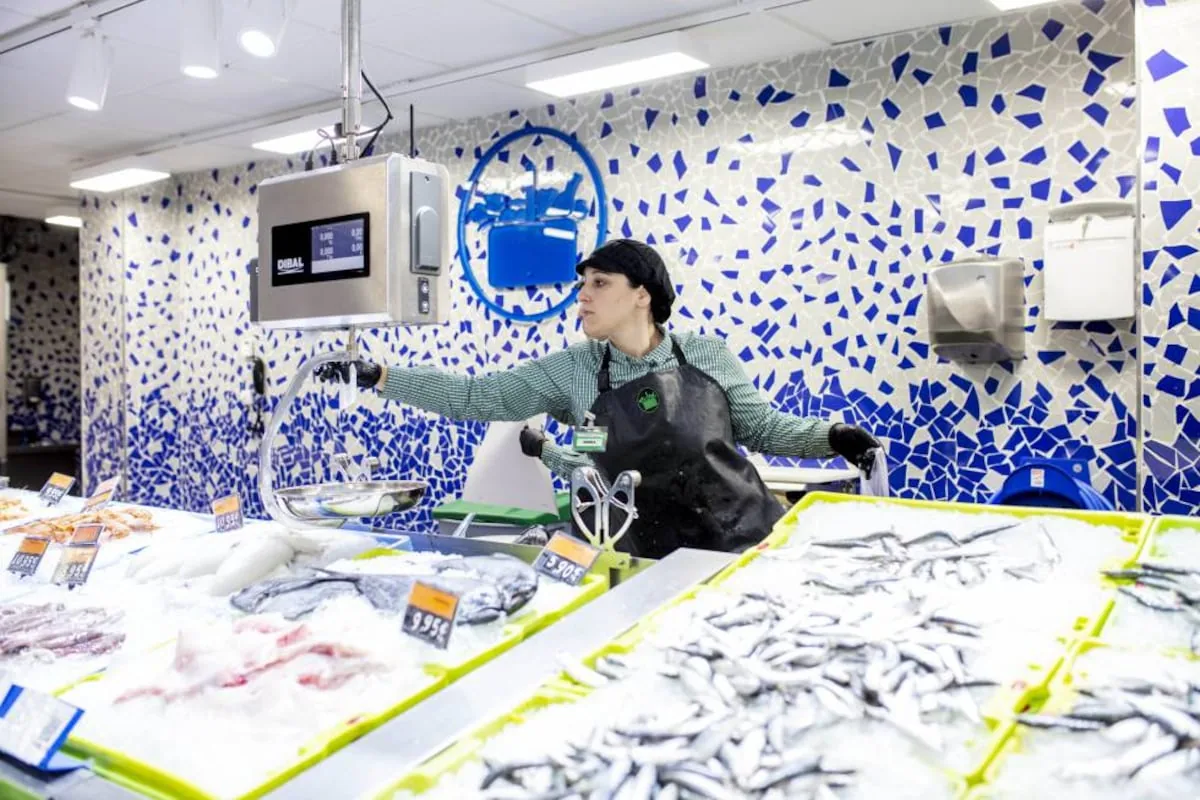
For two years, Mercadona has been implementing its new fish sales model in its establishments. A system that dispenses with traditional attended stalls where fresh produce was sold, to be replaced by refrigeration chambers where the product is sold already cut, portioned, and prepared for cooking, in trays.
Read more The investigation that was stillborn due to the power of Los Pancetas in Ayuso’s PP
A system with which Mercadona wants to “promote fish consumption through a more agile and closer service,” as defined in one of its latest annual reports, and which requires industrial adaptation by its suppliers. Something the supermarket company is collaborating on by granting nearly 130 million euros in loans.
This is extracted from the latest annual accounts of Inmo Alameda, the holding company through which Mercadona’s main shareholder, Juan Roig, controls the company. They show a significant jump in outstanding balances for loans formalized with “third-party suppliers of goods,” which at the end of 2025 amounted to 171 million euros, when a year earlier they barely reached 41 million.
A jump of 130 million that Mercadona explains by the amounts lent to seafood suppliers to carry out the industrial adaptation to the new sales model for this type of product. These loans have long-term maturities, starting from the 2030 financial year, as can be seen in Inmo Alameda’s accounts.
Its president, Juan Roig, already explained last March the type of collaboration that the new fresh fish sales system required with its suppliers. “We are going to replicate what is established in meat: we are going to have the supplier manufacture most of the products for us,” said the businessman. “For quality and food safety reasons, we want a supplier to do it for us. There will be four or five products that we will continue to prepare in central workshops until a supplier has the technology to do so,” he added. It is in this adaptation that these loans come into play: the sale of already prepared fish requires investments, for example, in packaging systems to extend the cold preservation of the product and ensure it is in optimal condition for consumption while in the chambers.
“For the development of this re-engineering of the fish section, Mercadona has the support of leading companies and specialists in the sector, such as Profand and Piscifactorías Andaluzas, who are collaborating in improving the assortment and adapting to this new format,” explained the 2023 report, the year Mercadona began testing this model in 77 stores.
Read more The betrayal of the Bárcenas’ driver: “He was like one of the family”
By the end of 2025, 310 establishments had already implemented it. As detailed on its website, the key to the model is to “minimize the time from when the fish leaves the water until you consume it. Therefore, we put all products into trays, guaranteeing quality and freshness.” Furthermore, it explains that it decided to modify the way it markets seafood products because “the experience at home was not always as expected.”
This change is one of the main modifications the company will implement in its new commercial model, called Tienda 9, which will entail an investment of 3,100 million until 2033 to transform the internal organization of its points of sale.
Major suppliers
Mercadona has about a dozen Spanish seafood suppliers, including those that supply fresh and frozen fish and shellfish. The most important of them all, by sales figures, is Profand itself. The Vigo-based company closed 2025 with a record revenue figure of 1,116 million euros, a 10% increase. It acknowledged that its growth was motivated by its relationship with Mercadona, its main client, to whom it supplies all types of seafood varieties. Since 2019, Profand has doubled its sales. That year, it acquired Caladero, an Aragonese company specializing in packaged fish production, from Mercadona itself.
Other key suppliers in the maritime sector include Mascato, which in 2024 recorded a turnover of 236 million and has grown by 62% since 2019; Frime, specializing in tuna, with a turnover of over 170 million; Congalsa, exceeding 150 million, or Japofish, surpassing 100 million in total sales.
Among these suppliers is also Nueva Pescanova, although in its case, most of its business is generated through its own brands. It supplies Mercadona, for example, with ultra-frozen prawns.