








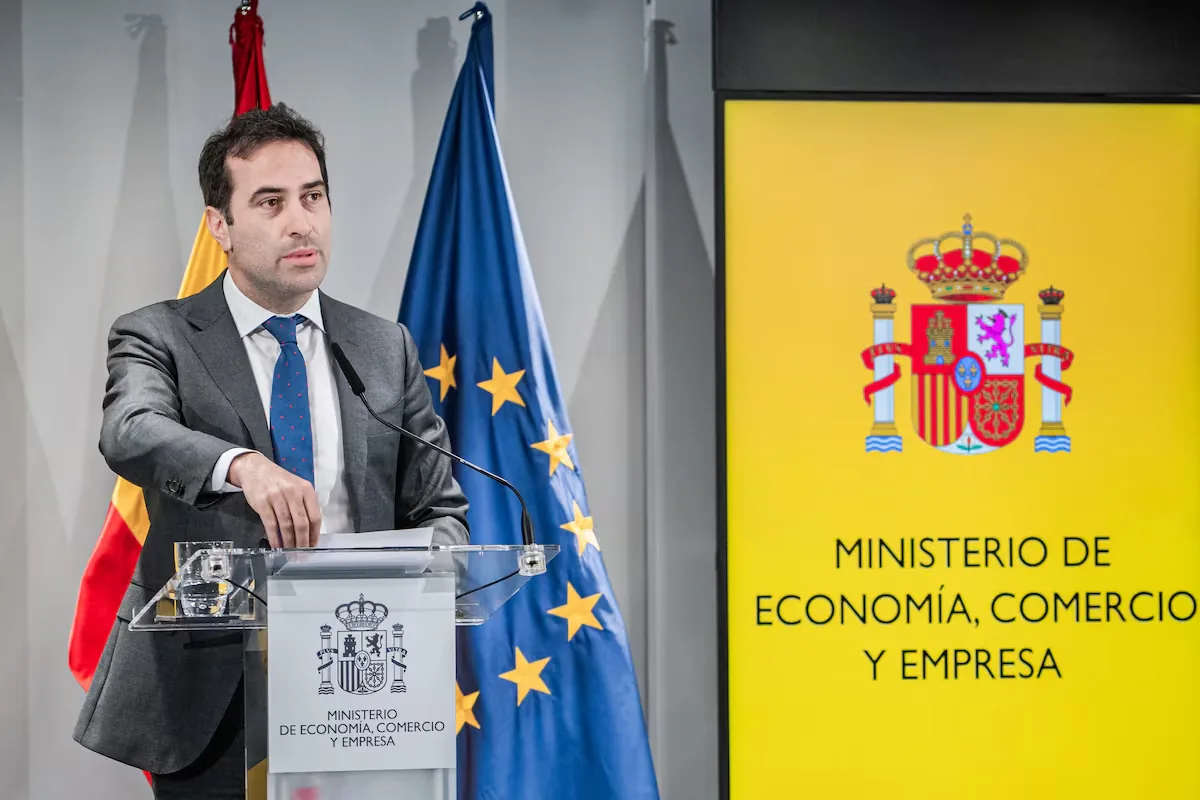
The First Vice President of the Government and Minister of Economy, Carlos Cuerpo, announced this Friday that the Executive will reactivate after the summer the processing of the new Financial Client Defense Authority, an body that will resolve customer complaints against banks without the need to go to court. The initiative has been awaiting its implementation for more than four years, postponed first by the call for early elections in July 2023 and by the parliamentary blockade that has occurred since then.
Read more A car bomb intercepted near the border between Ireland and Northern Ireland
This body was conceived as a one-stop shop for financial clients to file complaints against banks, insurers, and investment firms, centralizing functions currently held by the Bank of Spain, the National Securities Market Commission (CNMV), and the Directorate General of Insurance and Pension Funds (DGSFP). It will resolve complaints in less than 90 days and its decision will be binding, without the need to resort to other authorities, for claims of an amount less than 20,000 euros. For matters involving higher amounts, it may issue expert reports.
Among the issues to be resolved are possible breaches of conduct rules, good practices and financial uses, or the abusiveness of clauses in financial contracts. In 2025, the Bank of Spain received 30,970 complaints, according to data published this week in its Complaints Report. Although the figure decreased by 30% compared to the previous year, an 18% growth in those related to banking fraud stands out particularly.
The launch of this new supervisor dates back to Nadia Calviño’s time as Minister of Economy. She announced its implementation in April 2022, when the Council of Ministers approved it for the first time. It was then on the verge of seeing the light, but the aforementioned dissolution of the Cortes due to the call for general elections brought it back to square one. Once a new Executive was formed, the Ministry of Economy relaunched the project at the end of that same year 2023 and anticipated that it would be constituted by 2024. The reality has been more complicated.
Once the Council of Ministers gave the green light to the project for the second time, it reached the Congress of Deputies. It did pass the stage of total amendments, which, had they succeeded, would have meant returning the project to the Government. But after that, it has languished for two years in the process of partial amendments.
The ministry seeks to end this delay and has announced that it will advance in parliamentary processing by taking the matter to the Economy Committee in September, a preliminary step for its definitive approval by the full Congress, as announced by Cuerpo at the end of the periodic meeting with banking and user associations on financial inclusion, held this Friday. The law that will create the Financial Client Defense Authority will face, in the final stages of the legislature, the parliamentary weakness of the Executive, which has prevented the approval of several laws and decrees. In the previous legislature, the initiative had the abstention of the PP, which would facilitate its processing.
The project has been controversial from the beginning. It has met with strong opposition from the two banking associations, the Spanish Banking Association (AEB) and that of the former savings banks (Ceca). They see this new body as an additional complexity to their daily operations, as well as a possible new source of litigation after the disputes faced over the marketing of products such as mortgages with floor clauses or preferred shares. They also criticize its financing, through a fee of 250 euros per complaint that banks will have to pay.
“We already said that we did not consider it necessary to create a new body. We considered it a better option, in line with what has been done in other countries, to improve or adjust some aspects of what exists in the Bank of Spain, the CNMV, and the Directorate General of Insurance. The only similar experience is the one we have in the United Kingdom, which was designed for 300 workers with the aim of reducing litigation, and once implemented, both the structure and the number of complaints have multiplied,” pointed out Alejandra Kindelán, president of the AEB, in one of the latest interventions on the matter.
But the creation of this body has not only met with rejection from the banking sector, but also from other supervisors, such as the Bank of Spain and the CNMV. On the one hand, they see how it could mean a reduction of functions and view more favorably the creation of a supervision system known in jargon as twin peaks. That is, one body responsible for monitoring the conduct of financial entities and customer protection, and another for solvency.
The former governor of the Bank of Spain, Pablo Hernández de Cos, criticized the launch of this body. In his opinion, its aforementioned financing model would lead to an increase in litigation between banks and clients and proposed that it be paid by whoever received an unfavorable resolution. However, since the previous processing of the regulation, both the leadership of this body and that of the CNMV have changed. Neither the current governor, José Luis Escrivá, who was in the Government when the Council of Ministers authorized it, nor Carlos San Basilio have commented on the matter.
Read more Kast dismisses Undersecretary of Finance after testing positive for drugs