





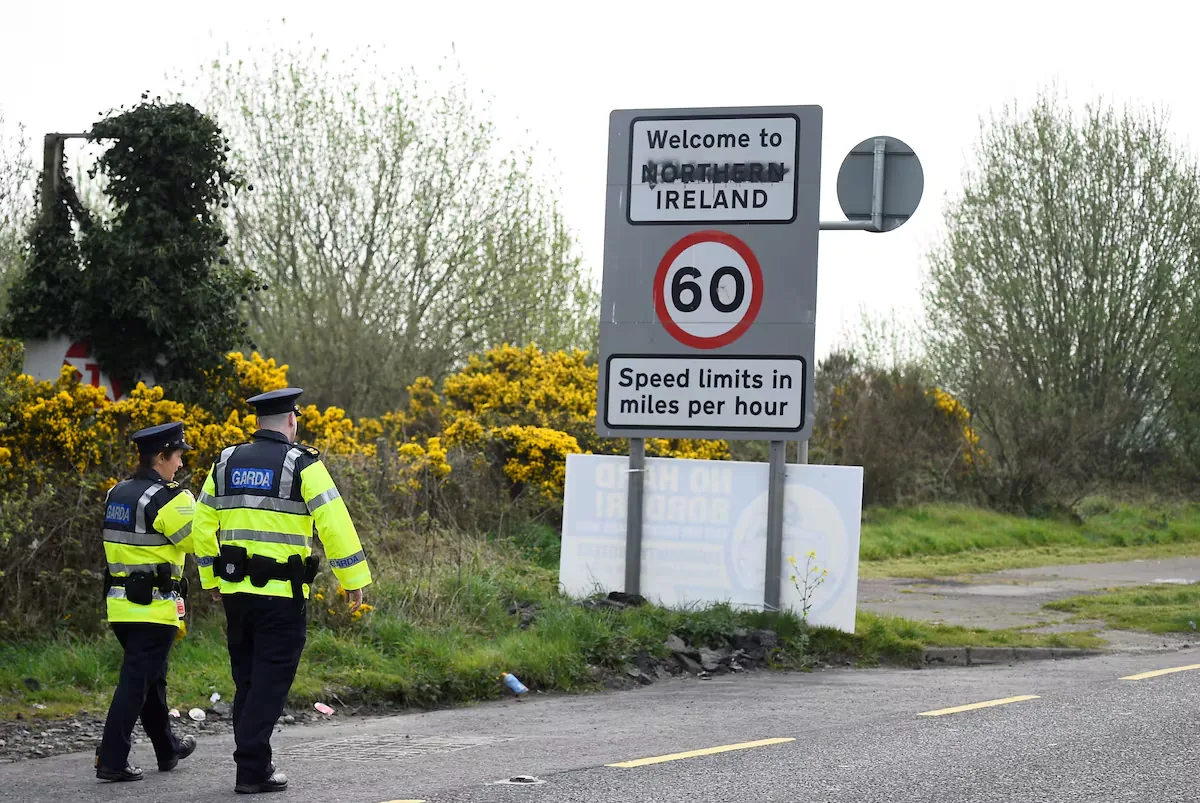
Alarms have been raised within the police force of the Republic of Ireland. Last Wednesday, a “significant explosive device” was intercepted in a car heading towards the border with Northern Ireland, the force announced this Friday. It was the most powerful bomb detected in the last 10 years, containing military explosive material and “a degree of sophistication” that has surprised experts.
The driver, a woman in her 20s, was arrested, as was a man in his 40s. The hypothesis being considered by investigators is that the alleged car bomb was the work of dissident nationalist militants, opposed to British sovereignty over Northern Ireland and against peace with the United Kingdom. It is the third similar incident in recent months, although the most significant.
Police are questioning two people for possible offenses against the State, after officers who stopped the vehicle on Wednesday requested the intervention of the Army’s Explosive Ordnance Disposal (EOD) team to examine its contents.
“This was undoubtedly a significant explosive device; it was not simply the seizure of components or parts. It could have caused considerable damage,” explained Irish police commissioner Justin Kelly, who detailed that the device contained plastic explosives.
“We know there is a small minority of dissident republicans who did not agree with the Good Friday Agreement [of 1998]. I would describe them as radicalized republicans, and this is a threat we will continue to face for some time,” he added.
Sporadic attacks by militant groups, mostly nationalist, often through attempted car bombings, continue in Northern Ireland almost three decades after the 1998 peace agreement largely ended sectarian violence in the UK-administered region.
Read more Kast dismisses Undersecretary of Finance after testing positive for drugs
“They still have the capability to manufacture these explosive devices,” Kelly noted, “and that is why an operational anti-terrorism unit continues to exist.”
Many members of this dissident group are young enough not to have lived through the period of sectarian violence that plagued Northern Ireland, the period known as the troubles. Even so, they have fallen into a radicalization that has led them to embrace terrorist violence.
Around 3,600 people died during the conflict between nationalists seeking a unified Ireland, pro-UK unionists who wanted Northern Ireland to remain a British province, and British security forces.
The vehicle was intercepted near the town of Carrickmacross, in County Monaghan, about 10 kilometers from the open border between the Republic of Ireland and Northern Ireland.
Last April, the armed group New IRA claimed responsibility for another car bomb that exploded outside a police station in Belfast. A month earlier, another explosive device had been placed in a stolen vehicle and directed at another police station. It was defused without causing damage.
Read more The PP asks Judge Pedraz to remove the Civil Guard director’s command capacity over the UCO