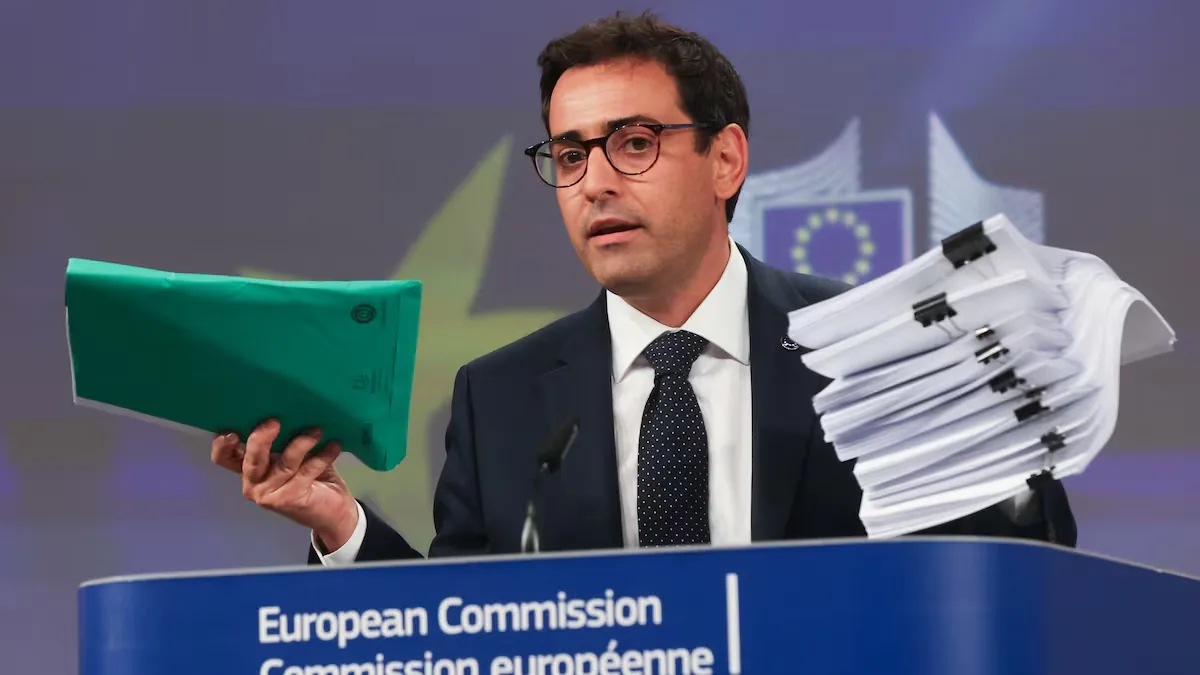
Geopolitics has also become the compass with which economic decisions are made in Brussels. This is clearly seen in the new regulation proposed by the European Commission this Wednesday, which seeks to give preference to products and services made in Europe in public procurement, especially in critical sectors such as energy, transport, or water. The goal is twofold: on one hand, it helps EU companies against global competition and, on the other and above all, it aims to strengthen economic security by reducing dependencies on other major powers like China.
What the Commission puts on the table with this rule, which is in line with the industrial acceleration regulation presented a few months ago, is to give public buyers (national governments, regional authorities, municipalities) the possibility to give an advantage in tenders to offers coming from Europe or even to veto the participation of companies from countries that do not apply reciprocal conditions, especially in key sectors such as energy, health, water, transport, shipbuilding, railway equipment, or the dual-use industry (civil and military). In principle, the restrictions that Brussels proposes do not oblige member states to adopt them, but they open the door wide. The Commission also reserves the right to propose to the EU Council the conversion of some aspects covered by the rule into mandatory ones.
In the proposed regulation, previewed by EL PAÍS in early July, Brussels includes as “covered countries” those that have signed free trade agreements with the EU that include public procurement and the states that have signed the World Trade Organization (WTO) Government Procurement Agreement. Under this latter umbrella are the 27 member states of the bloc, plus other countries such as the United States, United Kingdom, Japan, South Korea, Australia, Switzerland, and about a dozen more. The EU seeks to respect the principle of reciprocity and give the same treatment to European companies as to those from countries that, on paper, do the same. However, in recent years this type of protectionist measures has increased worldwide, including in associated countries, which is why Brussels also considers the possibility of excluding from this coverage those who do not respect reciprocity.
Another point concerns changes in tender criteria. The proposed regulation suggests that there be at least 30% quality criteria. This percentage can even reach 50%. Sources from Brussels explain that currently many tenders already apply this logic in practice, so the measure itself is not entirely new. What is done, therefore, is to provide legal certainty to public buyers and protect them against legal claims.
Read more Penélope Cruz, after the 15-minute ovation in Venice: “I am the most surprised by what is happening”
As with the industrial acceleration rule, all these steps have one consequence: making it more difficult for China to access the European market. The Asian giant is not explicitly mentioned in the rule − it cannot be if international law is to be respected − but the design of the measures leads to that result. For example, although Beijing is part of the WTO, it has not signed the public procurement agreement and there is no bilateral agreement signed on this matter either.
Tenders and public procurement are a very important economic policy tool that also allows governments and authorities to act directly in markets as key players. The regulation itself acknowledges this when it points out that public procurement accounts for around 15% of the EU’s GDP, about 2.6 trillion euros. “[This] makes public procurement an instrument to support the broader political objectives of the Union, including strengthening a highly competitive, resilient, and sustainable social market economy.”