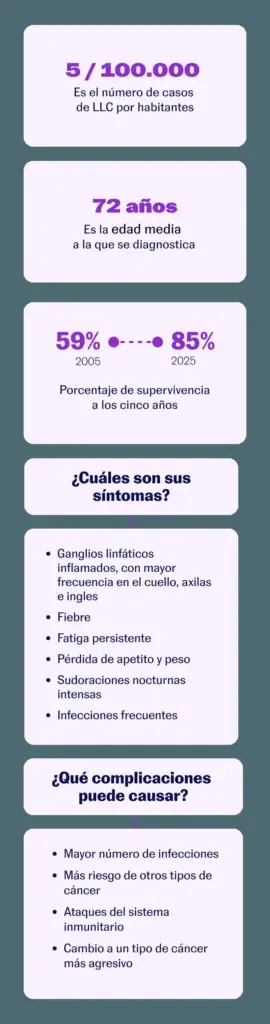
The history of oncology has been written with gradual advances that have led to an increase in overall cancer survival, as well as with major therapeutic leaps, such as precision medicine, which have marked a before and after in the approach to certain types of cancer. One of these is chronic lymphocytic leukemia (CLL). Five-year survival data for patients with CLL reveal this impact: it has gone from 59% in 2005 to 85% currently, according to data collected by the Spanish Society of Hematology and Hemotherapy in its report Advances in hematologic cancers.
Francesc Bosch, head of the Hematology department at Vall d’Hebron Hospital in Barcelona, places the definitive turning point in the last decade: “The understanding of the biology of CLL has translated into the development of highly targeted drugs that seek the weaknesses of the disease.”
The combination of mutations recorded in a cancer is unique to each person, and precision medicine applied to oncology is based on searching for those tumor genetic alterations to predict treatment response. In CLL, this has meant, in practice, moving from chemotherapy applied to all patients to personalized treatment. Therapeutic advances have also resulted in fewer side effects and, consequently, a better quality of life for patients.
What chronic lymphocytic leukemia consists of
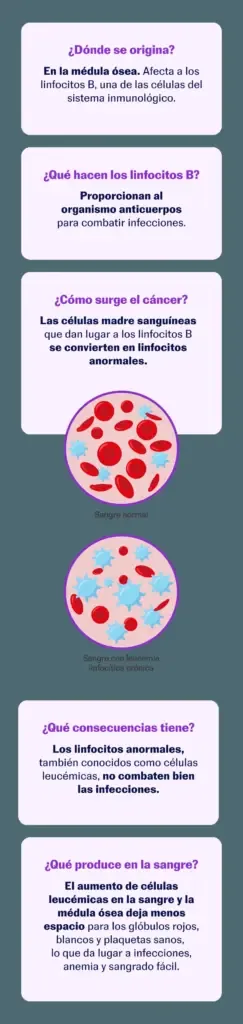
Leukemias are classified according to how quickly they develop and the cell in which they originate. Francesc Bosch explains that “chronic lymphocytic leukemia affects lymphocytes and the organs where these cells are located and, unlike acute leukemia, which manifests abruptly, CLL appears slowly, so many patients will not need treatment for their disease.”
When a person hears the word leukemia from their doctor’s voice, they do not expect the instruction to be an appointment in three or six months. In that person’s mind, the idea of cancer settles, a diagnosis that everyone automatically associates with receiving urgent treatment. But, in the case of CLL, active surveillance is part of the process. Jesús Pérez Viejo, psycho-oncologist and professor at the National Distance Education University (UNED), has observed that initial perplexity in many patients: “Sometimes it is difficult to integrate words like cancer and chronic disease because the patient does not expect to live with leukemia for life; the widespread idea we have of an oncological process is that if you don’t get cured, you die.”
“Chronic lymphocytic leukemia is one of the cancers with the best prognosis and the uncertainty of the diagnosis disappears if you know you are in good hands and if there is information about the path you will go through.”
How to manage that uncertainty is, according to clinicians and patient associations, one of the challenges in CLL. Julio González, president of the Chronic Lymphocytic Leukemia Patients Association (ASPALLC), has lived with it for 12 years and emphasizes the importance of the diagnosed person knowing the disease as well as possible to clear the dark clouds that tend to settle in the mind and find answers to the dozens of questions that arise: “Chronic lymphocytic leukemia is one of the cancers with the best prognosis and the uncertainty of the diagnosis disappears if you know you are in good hands and if there is information about the path you will go through.”
An involved patient and shared responsibility
The healthcare teams themselves, increasingly multidisciplinary, encourage patient involvement. That prominence belongs to them, and assuming it impacts, among other things, therapeutic adherence. “The more educated and involved the patient is, the greater the adherence,” says Dr. Bosch. Jesús Pérez Viejo, for his part, stresses that the benefits reach everyone involved in CLL: “Patient participation, especially in decision-making, improves their ability to cope with the disease and helps healthcare staff share their responsibility.”
“With the treatments we have, based on the genetic characteristics of the disease in each patient, the response is very fast: after a month or two the symptoms disappear and the patient notices a great improvement.”
Of all the people diagnosed with CLL, one third do not need treatment, and the decision to apply it depends on whether the disease is active or not, according to clinical guidelines; that is, whether the patient presents symptoms associated with leukemia, such as lymph node enlargement, anemia, or platelet decrease. If treatment has started, adherence is very important because there is a group of patients for whom therapy will be lifelong, just as in diseases like diabetes or hypertension.
Although the adverse effects of these therapies are far from those caused by chemotherapy, they still exist, as with any chronic treatment. Hence specialists value one of the changes recorded in recent years: the incorporation of time-limited treatments based on the combination of different existing therapies. “With a fixed-duration therapy, toxicity for the patient is saved and the possibility of developing resistance to treatment is avoided,” Bosch points out.
Chronic lymphocytic leukemia (CLL), in data
Along with therapeutic advances in recent years has come increasingly comprehensive care for patients. Jesús Pérez Viejo specifies: “Cancer affects all areas of life, from family to work, and there are times when treatments or disease progression require specialized emotional support.”
Psycho-oncology professionals have an increasingly prominent role in that accompaniment. It is about living and doing so with quality of life, and in achieving that goal emotional well-being is fundamental. Pérez Viejo comments that the psycho-oncologist can resolve many of the fears experienced by the patient and their environment: “CLL involves symptoms that generate psychological challenges, as there is immunosuppression and infections must be guarded against. Sometimes, this generates insecurity in many patients because they fear contagion, which makes them avoid certain places and leads to consequent isolation.”
“Patient participation, especially in decision-making, improves their ability to cope with the disease and helps healthcare staff share their responsibility.”
With 12 years of experience living with CLL, Julio González recommends having “a personal toolbox” to face an unwanted but inevitable relationship, such as leukemia. That toolbox helps him face the repercussions of the disease in all the areas in which he operates. Thus, for people who are still working, he recommends being clear that “the diagnosis is part of private medical information and it is the patient who decides what to share, with whom, and when.” If flexibility is needed for check-ups or tests, he points out that the best approach is to be practical: “I need such a day or such a time slot. Solutions must be proposed. Less drama, more clarity.”
Patients, associations like ASPALLC, and professionals who care for people with CLL consider that there are still unmet needs, mainly related to the lack of equity in access to comprehensive support. “There are places where the possibility of consulting a psycho-oncologist simply does not exist and information for patients is limited to a rushed consultation every four months,” Julio González points out. Other needs to be met reach other often ignored but important areas, which Jesús Pérez Viejo specifies: “They have to do with work, the economic cost of an oncological disease, or even sexological problems that may arise and that initially are not a priority but affect quality of life.”
Everything adds up in the comprehensive approach to a disease, CLL, whose horizon is increasingly tinged with green. Research and professionals involved in the oncological process have managed to drastically prolong survival and improve patients’ quality of life, but they have not forgotten the ultimate goal, which Francesc Bosch points out as a doctor: “A lot of research is done on CLL because it remains the most common leukemia in adults, but our ultimate goal is to cure it.”