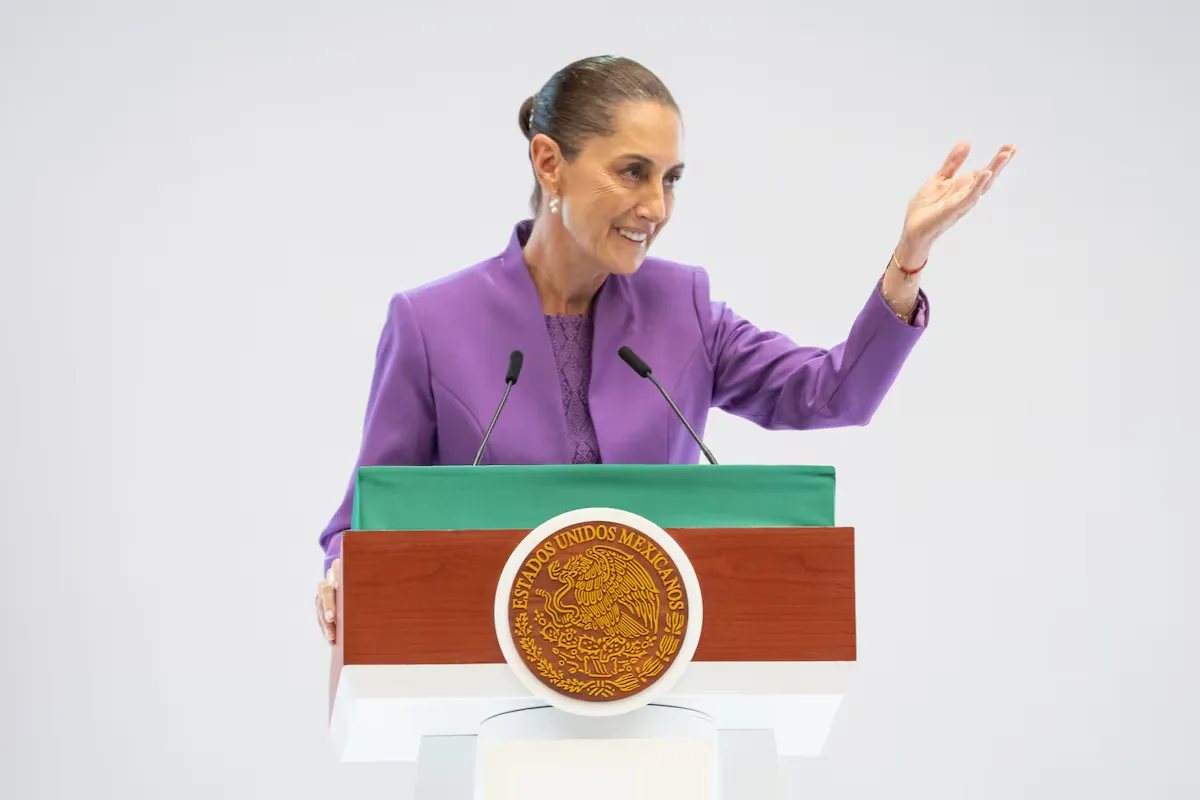
Reports are no longer what they used to be. And yes, I say this with the nostalgia of someone who respects institutions and the symbolism that comes with them. On Tuesday, September 1, President Claudia Sheinbaum gave her message about the second Government report that she would deliver that same afternoon to the Congress of the Union.
Read more In Panama, there is plenty of water, but it is missing from the taps
She began the message with some economic figures, which were to be expected given the habit of prioritizing narrative over reality. But these lines will not focus on the strength of the exchange rate, nor on the imaginary virtue of reaching an unemployment rate of 2.7%, nor on the 1.9% economic growth that only corresponds to the second quarter of this year. These lines will focus on love.
Yes, the president expressed a memorable phrase in her second report: having turned love into public policy. I suppose for some the image is powerful, those who write speeches must have suggested that appealing to emotion is more effective than appealing to evidence. It may be. But like any catchy phrase, it is worth subjecting it to the scrutiny of data. And there the numbers tell a less moving story.
We have not turned love into public policy. Instead, we have turned the absence of growth, productivity, and public services into a huge, growing, and costly network of monetary transfers.
It is enough to review the catalog of welfare programs to understand the magnitude of the phenomenon. There are already at least a dozen direct cash transfers: the Pension for Older Adults that grants 6,400 pesos bimonthly to those over 65 years old, the Women’s Welfare Pension that gives 3,100 bimonthly to women between 60 and 64 years old, the Disability Pension of 3,300 pesos bimonthly, the scholarships — which are not scholarships but transfer programs — Rita Cetina for primary and secondary education, Benito Juárez scholarships for high school, Young People Writing the Future scholarships for higher education, the Working Mothers Program, the Young People Building the Future scholarships for those who neither study nor work, the program The Youth Unite the Neighborhood — operated by the Secretariat of Security and Citizen Protection — with amounts up to 15,000 pesos monthly for municipal leaders.
To these programs, all monetary transfers, are added some agricultural programs such as Sembrando Vida, Production for Welfare, Fertilizers for Welfare (this is delivered in kind), and the microcredits of the Welfare Tandas.
The list is long and growing. Its impact on the budget will also grow given the constitutionality of the programs and their mandated inflationary increase. Each program, taken in isolation, responds to a real and in many cases urgent need: old age without sufficient savings, labor informality, educational lag, rural precariousness. The problem is not the existence of social policy — no serious country does without it — but its relative size compared to the almost total absence of other policies that should be investigating causes and not just alleviating symptoms and causing side effects.
Read more Orphan and mother of four siblings at 18: the life of Heidy Rojas after the earthquake in Chocó
We must distinguish between the various existing programs; not all are the same. On one hand, there are services: IMSS-Welfare, Benito Juárez García Universities, Internet for Welfare. These are public goods, in the strict sense, and their expansion, if executed with precision and quality, is desirable in any development strategy. But on the other hand, there is the majority of the catalog programs based on direct monetary transfers, without relevant productive conditionality, which seek to compensate income that the labor market is not generating due to deficits inherent in social development policies, such as health or education.
There lies the core of the argument. If the Mexican economy grew steadily above 3% annually — something that has not been consistently achieved in two decades —, if informality did not exceed more than half of the employed population, if total factor productivity advanced instead of falling, the need to sustain the income of millions of people with public transfers would be substantially lower.
A Young People Building the Future program with 9,582 pesos monthly would not be necessary on the current scale if the economy generated enough formal employment for the thousands of young people who join the labor force year after year and that the formal sector fails to absorb. A Women’s Welfare Pension would not compensate, to the same degree, the gap in female labor participation if it were not limited by the lack of affordable care, adequate leave, and flexible work schemes. If agricultural and livestock policy in recent decades had bet on productivity and water infrastructure, perhaps the supports would not be necessary to the extent they currently exist and productive distortions would be smaller.
In other words: each monetary transfer is, in some sense, a confession of the failure of another public policy that should have worked before and did not. Love, in the presidential rhetoric, appears precisely where the economy failed: in old age without sufficient pension, in the young person without employment, in the farmer who has no access to credit, or in mothers who have no daycare centers that allow them to delegate their caregiving tasks to some extent. It is not that love is a bad word to name the solidarity that a State owes its most vulnerable population. But calling “love” what is really compensatory policy hides an uncomfortable question. Why after so much time do we still need to expand year after year the number and amount of transfers instead of having a vigorous economy that makes them less necessary? Could it be, perhaps, that “love” seeks an electoral return?
There is also a fiscal sustainability problem that the rhetoric of love does not solve. One trillion pesos allocated to Welfare Programs, according to figures from the Report itself, is an amount that competes for budget space with investment in productive infrastructure, science, and the quality — not just coverage — of public education. Well-designed social policy is not the enemy of growth; but social policy that replaces growth, instead of complementing it, has an expiration date, because it depends on oil, tax, or debt revenues that do not grow at the same pace as beneficiary registries.
That is exactly the point that the presidential phrase does not resolve. Turning love into public policy sounds good in a Government report, but it does not replace the much harder and much less photogenic task of turning productivity, formality, and investment into public policy. When that happens, we will know that we do not need so much love, because the economy will have finally begun to love Mexico with actions and not just with transfers.
Read more Why dermatologists recommend introducing a retinol night cream into the routine at the end of summer