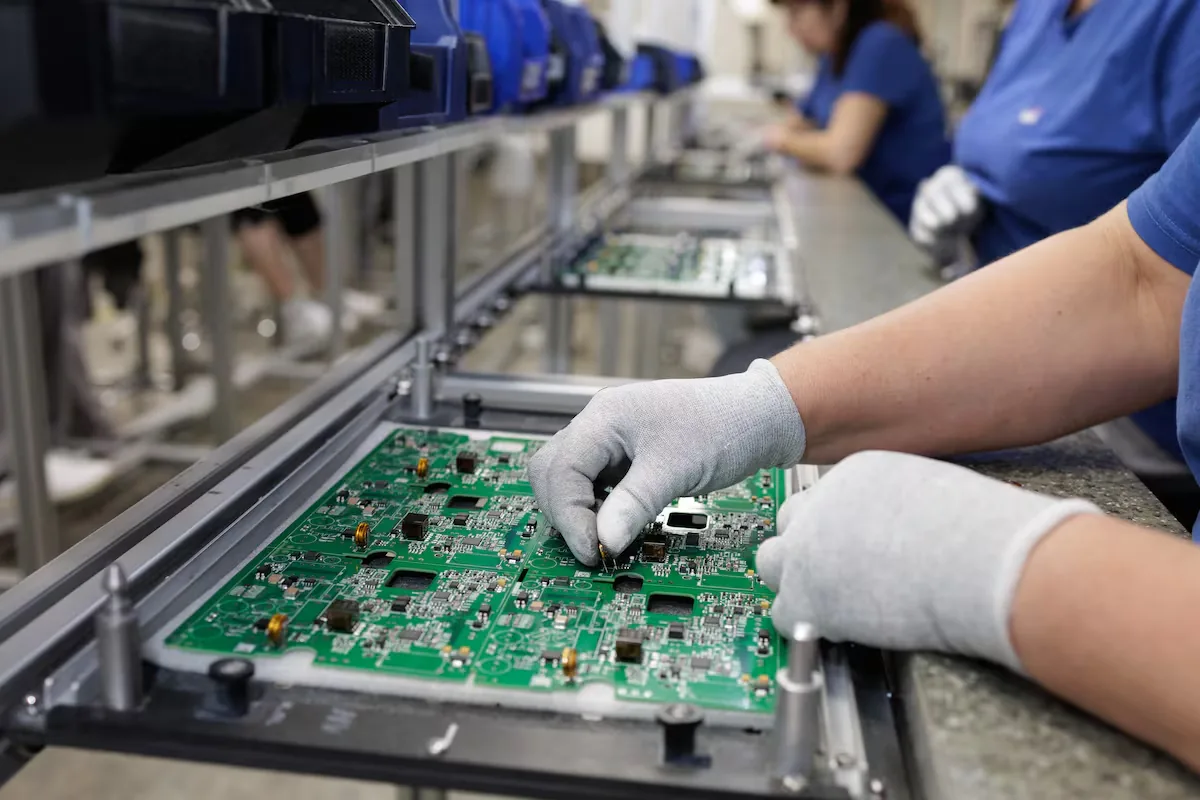
Mexico faces a new scenario for the destination of its exports with the rise of Artificial Intelligence (AI). Exports of computing equipment for the use of this technology have grown by 172% in the first half of 2026 and have reached 82.9 billion dollars, according to a report by S&P. The majority of these products – 93.9% – are sent to the United States, its main trading partner and where AI has gained notable relevance. Shipments of these computing products have surpassed, for the first time, the export of automobiles and auto parts, which in the first six months of the year have recorded 74.8 billion dollars and go against the tide amid Donald Trump’s tariffs.
The Latin American country has stood out in the last 30 years as an important supplier of manufactures for North America, driven mainly by the free trade agreement with the United States and Canada (USMCA). The industry that had taken the lead in that period was the automotive industry, which proved that integration between the three countries was possible: a car can cross the borders up to eight times until it is fully assembled. The new data show the automotive sector with some difficulties and a new sector, with different characteristics, taking the lead. “In Mexico we do not produce the entire chain, but it has the advantage that there are industries integrated with the United States,” warns Julio Ruiz, chief economist at Citi in Mexico.
The growth of Mexico’s exports of computing products is explained from Taiwan. The Asian island has found in the Latin American country a way to introduce its products to the United States, tariff-free, thanks to the USMCA. Taiwan manufactures cutting-edge chips used by firms such as Apple, Nvidia, and AMD, as well as other semiconductors. These are assembled into platforms or servers in Mexico and then sent across the northern border. “The evidence suggests that the country has consolidated itself as an assembly platform close to the U.S. market, while design, technological integration, and supply chain coordination activities remain concentrated in Asia,” explains a Banamex report.
This leaves Mexico as the assembler of the technology that data centers installed in the United States require. Although the shift in exports favors the trade balance of the Latin American country, the evolution towards the production of high value-added goods is blurred. “Participation in the final stages of manufacturing generates production, employment, and exports, but most of the value tends to concentrate in segments associated with technological development, intellectual property, and global coordination,” adds Banamex. The rise in exports of the computing sector is not yet significantly reflected in employment data.
Read more Presidential possession and military power (I)
The United States, which is in an open trade war with China, has monitored more closely the origin of the products it imports since Donald Trump’s return to the White House. It has even accused Mexico of being the springboard for Asian imports, but has not protested imports in the technology industry, despite a good part of its components not being North American. “Compared to the average of export manufacturing or the automotive industry, the server and computing equipment industry shows lower levels of domestic content, less local linkage, and a relatively reduced capture of added value. The evidence suggests that Mexico’s main attraction within this chain continues to be its function as an integration and assembly platform close to the U.S. supplier market,” points out Banamex.
Taiwanese authorities – who are in permanent conflict with China – have shown interest in continuing to invest in Mexico in the coming years. For example, they have their sights set on an industrial park in the State of Sonora. According to the latest data, the assembly of technological products has strengthened in recent months in states of the Bajío and the north of the country such as Ciudad Juárez (Chihuahua), Tijuana (Baja California), Reynosa (Tamaulipas), Zapopan (Jalisco), Apodaca (Nuevo León), and Mexicali (Baja California).
Additionally, various technology companies have increased their investments in Mexico for the installation of data centers, mainly in the Bajío region. Various analysts point out that these will require a more skilled workforce and an electrical supply capacity that the country has not yet reached. “The [electrical] grid that Mexico currently has barely meets the current demand. Without greater energy capacity, there will be no way to capture that window of opportunity,” warns Valeria Moy, director of the Mexican Institute for Competitiveness (IMCO), in a publication.
Read more The Supreme Court sets a precedent in environmental justice by taking on the Royal Caribbean case