









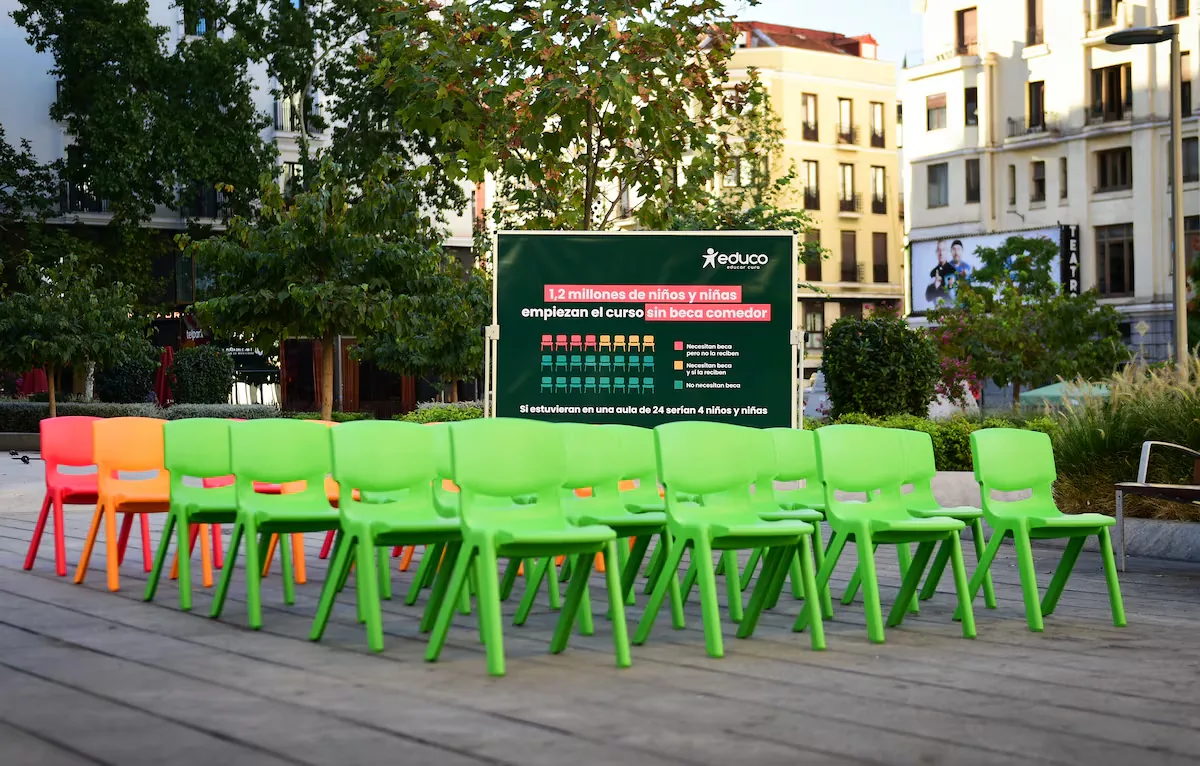
The start of the school year does not always mean, for everyone, access to the cafeteria. This is reflected in the report Back to school, back to the cafeteria?, by the NGO Educo, which estimates that 1.2 million children and adolescents at risk of poverty or social exclusion — 54.7% of vulnerable students — are left out of the scholarship and cafeteria aid system. In Spain, one in three minors (33.8%) is at risk of poverty or social exclusion, according to the dossier. Specifically, the organization calculates that more than two million enrolled minors are in this situation, of whom 981,000 receive some type of financial aid.
Pilar Orenes, general director of Educo, points out that Compulsory Secondary Education (ESO) is the stage that presents the most difficulties in accessing this service: most vulnerable minors who do not receive these aids study in this cycle, where only 18% of public schools have a school cafeteria. “These children come from a summer in which they had fewer leisure opportunities than their classmates, many of them have been in homes that are not prepared for the extreme heat waves we have experienced. Now, at the start of the school year, they face another challenge that puts them at a clear disadvantage: not having access to school meals and the midday space,” Orenes explains in a statement.
The inequality in obtaining cafeteria aid varies depending on the autonomous community. The largest gaps between the proportion of minors at risk of poverty or social exclusion and the reach of the aid are recorded, according to the report, in Melilla, where 60.2% of minors are in this situation, compared to 2.8% of students who receive cafeteria scholarships. Following are Murcia (44.6% versus 2.3%), Ceuta (40.9% versus 7.2%), Castilla-La Mancha (43.4% versus 8.4%) and Extremadura, with 34.7% of vulnerable students and where aid only reaches 0.58%, five regions with scarce aid despite their high rates of poverty or social exclusion.
The situation is more balanced in Galicia and the Basque Country, territories where there is a closer relationship between the dimension of vulnerability and the reach of aid, according to the NGO. In an intermediate position are Catalonia, the Canary Islands, and the Valencian Community, with notable percentages of scholarship students but also high rates of child poverty.
The report demands that, given this diverse situation, universal free cafeteria access should be a goal to achieve for all of Spain. To support this, Educo assures that it is a costly but affordable measure, given the importance of this service in the health, development, and school performance of minors. The NGO’s calculations show that guaranteeing this access universally would cost 6.165 billion euros per school year, equivalent to 0.37% of the national GDP. Spain currently allocates 4.34% of its GDP to education, below the European Union average, which stands at 4.65%. If the cafeteria cost were included, Spanish educational spending would rise to 4.71%, according to Educo’s calculations, slightly above the European average and still below countries like Sweden (6.8%) and Finland (6.29%), which guarantee universal school cafeteria access in compulsory educational stages.
Achieving universal access to food at school would be a relief for families who not only cannot offer their children a healthy and balanced diet but also need to balance their roles as mothers and fathers with their work life. This is the case of Leudymar, who explains that before receiving the aid, she had to pick up her children at noon and prepare their meals before taking them back to school activities. “When I didn’t have the Educo scholarship, I couldn’t work because no job would offer me a schedule that allowed me to be home at 12 to pick up the children,” she says in a testimony provided by the NGO. The scholarship, she adds, allowed her to access an eight-hour workday and not worry about her children’s meals during the school day, which has meant a “relief” from the “physical exhaustion” she experienced.