









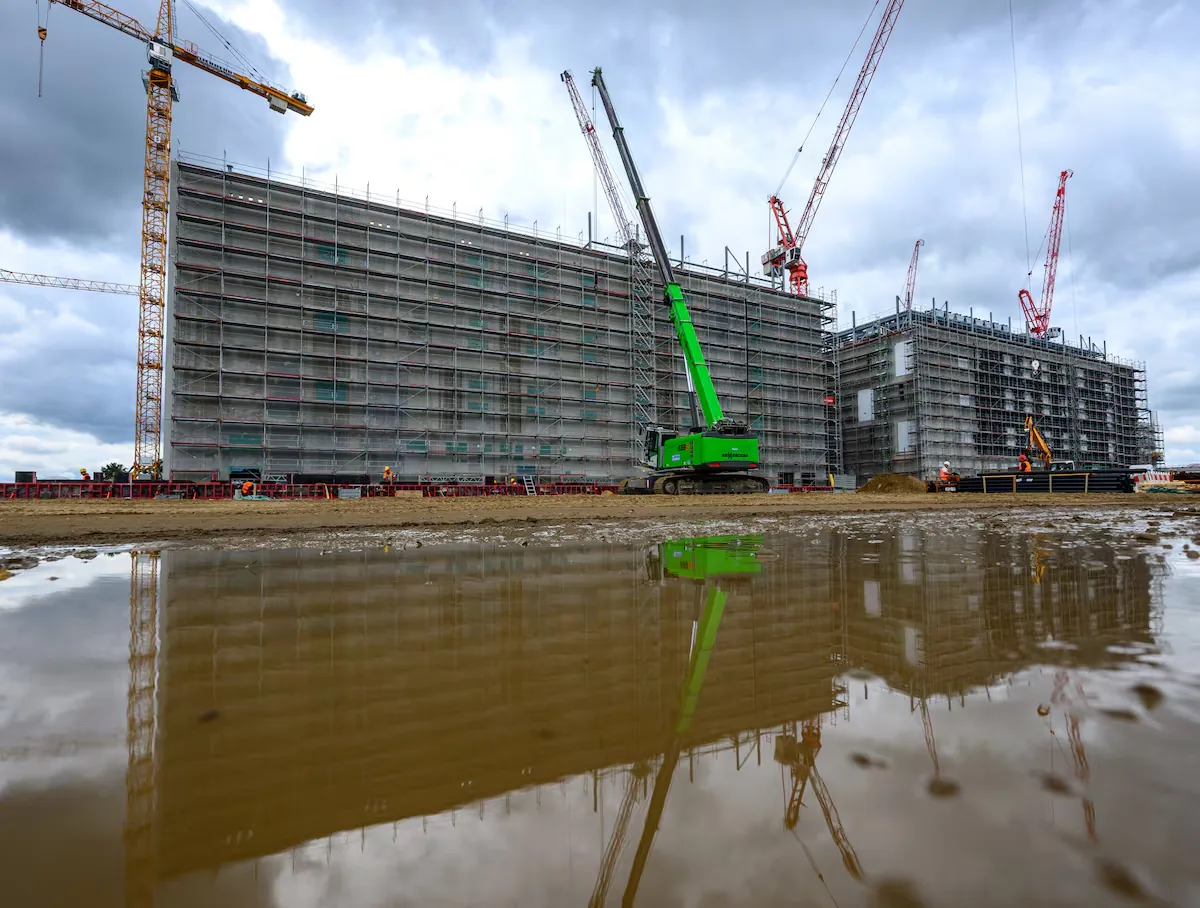
The time of picks and shovels has arrived for artificial intelligence (AI). During the California gold rush, merchants of these tools saw their business soar, driven by the frenzied demand for instruments to extract the mineral. The industry supporting ChatGPT or Claude is going through a very similar moment. The race to build the best large language model depends not only on thousands of lines of code but on a complex ecosystem that consumes electricity and demands chips, water, networks, land, concrete, minerals, permits, and a supply chain that never rests a single day.
Read more Man arrested accused of threatening Jorge Quiroz, Kast’s Minister of Finance, on social media
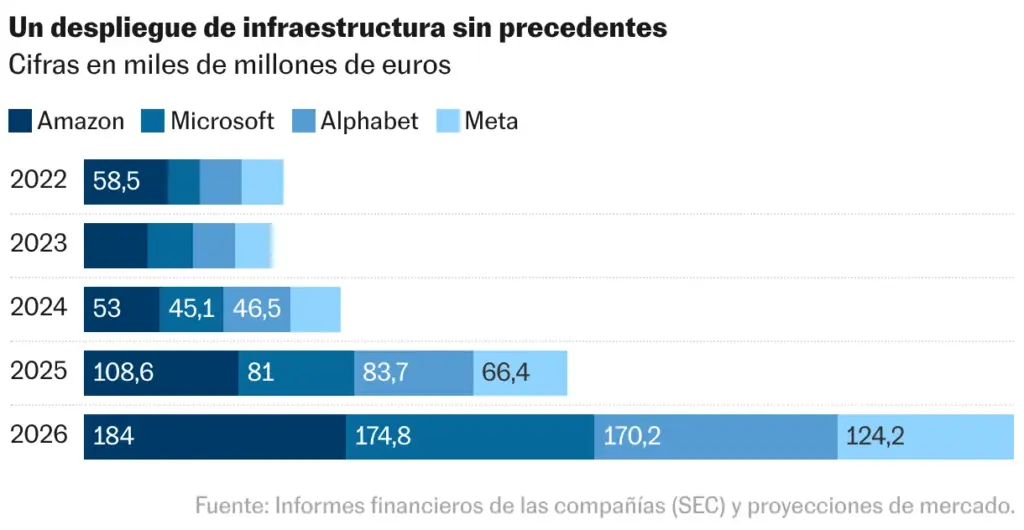
The race to lead the new technology has unleashed unprecedented investment in infrastructure and semiconductors, crucial for the operation of conversational assistants, and, in parallel, has raised alarms about the energy impact these systems could cause in the long term. Consulting firm Gartner predicts that global spending on this technology will increase to reach $2.59 trillion (about €2.27 trillion) in 2026, of which 1.43 trillion will be allocated to infrastructure. This latter amount is approximately 4.6 times the Apollo Program, adjusted for current inflation.
The calculations that bring models like Gemini —Google’s AI— to life are run on gigantic server farms spread across the planet, though especially concentrated in the United States. The so-called MANGOS (an acronym for Meta, Anthropic, Nvidia, Google, OpenAI, and SpaceX) keep excavators and bulldozers working day and night to build hyperscale centers that, unlike traditional data centers, are designed to withstand very high heat and provide the necessary power for the processes AI demands. Only Amazon, Alphabet, Meta, and Microsoft plan to invest €630 billion this year, compared to €360 billion in 2025. And, according to United Nations estimates, the land needed globally to deploy these buildings in the United States will exceed 14,500 square kilometers, about 10 times Mexico City.
This frenzy to erect infrastructure responds to the industry’s obsession with achieving more computing power. For Boris Gamazaychikov, co-founder of the consulting firm Sustainable AI Group, focused on understanding the energy consumption of these facilities, the problem lies in the growth model chosen by the major AI labs like OpenAI or Anthropic: relentlessly increasing the scale of their models. When the company led by Sam Altman designed the first version of ChatGPT in 2018, the conversational chatbot —which never left the labs— had been trained with 117 million parameters, a figure already considered a milestone in natural language processing. The leap since then has been exponential. The newly announced Chinese language model Kimi K3, from the company Moonshot, was trained with 2.6 trillion parameters, a thousand times more than the primitive GPT-1. “The size of the model is something that often determines its energy use,” Gamazaychikov notes.
This explains why the sector is betting everything on these gigantic campuses that house kilometers of servers. “Before the rise of generative AI, data centers were already growing and proliferating, though at a slow pace,” writes journalist Karen Hao in The AI Empire. “They were small and located in a few refurbished buildings in a few cities.
Neighborhood complaints
Attracted by regulatory ease and the abundance of flat, cheap land, large companies have now chosen to fill the southern United States with these mega-infrastructures, which has fueled local residents’ discontent. Neighbors fear that the expansion of these centers and their voracious energy demand will end up punishing families, forcing them to bear the extra cost if AI investments ultimately prove unprofitable. Residents also complain about the noise generated by the huge fans or the water evaporation systems needed to cool the servers. The xAI data center —Elon Musk’s company— for example, was built adjacent to the locality of Boxtown (Tennessee), where it was reported that the gas turbines needed to power the project emitted pollutants that directly affected residents, Reuters indicates.
“For years we talked about the cloud —the digital space where AI requests are executed— as if it were something ethereal, almost clean and weightless. Now we are beginning to understand its true materiality,” explains Enrique Dans, Innovation professor at IE University. The water consumed by these infrastructures has become one of the main criticisms surrounding this industry. Only in Texas, data centers will go from 49 billion gallons (185 billion liters) to 399 billion in 2030 (1.5 trillion liters), according to research by Houston Advanced Research Center (HARC). To understand the magnitude of the challenge, one of the most authoritative voices is Professor Shaolei Ren, professor at the University of California in Riverside, who has been documenting the water footprint of technology for years. He explains that what worries him most looking toward 2030 is not only the total annual consumption of the water resource, “but whether local water and electricity systems will be able to cope with demand peaks during heat and drought periods. Many community systems are not prepared to face the new demand at an industrial scale,” details the academic. It is estimated that 40% of new projects in the US are located in water-stressed areas, according to Business Insider research.
Popular discontent has only increased. Only between January and March of this year, protesters blocked or delayed 75 projects in the US valued at $115 billion, according to a Data Center Watch report. At the current growth rate, Hao maintains, it is expected that by 2030 these types of facilities will use 8% of the country’s energy, compared to 3% used in 2022.
Spain is not immune to this picture. The SpainDC employers’ association estimates that the country will attract €66.9 billion by 2030 and will multiply the capacity of its data centers by six. Aragon, in particular, already concentrates a third of the planned projects on the Iberian Peninsula; Amazon alone will invest €33.7 billion in this region. The NGO Ecologistas en Acción estimates that the Aragonese government plans up to 35 such facilities. Another example is Meta, which will build its fourth European data center in Talavera de la Reina (Toledo), with an investment close to €750 million. The Castilla-La Mancha government definitively approved the project in October 2024, although construction will not start until 2027.
Hardware on the podium
However, the land and energy needed to drive these megastructures are just two elements of the global supply chain demanded by AI. One must also consider the extraordinary volume of hardware —computers, cables, power lines, batteries, and generators— that this technology requires to continue expanding.
In particular, the AI frenzy has caused a seismic shift in the semiconductor industry, rewriting the list of winners and losers in this critical segment for the operation of conversational assistants. Data centers demand huge amounts of storage cards so that a model like ChatGPT can save users’ responses. And not just any type of memory, but a very special one called HBM (high bandwidth memory) composed of several chips stacked on top of each other so that information flows very fast. The drawback is that this component is manufactured by the same companies that produce RAM for mobiles and laptops: the Korean Samsung and SK Hynix and the American Micron, which are practically the only ones capable of assembling these pieces worldwide. Since these storage modules for AI are substantially more profitable, these firms have redirected their strategy so that most of the production focuses on meeting the demand of AI servers.
Currently, the frantic pace at which foundries (as chip manufacturers are known in the sector) operate is not enough to satisfy the relentless demand for RAM, a shortage that has begun to drive up consumer electronics prices. At the end of May, Micron announced that the prices of its RAM cards would rise by more than 60%. Everything points to consumers having to make a greater financial effort during the upcoming holidays to face the increases: the PlayStation Pro went from €799 to €900 at the beginning of April, and the latest Nintendo console will cost €30 more starting in September. The last company to announce increases was Apple, which will sell its laptops and tablets up to 15% more expensive. The Cupertino firm announced it could no longer absorb the cost of memory any longer.
Read more Enric Mas extends the gap with Roglic at La Pandera in the Vuelta a España
“The best time to buy a new phone was yesterday,” said Carl Pei, CEO of Nothing, the customizable terminal company, this past May. Pei explained that RAM now represents almost 50% of the manufacturing cost of a new terminal. “This year’s sales season will not have the discounts people are used to,” Pei assured in the digital media The Verge.
Small merchants like Vicente Ortega, who has repaired and sold computer parts in Valencia for three decades, already perceive congestion in the production chain: “In 20 years in the industry, I have noticed many occasional price increases, but never something as exaggerated and lasting as now.” Ortega comments that office and gaming computers have increased in price by 30% and 50%, respectively, due to the shortage of parts. “Many buyers are delaying the decision, and others are simply moving to the market for semi-new or second-hand PCs,” he notes.
Willy Shih, professor at Harvard Business School and supply chain expert, acknowledges that major manufacturers have already begun building new production plants to provide minimal relief to the market. “When they come online, there will be a chip surplus that will then cause prices to fall.” The problem is that the current demand required by the language model industry like ChatGPT is unparalleled in history and seems to overwhelm any forecasting capacity. Specialists are unable to set a date for when prices will begin to decline. Chris Miller, author of The Chip War and an authoritative voice in the semiconductor field, considers that “this is not simply a cycle but a structural increase in microprocessors —including memory ones— that the world needs,” so it is unclear if prices will deflate at some point. Ranjit Atwal, senior analyst at Gartner, anticipates that these increases will cause computer sales to fall by 12% this year. Low-end mobiles, meanwhile, “will become economically unviable” and cause a 10% drop in total smart terminal sales.
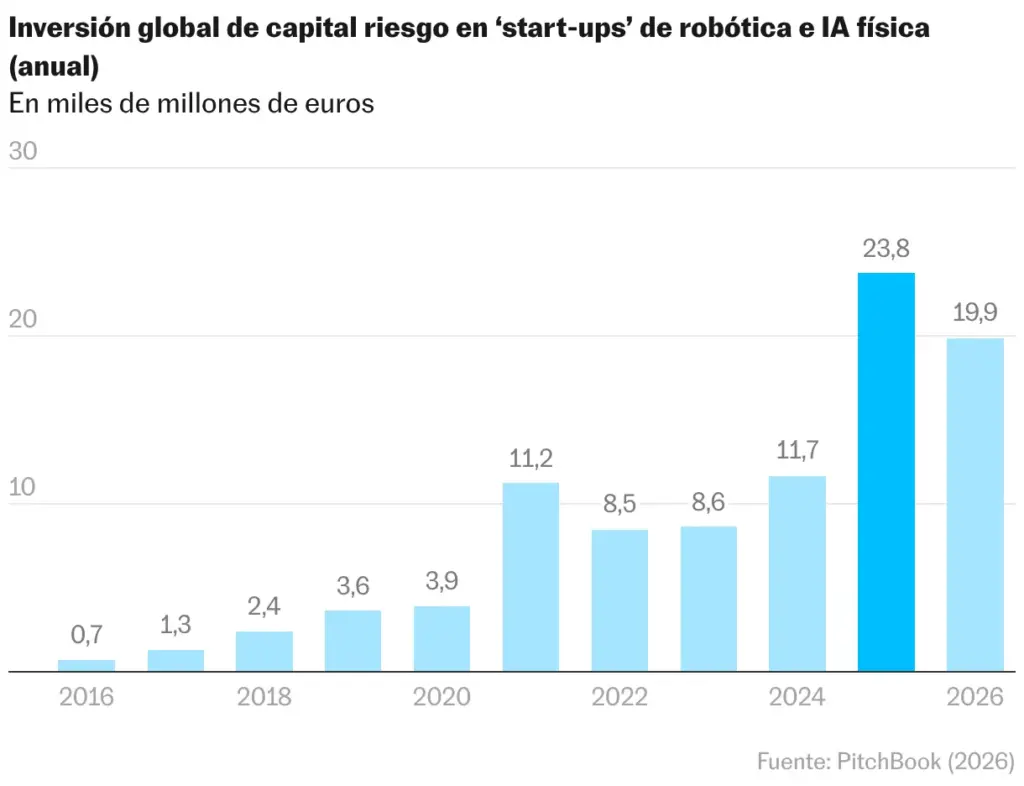
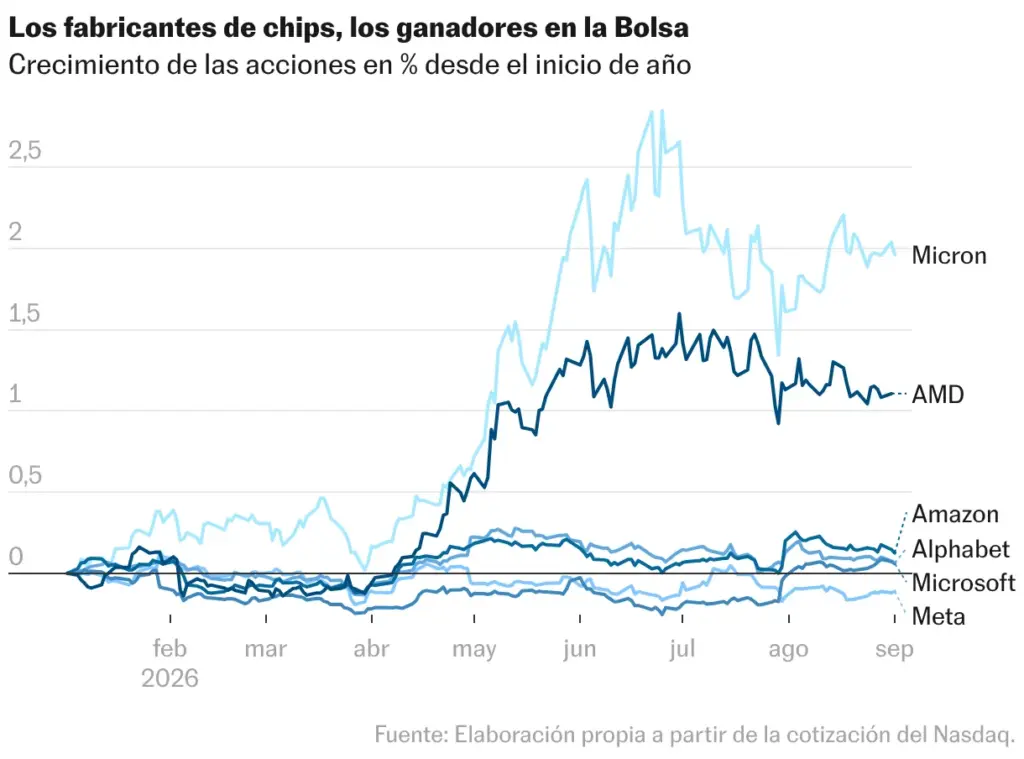
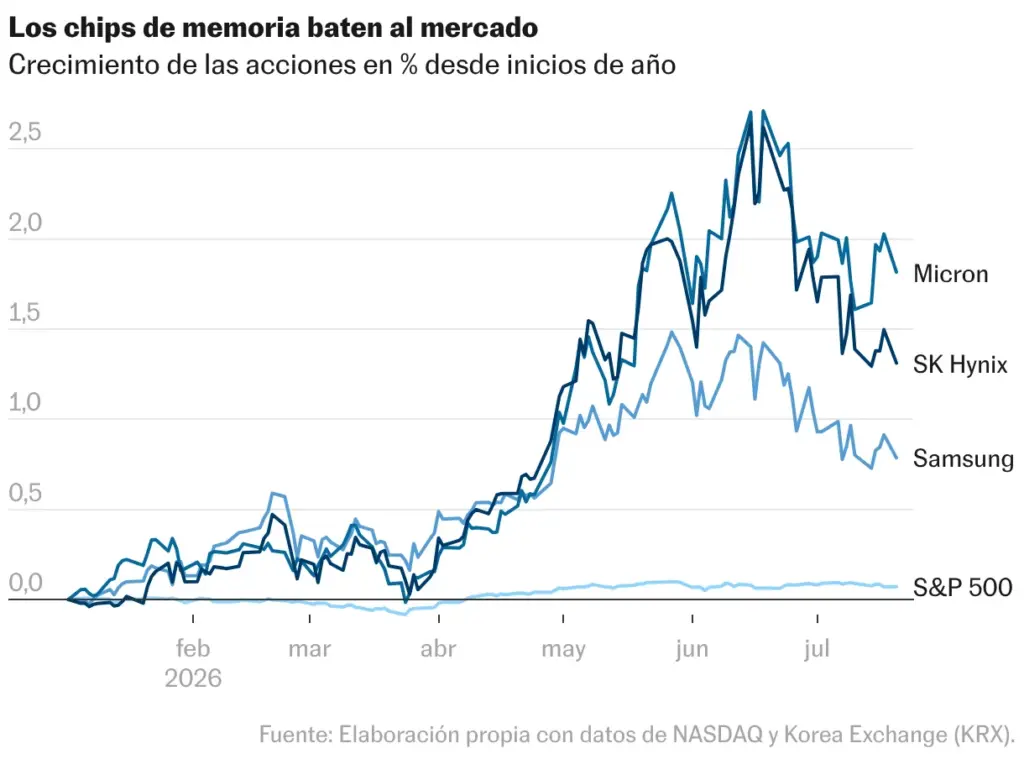
Despite the hit to consumers’ pockets, the good moment these foundries are experiencing is distributing record profits to most manufacturing firms. So far this year, Micron’s shares have risen 220%; SK Hynix’s, 160%, and Samsung’s, 100%. Wall Street seems to have assimilated that —at least for now— the opportunity lies in financing all the infrastructure underpinning AI development. And not only equity is being rewarded. According to PitchBook data, a platform that tracks private fund movements, venture capital investment in robotics and physical AI rose from about €3.7 billion in 2019 to nearly €24.2 billion in 2025. Only until May of this year, they had already raised more than €20.2 billion.
Hit to software
Paradoxically, every euro earned by infrastructure seems to come out of the pocket of the sector that for years spread smiles among investors: software. Internet service startups that for decades defined how the digital world worked have suffered significant drops in their stock value. Meta’s shares (parent of Facebook and Instagram) have cut their value by 10% in the last six months; Alphabet’s (Google) have fallen 5% so far this year, and Amazon has not managed to take off since late January. The most affected by the trend change have been the so-called SaaS (software as a service). Firms like Salesforce, Workday, Asana, or Monday, which for many years enchanted the market with programs that clients (mostly companies) paid for monthly, now see how AI allows their clients to integrate or custom-build those same management solutions at a fraction of the cost.
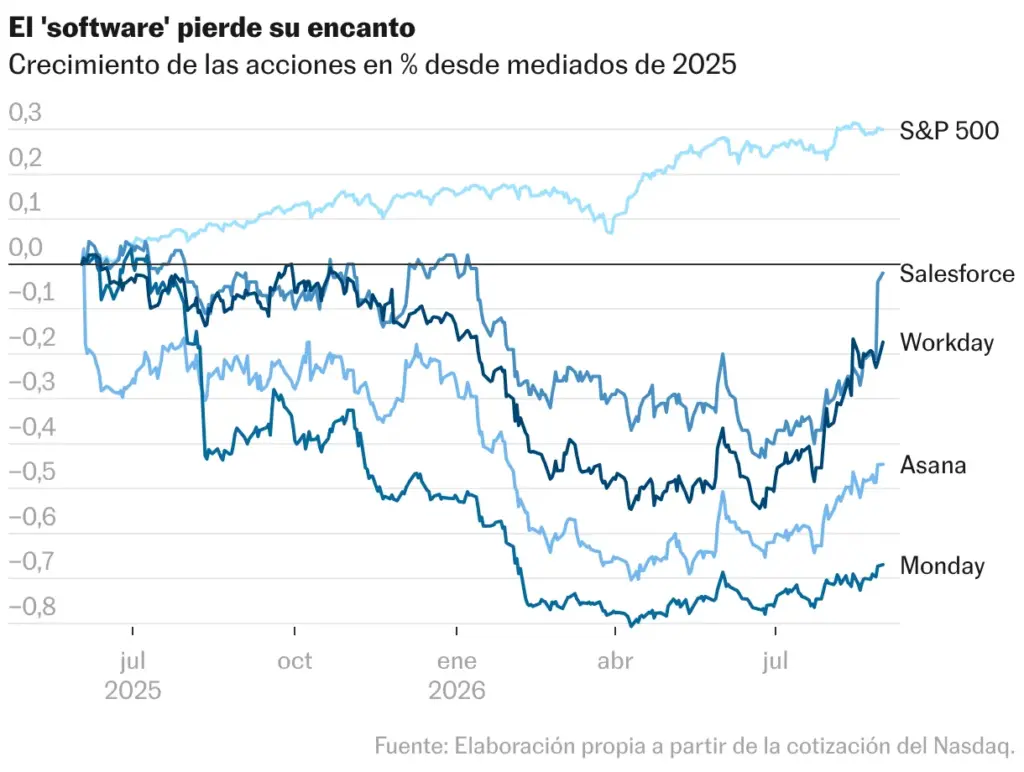
“For a long time, we lived with the idea that software was infinitely scalable, with marginal costs close to zero, fabulous profits, and an almost magical ability to capture value. And that was true to some extent. But AI has changed a significant part of that equation: writing code, integrating functionalities, automating processes, or even creating complete products has become much cheaper, faster, and more accessible,” Dans explains. His reflection is that a very important part of software that was previously categorized as the sector’s main attraction now begins to seem “just another feature, a replaceable layer.”
Even venture capital that used to look enthusiastically at SaaS companies or fintechs is beginning to change its mind about where to put money. Paradigm, the investment fund known for backing cryptocurrency companies like Coinbase and betting firms, recently made its first investment in the manufacturing sector, providing capital to SendCutSend, a company that manufactures metal sheets for robots and data centers. In parallel, Jeff Bezos founded Prometheus this year, a startup focused on developing AI systems capable of understanding and simulating the real world. The company builds what Bezos calls a “general artificial engineer,” software capable of automating the design and manufacture of complex physical systems, from jet engines to pharmaceutical compounds. They describe themselves as “AI for the physical economy.”
The latest jumps in the stock market have also shown enthusiasm for the physical part of AI. A good example is the successful IPO of chip manufacturer Cerebras and the startup Etched —which rivals Nvidia in semiconductor manufacturing for AI— as well as the arrival on the stock market of SpaceX —rocket assembler— which promises to generate historic profits, at least in the long term. Taiwanese firm TSMC, with a long track record in the industry, also recorded a second consecutive half-year of record profits, with a 75% increase in earnings.
The list of winners is long. Microprocessor manufacturer Intel reported its fastest revenue growth in 15 years at the end of July: its sales advanced 25% in the second quarter. “AI is driving unprecedented demand for computing capacity, and as we continue executing our strategy, Intel is well positioned to achieve sustainable growth,” said the tech CEO, Lip-Bu Tan.
Jensen Huang himself, president of Nvidia, declared on the All-In podcast in March that physical AI represents “the first opportunity for the tech industry to address a $50 trillion sector that has largely lacked [physical] technology until now.” The CEO of the company that reigns on the stock market and whose main activity is now designing chips specialized in training conversational assistants also assured earlier this year that “the ChatGPT moment for physical AI is about to arrive.”
Dans does not believe, despite everything, that the infrastructure world will absorb all the sector’s wealth. “There is a ceiling. It happened with railroads, with the internet, with mobile telephony, and it is happening now with AI. Whoever provides infrastructure at a time of scarcity has a fantastic position.” But he believes that, in the medium and long term, value tends to shift toward companies and users who manage to turn all that intelligence into something useful. While that happens, the sector celebrates its own gold rush.
Read more The perfect business of the “Ozempic era”: weight loss drugs, ultra-processed foods to gain weight