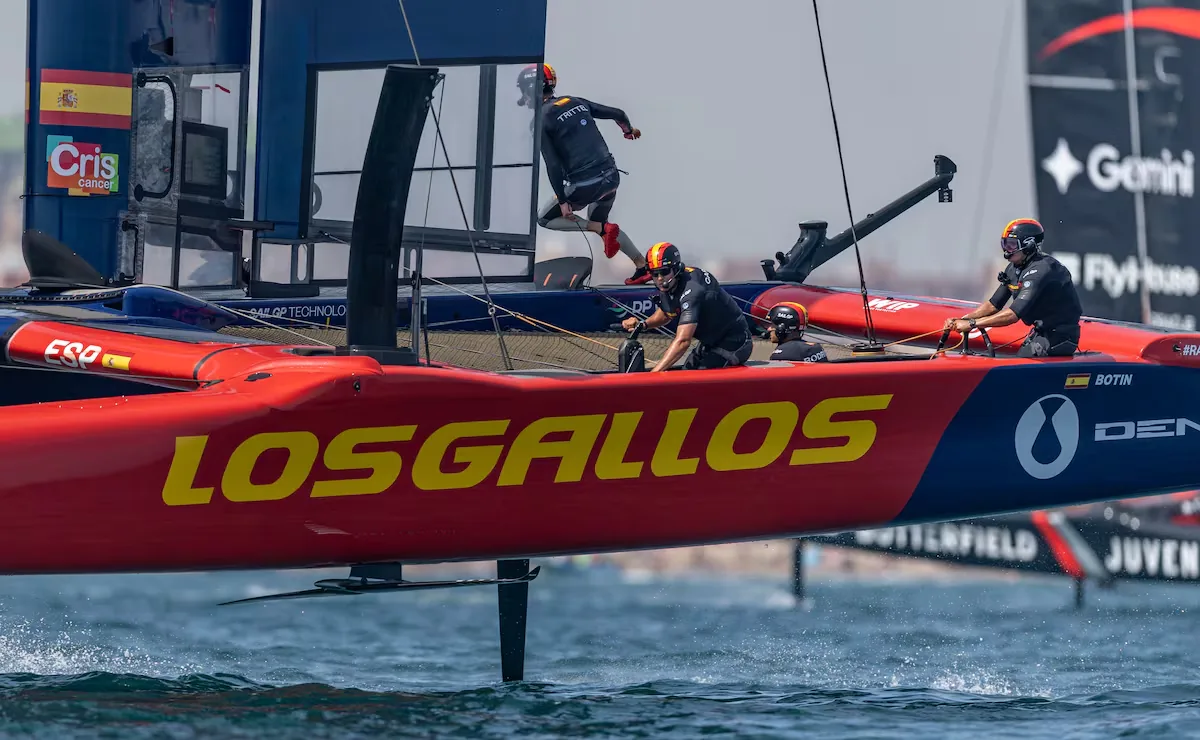
The Mediterranean is silk from Chengdu, minimally rippled by an invisible breeze cut, soft and firm like Lorenzo Caprile’s scissors, by the blades of Los Gallos, sharp foils, without violence or bites, and they whistle. It is a ballet of six giant catamarans on the boiling sea, and on the Malvarrosa beach, the bathers crowding it turn their backs on the chiringuitos where the paellas are roasting and, water up to their ankles, surrender hypnotized by the rustle of the flight of the F50 Victoria, the boat in which one of the best Spanish teams in any sport competes toe to toe with the best in the world in the most complicated competition. They start better than anyone and win two of the three races on the first day. One by a landslide; the second, wildly accelerating the scissors after going through moments of anguish. Plop, on the floats, in dead calm, the 14-kilometer-per-hour breeze suddenly disappeared, to surpass Denmark in a sprint decided in a photo finish. The Danes, the day’s great rivals, won the third, and the United States flanked both in all three.
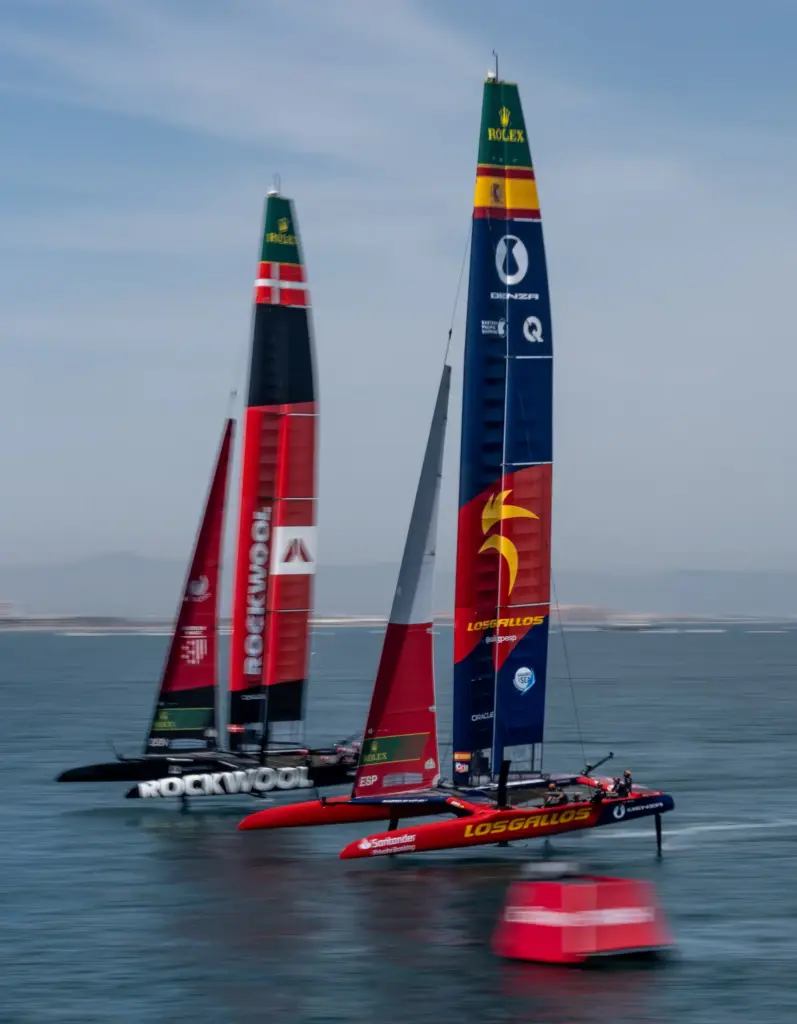
The 13 boats are divided into two groups. Seven in Spain’s, which leads with 14 points, against 12 Danes and 10 Americans, and six in the group of the great rival for the final overall, the flying kangaroos of Tom Slingsby and Hugh Jackman, unbeatable all year and leaders with Italy close in their group. The two races on Sunday (starting at 13:30, Vamos 2) will decide which four boats, two from each group, advance to the final. For Los Gallos — Diego Botín at the helm, Flo Trittel on the wing, Nicole van der Velden in strategy, Joel Rodríguez controlling the foil flight, and Joan Cardona on the grinder — competing for victory in a race on home turf would be historic.
“Our goal here in Valencia is to be in our seventh final of the year,” says Trittel. “It’s our dream because in SailGP we have won grand prizes, we have won the grand final, but we have never won at home and we haven’t even made a final at home. So it would be very nice and we are going to give it our all. We have to find a good balance between the additional social and public commitments and keep the focus on why we came, which is to perform.”
“We are very united, very focused and very concentrated on what we have to be on the water,” adds Van der Velden. “And that is a very positive point. It was today and it will be tomorrow as well, to secure the final.” With France, fourth, 10 points behind, the two spots for the final will be contested between Spain, Denmark, and the United States. Enough to simply think about watching two boats, a strategy that Botín, who only asks for more wind on Sunday, does not like. “Yes, both are our rivals to watch,” says the team’s best-known face, the one steering the wheel. But still, we only focus on ourselves. We’ll see if in the second race we have to think more about them or not, but we will definitely go out in the first race trying to win it.”
Despite the almost absence of the friendly wind, they found balance on the overheated Mediterranean water that scares the bathers and in which, while the danes that will thunder are cooking, they open up surrendered so the foils can happily cut them. “The warm water gives us more grip on the foils,” explains Botín after the races, calculating the time it will still take to strip off the combat uniform, riot police style with a bulletproof vest on which a burning sun violently clashes, and crying for the ice cubes already melted that he put between fabric and skin during the competition to lower body temperature. “There is a cold water temperature, between 14 and 16 degrees, in which navigation changes a lot. If it is colder, the water becomes more viscous. The foils ventilate more if you put a lot of angle of attack on them, and navigation is more delicate. So, well, only in that sense it is very good. And the salt water also gives us more grip.”
“Luckily, outside, with the wind, the heat is felt a little less than here on land, which is where it is worst,” adds Van der Velden, the team’s eyes, who, with Cardona and Botín more connected with the wind, and coach Simone Salvà sending data and instructions from the boat, controlled the rival boats more and communicated their position so their teammates wouldn’t get distracted looking outside. “We fight the heat with lots of hydration and we also always try to be on the side of the wing where we have shade when we are there waiting between races. And we also have Lu on the motorboat who is there to give us water and keep us cool.”
Read more Enric Mas extends the gap with Roglic at La Pandera in the Vuelta a España