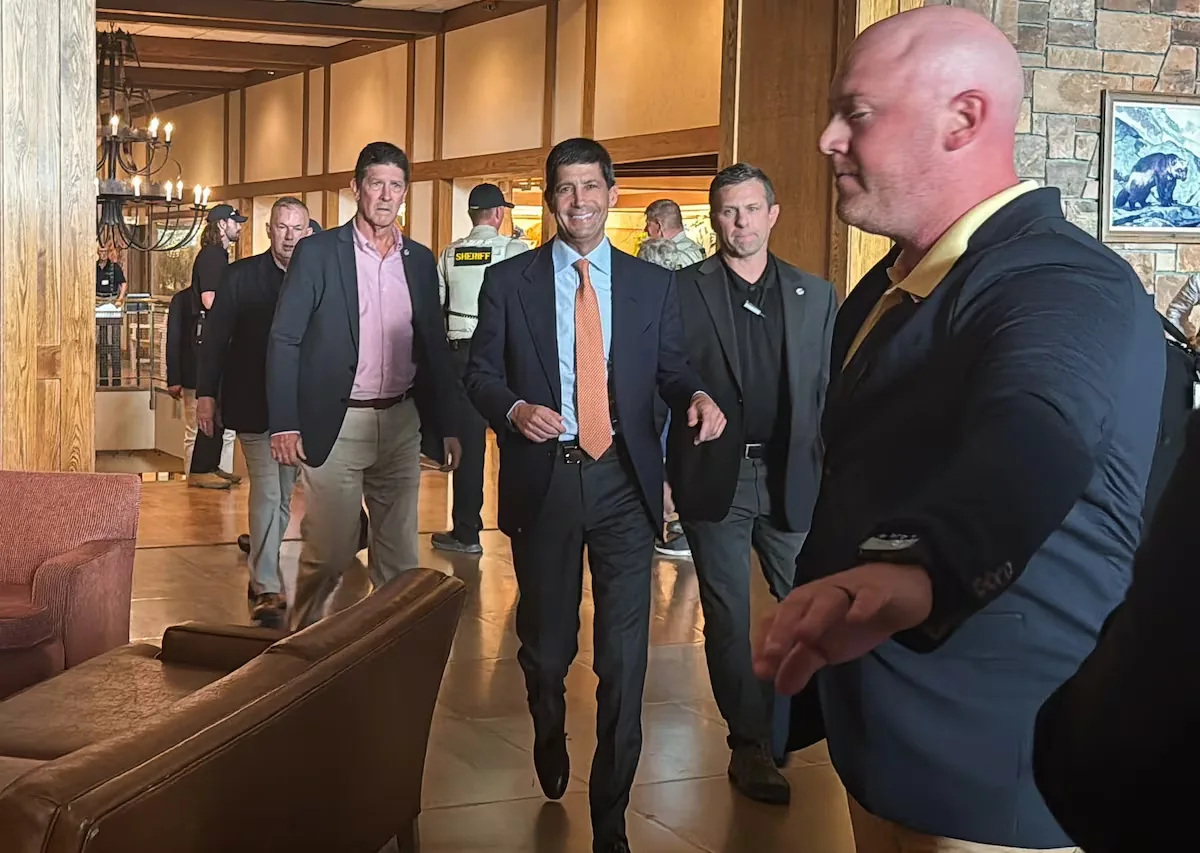
He has just arrived and already faces a difficult crossroads. Investors were attentively awaiting the speech of the new chairman of the United States Federal Reserve (Fed), Kevin Warsh, this Friday at the central bankers’ conclave held every summer in Jackson Hole, in the Wyoming mountains. The newcomer inherits a devilish puzzle. Growth forecasts full of doubts, a war in Iran with no expiration date, inflation above the 2% target, and a strained debt market make up the cocktail he has to deal with. Faced with this complex scenario, Warsh has shed some light on his next steps. The 56-year-old economist has shown his willingness to do whatever it takes to contain the rise in prices.
Read more The death of Ratko Mladic: hero’s honors in Serbia, painful memory in Bosnia
The interest in this event was to find out if the new Fed chairman would give any indication about future interest rate hikes to contain inflation, risking provoking the fury of President Donald Trump. The result ranges between “yes, with nuances” and “we’ll see.” Warsh did not utter the three magic words (interest rates), but he did show genuine concern about inflation and gave the market a much clearer signal than on other occasions when, on the contrary, he refrained from giving hints.
“It is the Federal Reserve’s responsibility to ensure price stability. There are no excuses,” he said. Whoever wants to understand these words, let them understand: Warsh commits his credibility to achieving inflation moving toward the 2% target. And if that requires raising the cost of money and angering the White House occupant, who criticized his predecessor Jerome Powell for the same, then he will have to do it. “This is my judgment: we must be certain that core inflation is moving toward our target clearly and at a sufficient speed. Otherwise, we have work to do. That is our job,” he added.
The markets responded immediately. As soon as Warsh finished speaking, CME Group futures market prices, which analyze the probabilities of upcoming moves, were already pricing in the change in tone: they went from showing an implied probability of a rate hike of 35% on Thursday to 57% the next day.
Warsh showed some relief in his speech that the inflation data known this summer were better than expected, but that does not seem enough for him. “Those indicators do not tell me that core inflation has substantially improved. […] Markets show their confidence that we will achieve price stability. And I can assure you they are right,” he stated.
Storm in the debt market
Warsh’s arrival at the top of the United States central bank coincides with a stormy moment in global debt markets. Economic uncertainty grips all agents. The closure of the Strait of Hormuz due to the Iran war, a zone through which, until Washington attacked Tehran last February, 20% of the world’s oil circulated, has worsened inflationary tensions worldwide. In these circumstances, institutional investors are demanding increasingly higher interest rates to lend debt.
The 30-year United States bond trades at its highest level since mid-2007, at 5.3%; the German bond at the same term reaches 2011 highs, the British 1998 highs, and the French 2008 highs. The imbalance of public accounts and the growing debt burden that technology companies are assuming in their bet on artificial intelligence add to inflation prospects to raise long-term interest rates.
In this context, investors expected Warsh to make it clear that he is not willing to tolerate inflation whims. Even if that meant a clash with Trump, as happened to his predecessor. The chairman, a deep Wall Street expert, saved the match point by announcing his commitment against inflation; if he had not sent that signal, markets would surely have responded to show their discontent.
The Fed chief insisted in Jackson Hole that the institution he leads has failed in its inflation goals for too long. “There is a signal that no one can overlook: the responsibility for 65 months of high and sustained inflation falls directly on the central bank,” he assured. In that context, he suggested that if no progress is made, he will have to raise interest rates from their current level, between 3.5% and 3.75%. “Price stability is not guaranteed by itself,” he said firmly.
Before Warsh spoke, three senior central bank officials had already warned of the risks of prices persistently deviating from the target, but until now the Fed chairman had not spoken so clearly on the matter.
At the July 29 meeting, the Federal Reserve decided, by a majority of nine to three votes, to keep interest rates unchanged. “Many participants considered that a tightening of monetary policy would probably be necessary if inflation did not decrease,” the minutes of that meeting, published last week, state.
After this Friday’s speech in Wyoming, all eyes are now on the Fed meeting to be held on September 16. Less than three weeks remain to find out if Warsh is serious about his words if August inflation, to be known on September 11, continues to show no respite.
Read more Unemployment in Chile rises to 9.5%, its highest figure in five years