







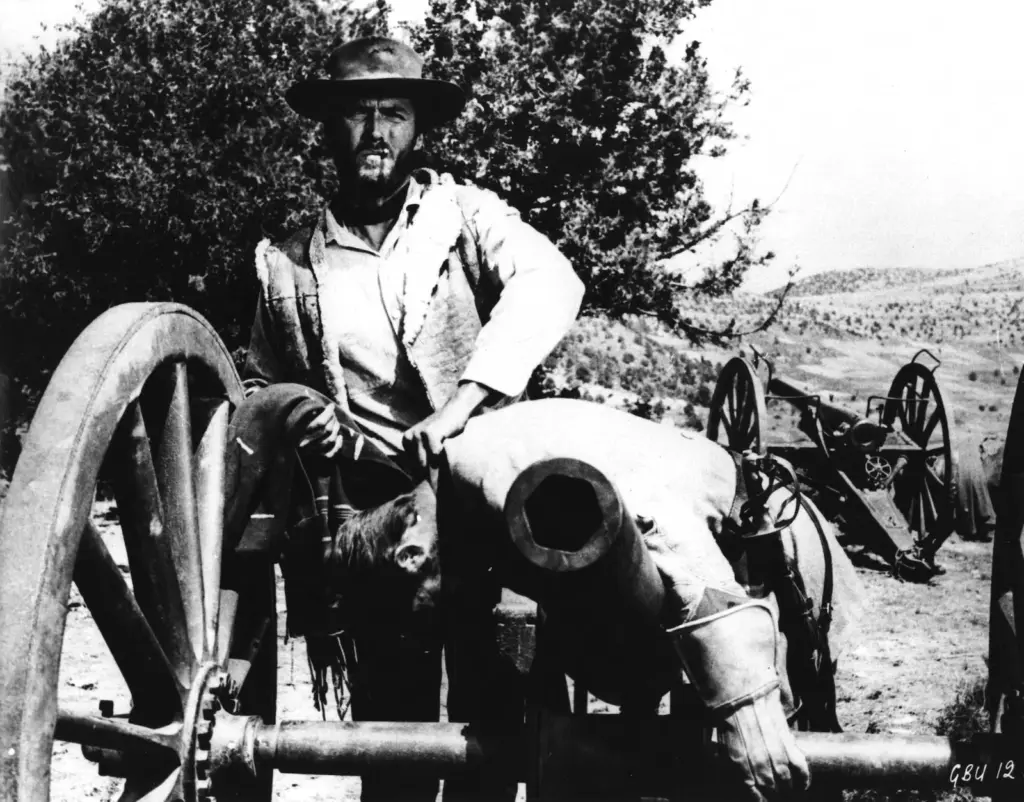
The rough cowboy of the Old West loads a cannon and fires it at a rider fleeing among the hills. The man known as the Man with No Name, played by Clint Eastwood in The Good, the Bad and the Ugly, filmed in Burgos in 1966, used a real 1873 cannon during that shoot whose whereabouts were unknown after that Sergio Leone film. The effort of Diego Montero, a member of the Sad Hill Cultural Association, which recreates in Burgos the cemetery from the film’s iconic scene, has made it possible to locate the weapon at the Military History Museum of Cartagena thanks to specialized readings about Leone’s films. Sergio García, president of the commemorative group, celebrates the discovery although he acknowledges the difficulty of bringing it to Burgos two months before the events prepared for the anniversary: “Finding original material used in the film is a feeling similar to what Indiana Jones might have felt when he obtained the Ark of the Covenant […]. With time, it can surely be studied for a temporary loan.”
The discovery comes after Montero carefully read the book Behind the Scenes of The Good, the Bad and the Ugly, by Sergio Leone, by Peter J. Hanley, and compared it with the documentation from that military museum. He has thus confirmed that the piece, catalogued as MUE-5410 and displayed in those facilities, corresponds to the original elements used by the filmmaker. This is confirmed to EL PAÍS by the director of the Cartagena museum, Lieutenant Colonel of the Army Ernesto Terry Andrés, who collaborated with the Burgos association to verify the serial number of the piece and its inscription. “It’s not that it is a cannon of the same model as the one appearing in the film, it is exactly the one used in the shoot,” he summarizes.
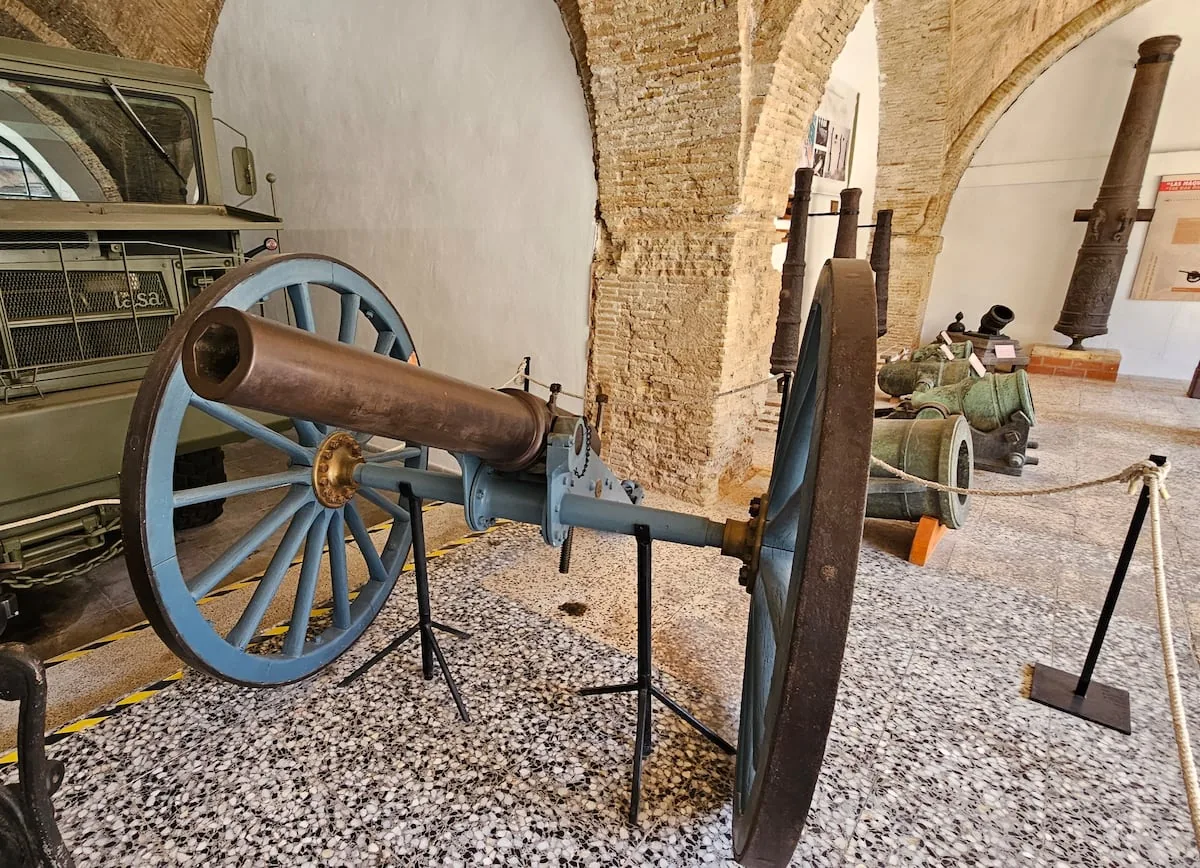
The museum was unaware that the piece had been a protagonist of the legendary western until the cultural association contacted them, but Terry Andrés points out that it was already a unique element of the collection, of more than 3,000 war components, that the center holds, because it has the peculiarity of having a hexagonal bore (inner part), which allowed the projectile, also hexagonal and nicknamed cucumber, to have greater stability and, therefore, greater accuracy.
The cannon arrived at the Military History Museum of Cartagena in 2010 from the Army Museum after its transfer from Madrid to Toledo. It is a 75 mm caliber Whitworth cannon manufactured in Manchester (England), in 1873, and used during the Third Carlist War (1872-1876). The weapon handled by Eastwood in the film bears the inscription “No 572 / WHITWORTH / TRADEMARK / MANCHESTER 1873” and the serial number “JOSEPH WHITWORTH MANCHESTER 5410”, according to the Burgos group. As a curiosity, the museum director recalled that this model was manufactured from 1873, so in 1862, the year in which the film’s plot is set, this cannon really did not exist.
The association’s researchers have revealed that during the shoot, in 1966, the director’s team “requested from the Army Museum of Madrid various original cannons and mortars from the 18th and 19th centuries, transferred and escorted by the Army to the Burgos locations,” near Santo Domingo de Silos. The military material was specifically selected by Giancarlo Santi, Leone’s assistant director, who went to that Madrid museum based on real photographs of the American Civil War taken from books of the era showing Whitworth cannons similar to those he wanted for the film. There the desert of those cowboys and outlaws was fictitiously located and the association has replicated a cemetery like the one in the film, which thousands of people visit annually for free.
“The discovery constitutes an important cultural and cinematic attraction for the thousands of fans of the film, incorporating Cartagena into the set of locations linked to the film, along with the Arlanza valley, the Tabernas desert, the Madrid mountain range, or the La Calahorra area in Granada,” highlights the press release. In the case of Cartagena, the cannon is permanently exhibited in the Cannon Room on the ground floor of the Military History Museum.
The association’s president, Sergio García, is moved by the discovery: “It is a feeling similar to what Indiana Jones might have felt when he obtained the Ark of the Covenant. It stirs our most nostalgic side and, why deny it?, more childish. These films take many years off us, they are safe places we like to return to frequently.” The man admits that it is complicated to bring the cannon to Burgos for the 60th anniversary events, an option that the museum director also does not see as possible, explaining that, as it is a heritage asset of a state museum, it is declared a Cultural Interest Asset (BIC) and requires an order from the Ministry of Culture authorizing its removal from the museum. “The deadlines to manage these removals are long,” they have pointed out.
Nevertheless, Sergio García trusts that, someday, it will be possible to bring it closer to the province: “With more time, after the events, it can surely be studied for a temporary loan and exhibited at the Captaincy, the Military Museum of Burgos, or perhaps in one of the towns around the shoot.”