








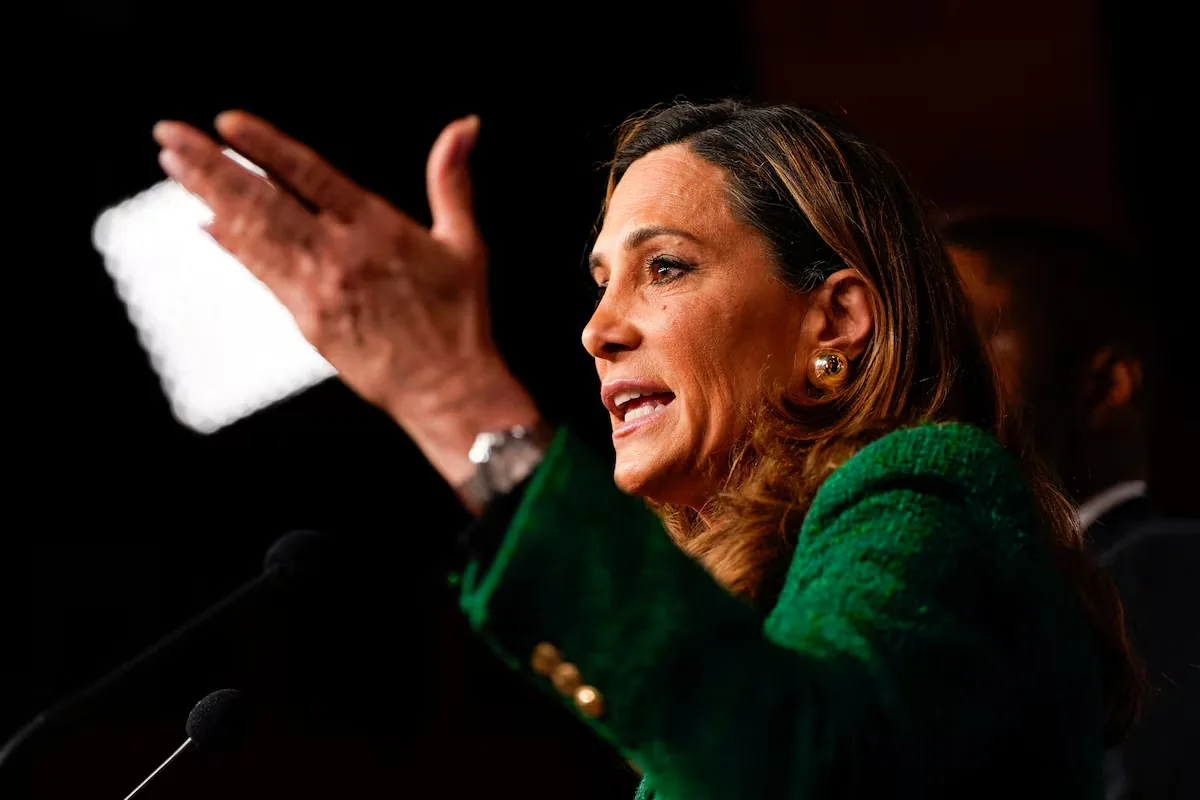
Republican Miami Congresswoman María Elvira Salazar’s criticism of Donald Trump’s immigration offensive, whose tactics she has said “have gone too far,” has sparked a double backlash among the ranks of her supposed allies.
Read more National Drill of September 19: a key guide to prepare it at home
Both the MAGA wing of the Republican Party, which has attacked her for challenging the president, and in South Florida, her local territory, where some question that the message comes too late and identify it as a change of tone motivated by the proximity of the November legislative elections, where she seeks re-election. The president, for his part, has not withdrawn his support for the congresswoman so far.
Asked about the video published by Salazar this Thursday, Trump said, “she obviously has no feelings about the border. I do.” “She is a good person. I made her get elected. Without me, she wouldn’t have been elected,” but limited himself to this criticism.
Among South Florida Republicans in Congress, Salazar’s message has so far been received with caution and almost complete silence. Her Republican colleague from Miami, Mario Díaz-Balart, told Axios that they had been “sending this message to the Trump Administration for months.” Díaz-Balart, Carlos Giménez, and Salazar, all Cuban Americans from Miami, often appear together and have often presented themselves as a bloc. Díaz-Balart’s office told EL PAÍS that he was not available for comment. Giménez also did not respond to a request for comment.
Between two political impulses
But the discomfort among Hispanic Republicans in Miami with President Trump is not new. One of the most prominent voices has been State Senator Ileana García, who founded Latinas for Trump during the 2016 presidential campaign, and since last year has publicly broken with the immigration policy and ICE operations.
García told EL PAÍS this Friday in response to a request for comments on Salazar’s message that voters did not vote “to demonize hardworking immigrants without criminal records,” and that “the instrumentalization of policies by [presidential advisor] Stephen Miller is more theater than a genuine enforcement of immigration law; it is a serious abuse of power.” The state senator did not explicitly refer to the congresswoman in her statement.
In her message, Salazar directly told Trump: “Be careful with what your advisors are telling you about immigration policies,” in a reference widely interpreted as directed at Miller. And she warned him: “The same Hispanics who helped bring you back to the White House in 2024 now feel betrayed.”
When she talks about Hispanic voters, Salazar is talking about her own voters. The congresswoman who arrived at the House of Representatives in 2020 is seeking re-election in a district where nearly three out of four residents are Hispanic. In Miami-Dade, 62% of voters and 76% of registered Republicans are Hispanic. In 2024, Trump won District 27 with 57% of the votes, consummating Miami-Dade’s shift, for decades a Democratic stronghold, toward the Republican Party. But many voters who supported Trump have expressed frustration and regret over the impact of his anti-immigrant offensive.
Among her colleagues in Washington, Salazar has received strong rejection for her comments. The conservative House Freedom Caucus said that “President Trump’s efforts to enforce immigration laws should be applauded and continue as they have so far.” And that any proposal allowing undocumented people to stay in the country amounts to “amnesty.”
Salazar had expressly said in her message that she was not “talking about amnesty, but about giving them a dignified life.” In this regard, the congresswoman has introduced a bill called Dignity, which seeks a path to regularize some immigrants, who would have to pay $7,000, and does not offer a path to citizenship. Despite Salazar’s campaign for the bill, she has never shown signs of gaining enough support to take off.
The DHS, for its part, stated that it will continue to enforce the law “whether Salazar likes it or not.”
Within the MAGA movement, some have accused the congresswoman of “treason.” Conservative commentator Tomi Lahren said it was “an absolute betrayal of Trump and his 77 million voters.” Other activists in the Trump universe called for the president to withdraw his support. Anthony Sabatini, a Republican commissioner from a central Florida county, called for Salazar to be deported even though the 64-year-old congresswoman was born in Miami.
A late gesture under street pressure
Salazar’s break with Trump and the political storm it has unleashed occurs amid the unease of voters and residents of Miami-Dade, a majority Republican county that Trump won in 2024, in the face of the intensification of Immigration and Customs Enforcement (ICE) operations in their communities, where some of the largest Latin American diasporas in the country live. The region, like other migration hotspots in the country, has been especially hit by the historic immigration offensive unleashed by the Trump administration.
The waves of immigration arrests have generated terror in neighborhoods like Doral, nicknamed Doralzuela because it is where the largest Venezuelan population lives. There, some question why Salazar waited less than two months before the elections to confront Trump. Two Venezuelan community organizations that sent a report to Salazar about the arrests earlier say her office never responded.
Immigrant arrests in South Florida have skyrocketed in recent months, including at traffic stops. In Doral, numerous videos of arrests posted on social media show businesses and avenues almost empty, for fear of the operations. Some business owners have said sales have dropped by up to 70% and that they have lost workers who fear being detained. Doral Mayor, Republican Christi Fraga, told a local TV station this week that she did not agree “with the way things are being handled.”
ICE agents arrested nearly 51,000 people in August, a new record number. More than three-quarters of those detained had no criminal records, according to a Reuters analysis.
Adelys Ferro, from the community organization Venezuelan American Caucus, says what is happening on the city’s streets is putting pressure on politicians. “It’s horrific,” she said, not only in Doral but also in other majority immigrant neighborhoods like Hialeah and Little Havana. According to Ferro, Salazar and the other Republican legislators from Florida “have been following President Trump’s plan step by step,” and supported his Big Beautiful Bill that gave billions of dollars to the DHS. The decision to confront Trump now, she assesses, is due to the proximity of the elections. “It’s double standards.”
Salazar did not respond to a request for comment. And leaders of Venezuelan organizations who have been asking for Salazar’s intervention for weeks and sent her a report last month about the increase in arrests, including people with pending immigration processes, say they never received a response.
Helen Villalonga, from AMAVEX, says statements are no longer enough. “I deeply appreciate, as a Venezuelan, any action that Congressional leaders take, but I think we are at a point where words no longer get anywhere. The community is too hurt,” she said.