




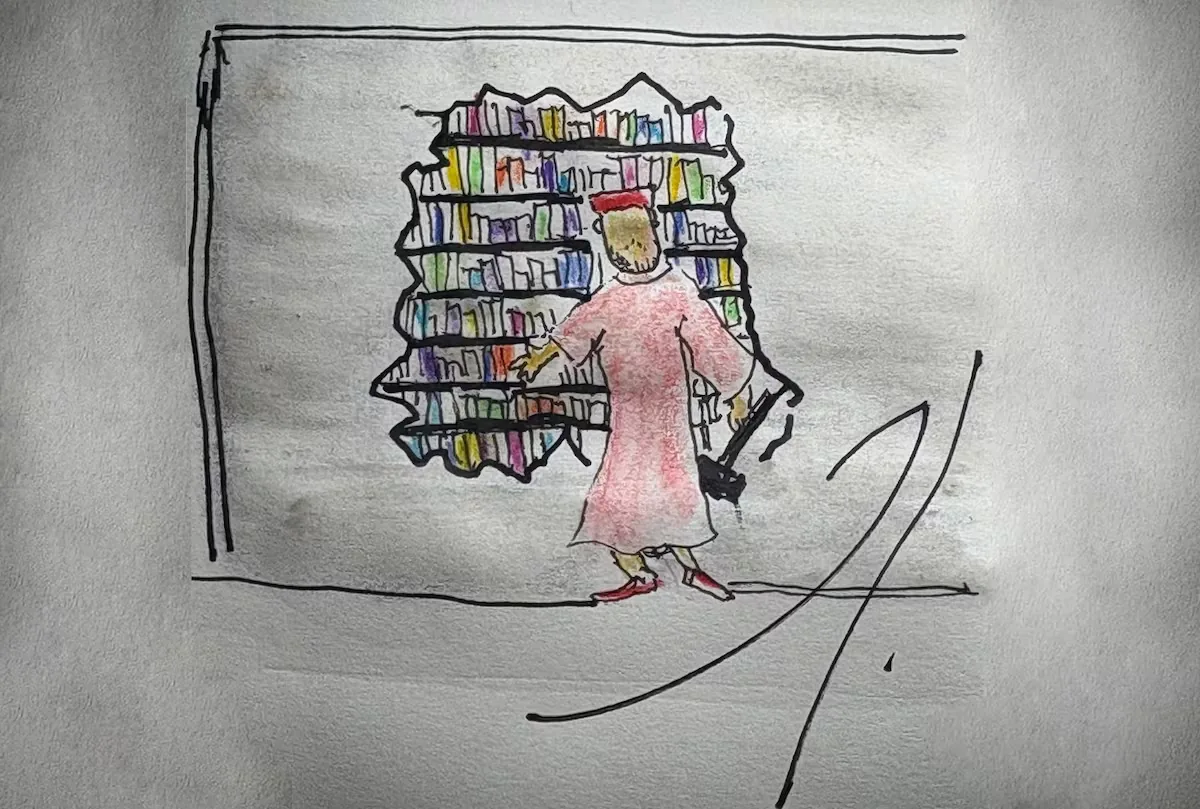
The writer-reader performs both functions in silence, except when tackling, for example, Lope de Vega’s Sonnets of Love (which should not be recited silently) or that hypnotic chapter in Julio Cortázar’s Hopscotch (which could be defined as a direct shot). Saint Augustine confesses in ink that, passing by Saint Ambrose of Milan’s cell, he saw him read without moving his lips, and the whole world inaugurated the luminous duality of being able to read in a silent mind or continue reciting aloud. One reads in silence or murmurs and writes without internal audio (although the writer listens to Bach to pace their anxieties). Anyone watching us from the cell door or the edge of the desk will know perfectly well that one is inhabiting a void unreachable by the other (until the miracle of reading happens), an assumed impenetrable silence that, however, is full of voices and sounds, chimerical spindles of the memory of the one who is spinning, word by word, the tuned sonatina of what they want to say without speaking.
The reader-writer may try to clone the voice of The Count of Monte Cristo by following with the tip of their vocal cords the typography of its revenges (preferably alone, since on a subway train or in a dental office it may cause discomfort among witnesses, passersby, or other patients). If they read without modulating the voices of the characters or the consonants of the plot, the reader-writer still hears the complaints of a lady, the heroic harangue of a swordsman, or the mad delirium of a genius lost in the jungle of a novel, and hears in the distance the scenery of the paragraphs in landscape, the voice of the rain, or the murmur of the snow.
The writer-reader seems to draft the weekly column (or the fortnightly story, as well as the umpteenth chapter of the next novel) in a silence of journalistic responsibility where the length in characters and the deadline form a grid of commitment that tightens the prose with haste. The column must gain voice as soon as it is read by another (perhaps in the newspaper’s newsroom) or once it multiplies exponentially for all possible readers, even being shared aloud at the edge of a table or on an airplane seat. However, the assumed silence that supports one’s opinion, whether on paper or on the newspaper screen, inaudibly envelops all the silent music and all the ambient noise that sustains the column (and even vice versa: a silent column that supports, like a Corinthian column, the apse and the entire temple of an essay in the making or a constant chronicle).
It would seem then that the writer-reader keeps silent before overwhelming facts or incredible misfortunes, that they fall silent before others’ pains or make a quiet exit before evictions, embezzlements, or ravines. It would seem that the unscathed reader does not tremble before the narration of a fire, the last breath of a shipwrecked person, or the desperate crying of a forsaken girl; that they remain unmoved before the eight-column opening of a rape, the chronicle that sweats hunger, or the seismic report whose letters collapse before the gaze like a paragraph shaken by dust and tachycardia. But both the writer who writes and the reader who reads do not sink into silence because of the eventual epiphany of being read or reflected in ink, but above all because of the miracle of hearing clearly and listening distinctly to the noise of the facts, the roar of a plot, the melody of the random hendecasyllable, and that slight noise made by the eyes of someone who smiles in slow motion.
Read more A new spiral of war begins in a country struck by an earthquake
It is not that they keep silent before the shameful crime of the day or the recurring abuses of every hour; it is not that they make a quiet exit before the empire of imbecility and the normalization of lies; it is not that they have nothing to write about the continuous absurdities, the ineffable arbitrariness with which unforgivable errors are disguised or minimized, the perfected shamelessness with which legality is simulated before injustices, the cynicism with which the past is interpreted as a pretext for all present pantomime, ignorance as a functional safe-conduct, or stupidity as a new form of fine arts. It is not about turning a blind eye or exercising apathy as a variant of complicity; nor about keeping silent out of fear of reprisals or to avoid a useless debate. It is not about abjection emanating from abstraction nor about incurable apathy thanks to a constant placebo of various distractions, nor about covering one’s eyes, ears, and mouth like a trio of discreet monkeys, much less a cyclical palliative of immunity before the impunity that stalks us.
One reads endless sheets of crimes and corruption, pustules of populism, and other deceptive eclogues that every day would seem to induce a written reply or demand a shout to the face, but one tries to write about the few goods and virtues. Like, for example, the recent recovery of the books of an elderly man in the context of the conflict in Syria, who, having bricked up his library in Damascus (as Don Quixote suffered in a place in La Mancha), was filmed smashing down the white wall that served as a cocoon for a thousand butterflies to read again all the wonderful music of his books, having whitewashed them in secret to avoid the scythe of censorship and the horror of being accused for reading and owning them in times of a now vanished diabolical regime…
And then one returns to the illusion of the eleventh chapter of a novel heard in the author’s own voice, and returns to the telegraphic keyboard or the silent fountain pen with purple ink to keep hearing the noise of the world and listen to the tempered concert of invented dialogues, absent landscapes, characters of flesh or desire, the syllables of each line seen without looking, all the tastes and all the decibels that the diversity of misfortune unloads on the eardrums, the endless fragility of the powerful, the misery of millionaires, and the abundant humanity of the humble: a chorus of slaves in tears who look at the lost land without ceasing to advance toward the promise of tomorrow and all its music… of course, in silence.
Read more The Latin American Art Museum of Buenos Aires grows: adds 1,250 works and doubles the space