
José Luis Rodríguez Zapatero, president of the Government between 2004 and 2011, became this Tuesday the first former head of the Executive in democracy to be charged by a judge. The former secretary general of the PSOE is under investigation as the alleged “leader” of an “organized and stable structure” of influence peddling that operated, at least, between 2020 and 2025 and used his family and environment to channel alleged illegal commissions. The judge of the National Court José Luis Calama has decided to summon him to testify on June 2 in a judicial proceeding “followed for alleged crimes of influence peddling and money laundering.” The magistrate is forceful in his writing, which caused a real political earthquake this Tuesday by affecting a figure who has become a moral reference for the party and who has taken charge of the spirit of the membership in recent times.
Read more Body of Yulixa Tolosa found on a road six days after her disappearance
The investigation describes how Zapatero used a friend, the Alicante businessman Julio Martínez Martínez, as a vehicle to channel payments from companies seeking his favors, and that the investigators estimate, in Zapatero’s case, at 1.95 million euros. To this end, they established the consultancy Análisis Relevante S. L., which the judge places at the center of the network. The magistrate believes it was a shell company that signed contracts for the drafting of consultancy reports with companies that, in reality, sought the influence of the former president to achieve an economic objective: whether it was the bailout of an airline (such as Plus Ultra) or the buying and selling of oil in Venezuela.
The Economic and Fiscal Crime Unit (UDEF) of the National Police, together with the Anti-Corruption Prosecutor’s Office, has been investigating this matter since the end of 2024, after receiving a request from the Swiss and French prosecutors about possible opaque money laundering from Venezuela. The operation culminated this Tuesday when agents appeared at the former president’s home to hand him his summons in person. They also searched his office, the marketing company of Zapatero’s two daughters, Whathefav S.L., as well as two other companies linked to the plot.
Judge Calama lifted the secrecy of the investigation this Tuesday and in an extensive 85-page order describes the “multiple pieces of evidence” pointing to the former president, placing him at the “apex” of a network that has the “coordination center of the network” in his private office on Ferraz Street in Madrid. From there, the instructor details, “instructions are given, documents are prepared, sensitive communications are managed, and the financial and corporate operations are articulated.”
The judge points to his “direct involvement” in “high-value international operations” related to petroleum products, gold, shares, or currencies. He bases this on emails, letters, and conversations of some of the implicated seized by the UDEF, as well as messages extracted from the phone of Rodolfo Reyes (a Venezuelan former owner of Plus Ultra) provided by the United States to the Spanish investigators. Additionally, he constructs the possible influence peddling around Zapatero’s pressures for the rescue of 53 million euros that the Government gave to the airline in 2021 and the former president’s alleged collaboration in creating an offshore company in Dubai to send there a commission collected after the aid.
“Decision-making and strategic core of the network”
The order assigns José Luis Rodríguez Zapatero a role as the “decision-making and strategic core of the network,” although his “leadership is not manifested formally or publicly,” but by avoiding “the direct execution of the most compromising dealings.” The judge deduces this from conversations of those investigated, who refer to the former president as “our buddy Zapatero behind” [buddy means “friend,” “comrade,” or “partner”], or talk about “Grupo Zapatero”; they refer to “Zapa is our contact,” “I don’t know if it will be good that (…) Zapatero talks to someone at SEPI,” and even say, in January 2021: “Tomorrow Zapatero intervenes directly. He will try to get us the permits without the Spanish embassy having to intervene.”
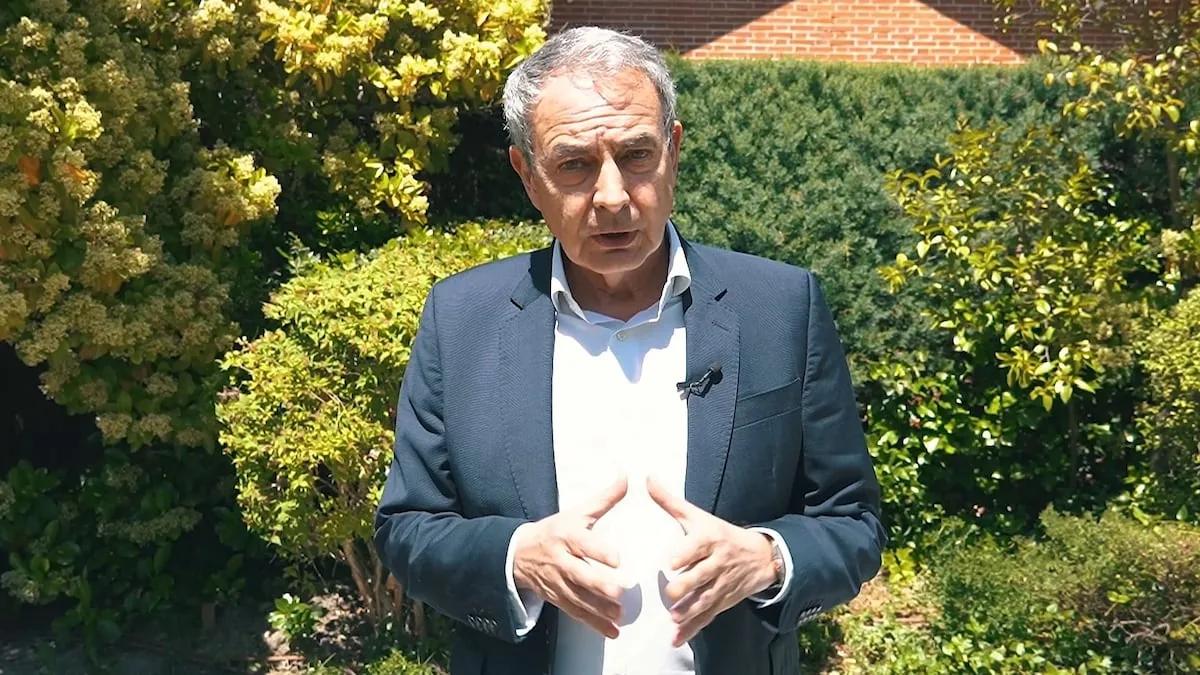
The former leader published a video this Tuesday in which he categorically denies any involvement in this bailout, as well as any irregularity in his private activity. “I want to reaffirm with all firmness that I have never carried out any management before any public administration, nor the public sector, in relation to the rescue of Plus Ultra, nor before any other administration,” he said.
Zapatero’s friend, who was arrested last December 11 along with Plus Ultra executives in a first phase of the operation, is one of the key pieces of this puzzle. This Alicante native controls a network of 39 companies, according to a report presented last February by the National Office for Fraud Investigation. Of these, 15 are active, although eight of them have no employees or barely any remuneration. For the magistrate, it is striking that, of all the corporate environment under Martínez’s control, Análisis Relevante is the company that receives the highest income. In total, 959,798 euros between 2020 and 2025.
The former president has publicly acknowledged that he was involved in the initial creation of this consultancy by his friend, who asked him if he would be part of it due to his value as a great expert in geopolitics and social dynamics. The investigation has shown not only that, but that there was a group chat called “AR” (initials of Análisis Relevante) that included Julio Martínez Martínez, Zapatero, Telefónica executive Javier de Paz, his daughter, and De Paz’s right-hand man and current senior official at Movistar+, Sergio Sánchez. For the judge, this reveals the “active and direct participation” of the former president in the organization and internal communication channels of the consultancy.
“Do you think we can ask Zapatero for help?”
The investigation chronologically details the communications between Julio Martínez Martínez, Plus Ultra president Julio Martínez Sola (they share name and surname but are not related), CEO Roberto Roselli, and Madrid lawyer Miguel Palomero, who were arrested on December 11 last year, when the existence of this case, which had been with the Anti-Corruption Prosecutor’s Office for a year, became public. “We need to get the aid (…) Let’s see what you come up with politically,” said Venezuelan Rodolfo Reyes, then owner of the company, to lawyer Miguel Palomero, investigated in the case, on March 23, 2020, in the midst of the pandemic. “Do you think we can ask Zapatero for help… political lobby issue,” he said a week later.
From then on, a whole string of messages begins in which they move their contacts until they reach Julio Martínez Martínez for the first time. In reality, the owners of Plus Ultra activated two channels “that would have operated simultaneously” to obtain the bailout that, at that time, the Government was launching to revive tourism or aviation companies after the halt that Covid was going to cause. One channel towards former Transport Minister José Luis Ábalos, for which they tried to talk to Koldo and even met with the Secretary of State, Pedro Saura. And “the Zapatero channel” that “acquired a predominant role,” according to the judge, and “allowed Plus Ultra to achieve the pursued objectives.”
The airline owners even sent a letter addressed to the vice president of Banco Santander indicating that “by instructions of Zapatero,” they requested help to obtain an ICO loan. Financial sources say that this, however, was never carried out. The messages make explicit that the company’s executives were willing to pay bribes (“As a friend says, we’re going to screw even if we have to pay a little,” said then vice president Martínez Sola on March 30); and that the supposed contacts with Zapatero began, at least, in April 2020. “Julio talked to ZP. 11 min. He explained everything (…), then when you can you ask him,” Rodolfo Reyes said on the 30th of that month. Trying to get closer to Zapatero, they reach a certain Julio Martínez Martínez, whom they also call “lackey.”
Rodolfo Reyes: “Are you going to be in the conversation with Zapatero?” he asked on May 18, 2020.
Roberto Roselli (Plus Ultra’s finance chief): “Not directly with him. I talk to a lackey (…) Well, he already told Julio they set up their finance boutique. So the bribe will come from there.”
Read more Arsenal wins the Premier again after 22 years of abstinence
A few months later, the airline hires Martínez through Análisis Relevante. Plus Ultra signed a contract with the consultancy on July 30, 2020 (eight months before obtaining the bailout), for a duration of 12 months, whose objective was “the delivery of a monthly report on the political, economic, and social situation in the world, especially in Spain and Latin America, including main innovative sectors and trends,” as well as “continuous advice, through specific reports on countries, international organizations, and their policies, of interest to the client.” Plus Ultra then began paying Análisis Relevante 5,000 euros monthly. A very similar contract to one that, for example, the Aldesa group (of Chinese origin) signed in September 2022 also as advisory and for the same amount: 5,000 euros per month. For this reason, the magistrate suspects that the consultancy was, in reality, a front to circulate commissions.
On September 19, 2020, the bailout had still not arrived and nervousness spread within the company. “By the way, buddy, nothing today. I was in a meeting and Julio called the contact and… man… the guy told him that the thing was completely stalled because SEPI has no staff to review files,” Roselli explained to Rodolfo Reyes that day. “I don’t know if it will be good for them to get a technical nudge from above or for Zapatero to talk to someone at SEPI.” From February 2021 the situation unblocks. On February 6 of that year, Reyes says: “You can organize a lunch with the namesake [Julio Martínez], you and Camilo [Ibrahim Issa, another Venezuelan]. Camilo was with ZP today. He said everything is going smoothly.”
On February 26, seven days before the fund management board met to decide whether to grant public aid to Plus Ultra, businessman Julio Martínez Martínez already informed Camilo Ibrahim Issa that the bailout had been granted: “My biggest congratulations for having achieved the goal. It has undoubtedly been the result of the exceptional work carried out.”
There is no direct communication from former president Zapatero proving that he indeed influenced the Government to end up granting 53 million euros to the airline, but the judge uses two closely timed clues to implicate him: a contract with a commission on the bailout and the creation of a company in Dubai. On January 19, 2021, the company Idella Consulenza Strategica (of Julio Martínez Martínez) signed a contract with Plus Ultra with a remuneration of 1% of the aid if it was finally granted. Seven days later, there is a chain of emails exchanged between Zapatero’s secretary and Julio Martínez’s manager showing that both had a meeting at the Portonovo restaurant and that, as agreed then, documentation was provided for the creation of a company in Dubai.
In that country, the company Landside was created, which the judge believes could be where that alleged commission for the bailout ended up, since no trace of it has been found in Spain. On February 23, Cristóbal Cano (Julio Martínez’s employee) sent an email to the Alicante businessman with the subject: “Copy of SEPI fee contract.” SEPI was the public entity that ended up injecting the money into the company, and investigators suspect that this email refers to a “fee” as a commission.
The “president” messages
The investigation reveals that, just as Julio Martínez Martínez hid Zapatero’s money, he also hid communications with him and acted as a sort of intermediary for everyone. Explicit messages were found on his mobile phone that say: “President, I report the news”; “President, we remain attentive to your instructions on this matter”; “We totally agree, president.” The businessman deleted all messages he had with the former head of the Executive, supposedly because he sought to remain hidden. The order also highlights the presence of the Alicante native in the authorities’ lounge at Madrid-Barajas airport and a communication from the former to the latter’s secretary: “Julio tells me he will leave with the president, but they usually do not record it. I hope I have explained myself.”
The involvement of both in the company Análisis Relevante is a cornerstone of the investigation because Calama says that the “usual service model” and the evidence in the intercepted messages that on some occasions the word “commission” was deleted lead to the conclusion that the purpose of this supposed consultancy was “to cover up the true economic nature of the operations.” That is, Análisis Relevante was, in reality, the way Zapatero managed his “high-level institutional and business contacts.” He points out that in his office, under his orders, was secretary María Gertrudis Alcázar, “in charge of the preparation and formal coverage of the documentation.” While on Julio Martínez Martínez’s side was his employee Cristóbal Cano, “manager of the corporate network and ad hoc billing.” This interlocution also took Zapatero out of the spotlight.
Zapatero’s daughters’ company, Whathefav S.L., which UDEF agents searched this Tuesday, also received payments from Análisis Relevante. Of all the companies owned by Martínez Martínez, the main paying company during the pandemic period was precisely Análisis Relevante, a total of 707,467 euros. Directly to Zapatero were 418,000 euros; to Whathefav, 242,423 euros.
Other payments and oil dealings
The Anti-Fraud Office has analyzed the accounts of the socialist former president and has found, in addition to those from Análisis Relevante, other income related to his activity focused on international conferences or advisory work: 37 transfers of 649,552 from Thinking Heads Group S.L.; 37 transfers totaling 352,980 euros from The Global Analysis & Trends In Emerging Regions; and 2 transfers totaling 31,766 euros from Thinking Heads Americas.
The magistrate’s narrative points to different types of influences allegedly deployed by the plot. Beyond the Plus Ultra bailout, two more companies paid Análisis Relevante that UDEF registered this Tuesday: Sofgestor S.L., which paid for international advisory services “lacking real content,” and Inteligencia Prospectiva S.L., managed by two Venezuelan brothers who, according to the judge, “constitute an entry point for foreign funds, simulated as capital increases that are later redistributed to Análisis Relevante, Whathefav, and Gate Center (an organization linked to Zapatero), and the Aldesa Group, already mentioned for its ties to China. Additionally, there are companies identified as shell companies that, according to the judge, served to obscure some payments such as Caletón Consultores S.L.
The judge links Zapatero to operations related to gold and the buying and selling of shares or currencies, without elaborating on this point. But he clearly points to deficit companies like Inteligencia Prospectiva, which carried out successive capital increases but also had outflows of 2.6 million euros. Among the main payments of this company are Análisis Relevante (380,208 euros), Whathefav (561,400 euros), and Gate Center (266,200 euros). Domingo Arnaldo Amaro and Guillermo Alfredo Amaro, the administrators, show involvement in relation to Venezuela that “manifestly exceeds the capacities and functions of a common businessman, affecting top-level state matters unrelated to the usual operations of a company.”
This is evident from communications intercepted on Martínez Martínez’s phone such as: “Ready to travel to meet with the Lady [presumably Delcy Rodríguez] and Minister of Petroleum.” The judge explains in this matter that they were trying to access an oil trading operation and that potential buyers necessarily had to channel management through an articulated network of influences. “The interlocutors even reveal that they do not know the type of crude they are going to acquire,” the magistrate indicates.