







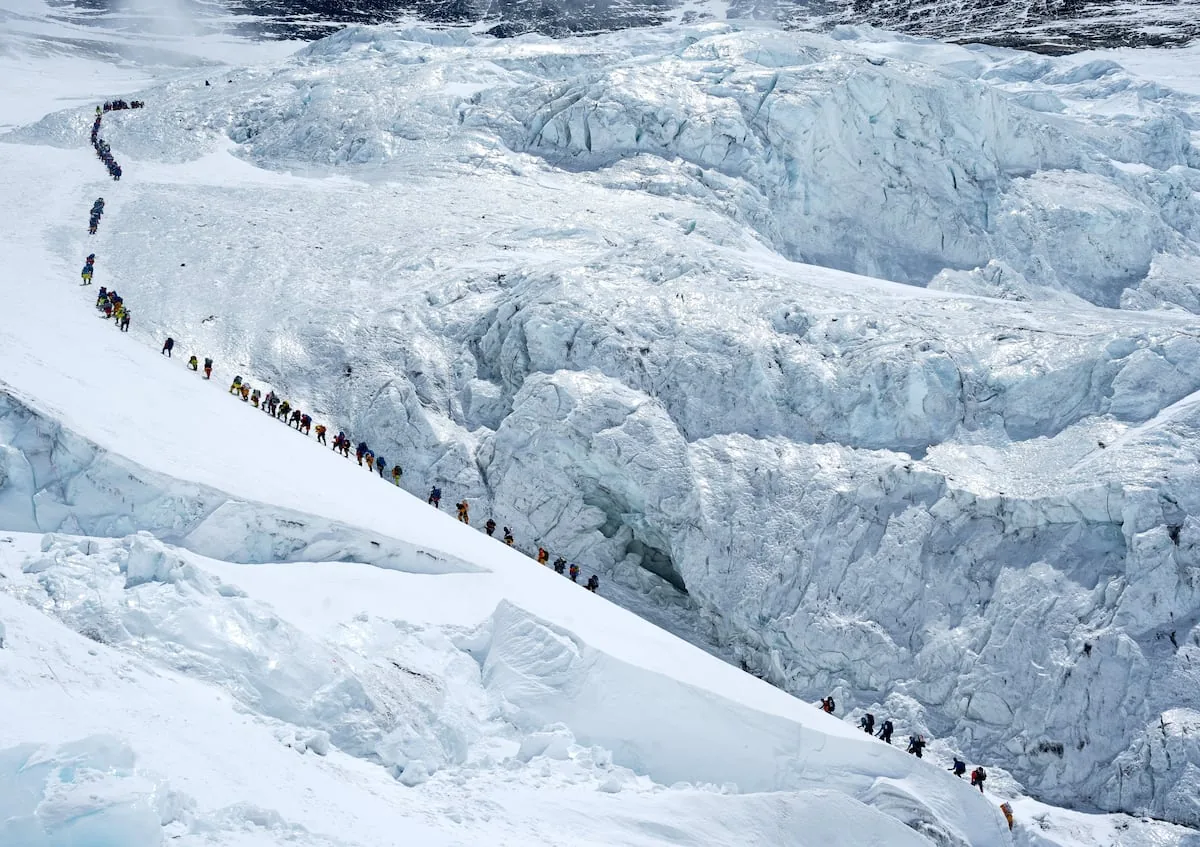
A few weeks ago, hundreds of aspiring climbers to crown Everest were desperate at the mountain’s base camp, on its southern side (Nepal), waiting for a huge mass of ice to finally break off and clear the access to Camp 1 through the Khumbu Icefall. If the mountaineers were worried, the local agencies almost panicked: there is so much money at stake that a closed Everest means ruin. But the benefits of mountain tourism do not improve the quality of life of a country that a few months ago shot at young people who protested in Kathmandu and that these same days has destroyed a huge shantytown where almost one and a half million workers took refuge, now forcibly displaced to equally unworthy but more dangerous places. But the sun shines on Everest and the sherpas who equip the labyrinth of ice and crevices of the Khumbu have finally found a safe path that avoids the threatening mass of ice.
None of these workers know who Henry Todd was, but the older owners of the Nepalese tourism agencies do remember him: he was the one who funded the first metal ladders to cross the huge crevices of the Khumbu and comfortably climb the highest ice blocks. Most likely Todd would have suggested blasting the darn ice block so that the show on Everest would flow… like the money.
Born in Scotland in 1945, he died at his home in Kathmandu last November 3 at the age of 80 after suffering a heart attack. He was one of the great promoters of tourism in the highest mountains of Nepal, and Everest in particular, a summit he never set foot on. It’s not that Todd loved the mountain irrationally, but he did love money, especially if it didn’t come from conventional work. For this reason, he was nicknamed The Toddfather (a play on words with The Godfather), a nod to his fondness for mafia affairs. He created the first low cost agency offering cheaper trips to Everest, and later to several eight-thousanders for those climbers without pedigree or large bank accounts but with enough motivation to save and buy a dream.
Henry Todd, Former LSD Kingpin and Everest Guide, Passes Away at 80 (https://t.co/jwzK3hrMlj) #dailydumpling #news #worldnews #trending #hot #breakingnews #top #US #Asia #Europe #America #MiddleEast pic.twitter.com/tc5it6nMUv
— Daily Dumpling (@dumplingnews) November 20, 2025
In fact, it can be said that the idea came to him in prison, where he served a seven-year sentence as the mastermind of one of the largest LSD production and distribution rings in UK history. If Todd’s parents worked for the Royal Air Force, he quickly chose another path: in the early 1970s he led a drug trafficking gang that was dismantled in 1977 after the police, in Operation Julie, found those responsible for producing and selling millions of LSD pills. Legend has it that when the agents knocked on his door, he came out to greet them with a smile: “I’m afraid, gentlemen, you’re not here to check if my TV license is up to date.” The police found more than a million pills in his home laboratory with a value of 6.5 million pounds on the black market.
Todd was sentenced to 13 years in prison, served seven, and upon release threw himself into the mountains. He soon discovered that the Everest business could bring him interesting profits and decided to lower costs, dispense with the luxury demanded by wealthy aspirants, and simply pave the way to the roof of the world for the people. More clients, less exclusivity. Later, he extended the formula to eight-thousanders like Cho Oyu, Manaslu, and even K2. He didn’t earn as much as with LSD but did well enough. Also, he quickly led the bottled oxygen business, inventing a system to refill empty cylinders.
Todd earned the sympathy of the sherpas, whom he cared for, and the enmity of many climbers, whom he despised when they dared to contradict him. The latter often said that Todd could be a person of great humanity or a true sadist, depending on the role he wished to adopt or the mood he woke up in. When leading his expeditions, his style once again referred to the prison example: iron fist and few replies allowed, and it didn’t matter that his climbing skills were modest: he liked to command from his base camp chair, even if he wasn’t always right.
In 2015, he lived through the tragic earthquake that shook Nepal at Everest base camp, where many deaths were also recorded, especially among Sherpa workers. Todd spent days digging, searching for the remains of his men and was the last to leave base camp along with the lifeless bodies of three of his sherpas. Those who earned his trust could hear amazing stories from his past: he liked to remember that it was not white-collar businessmen who invented the Everest tourism business, but guys like him, rebels and outside the law. Today, hardly anyone like him remains: it is the Sherpa people who make and unmake the business of the highest mountain at will, making a living just as Todd did, even outside the law, as shown by the mountain accident insurance fraud scandal reported just weeks ago.
Read more Why the jury has dealt a setback to Elon Musk: the key points of the big AI trial