








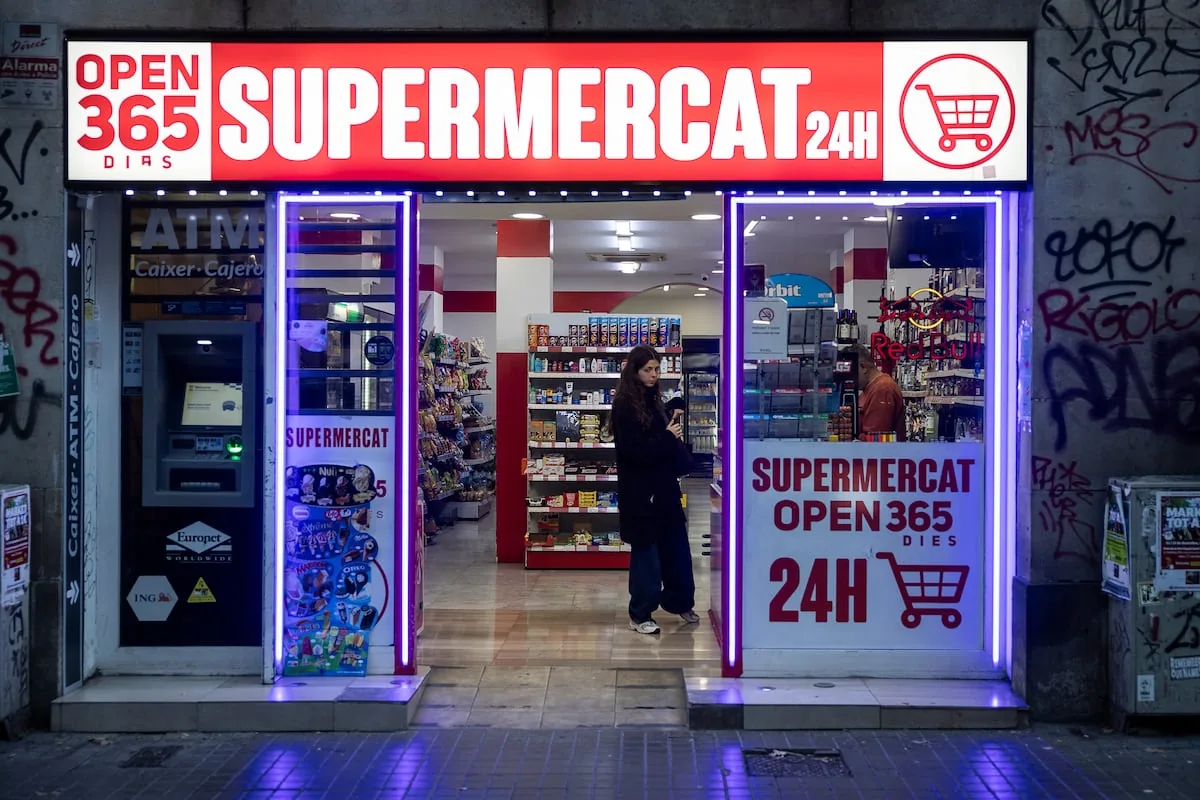
Barcelona has 1,300 supermarkets that can open 24 hours. In an easy division, that is an average of 130 in each of the ten districts; or 17 in each of the 73 neighborhoods. Their proliferation in recent years, with offerings not always aimed at residents (alcohol, suitcases, non-essential products) and whose business owners do not always comply with labor rights, has led the City Council to temporarily suspend the granting of new licenses for these supermarkets. The idea is to draft a usage plan for the entire city that sets where and how new establishments will be allowed.
The suspension was published this Wednesday in the Official Bulletin of the Province of Barcelona (BOPB) and takes immediate effect, lasting for one year. Meanwhile, work will be done on new planning that “allows protecting local commerce, preserving commercial diversity, and avoiding saturation and monoculture processes in certain areas of the city,” the council announced. The districts of Sant Martí and Ciutat Vella already have restrictions on the establishment of these businesses.
The City Council has explained that, in parallel, it will maintain inspection pressure to ensure compliance with the regulations for this type of establishment, with regular inspections and multi-inspections. At the end of 2024, the Urban Guard detected about 2,000 violations in just a hundred establishments it investigated.
The 1,300 supermarkets operating every day, all hours of the year, should on paper offer everyday food shopping products. They are exempt from complying with the schedule rules set by regional regulations due to having a surface area that cannot exceed 300 square meters. But “the widespread establishment of this type of store has generated coexistence problems with neighbors, especially in areas with high population density or strong tourist pressure,” explains the government of Mayor Jaume Collboni, who defends “the need for a global and coordinated regulation at the city scale.”
Read more Henry Todd or how the ‘king of LSD’ ended up creating the first low-cost agency for Everest tourists
The measure specifically affects the different types that, by their license, can operate 24 hours and are as follows: multipurpose food, self-service (between 60 and 150 square meters of sales area), superservice (from 140 to 400), superservice with sale of meat products (250 to 400 meters) or convenience stores.
The suspension affects both the granting of new licenses and the processing of communications for future installation works, a formula that is usually a loophole for future businesses during moratoriums.
The measure does not affect municipal markets, which are explicitly excluded. With this action, the City Council wants to buy time to carry out the necessary studies to evaluate the impact of this commercial model and define a regulatory framework that guarantees balanced and sustainable development of Barcelona’s urban and commercial fabric.