








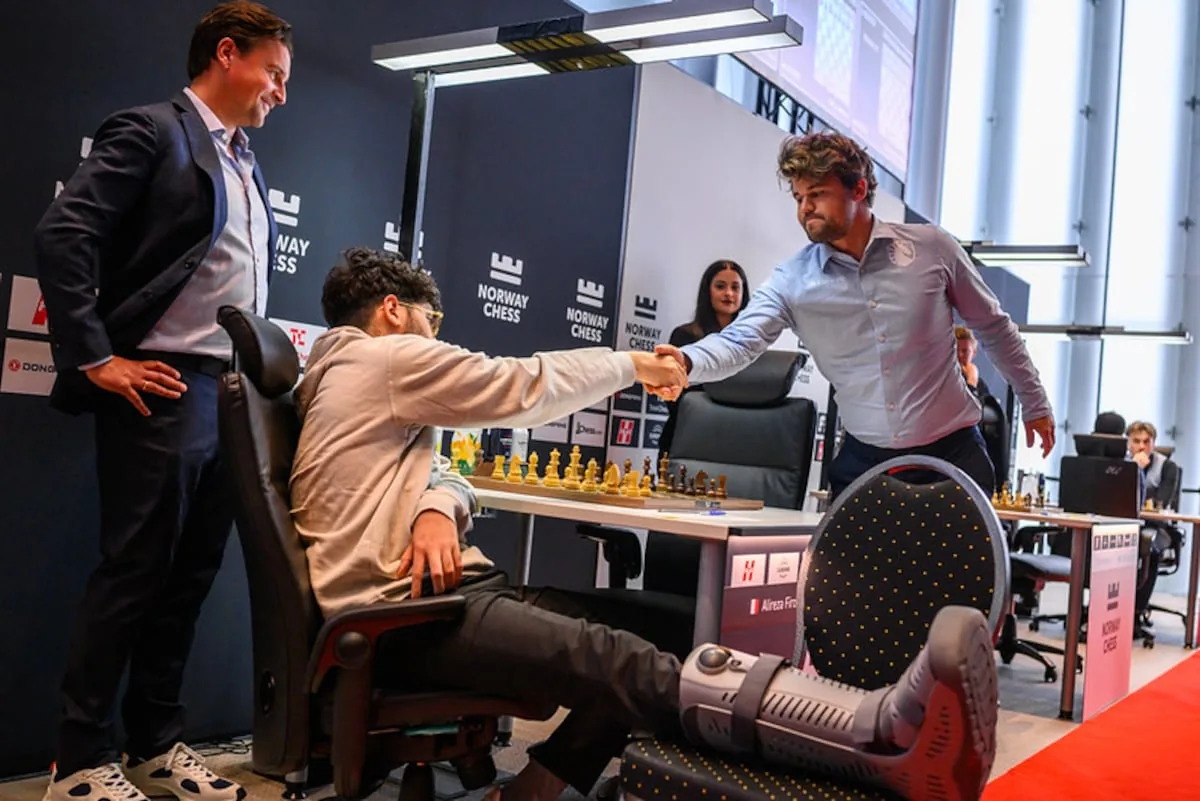
It is well known that Magnus Carlsen tends to falter from time to time in the early rounds of tournaments. But this time it was special: his executioner, the Franco-Iranian Alireza Firouzja, 22 years old, is the young star most praised by the Norwegian; and he also achieved victory in the first round of Norway Chess in Oslo, with one leg resting horizontally on a chair to alleviate ankle pain. In the women’s tournament, the Kazakh Bibisara Assaubayeva, recent winner of the Candidates, took the lead with her victory over the Indian Humpy Koneru.
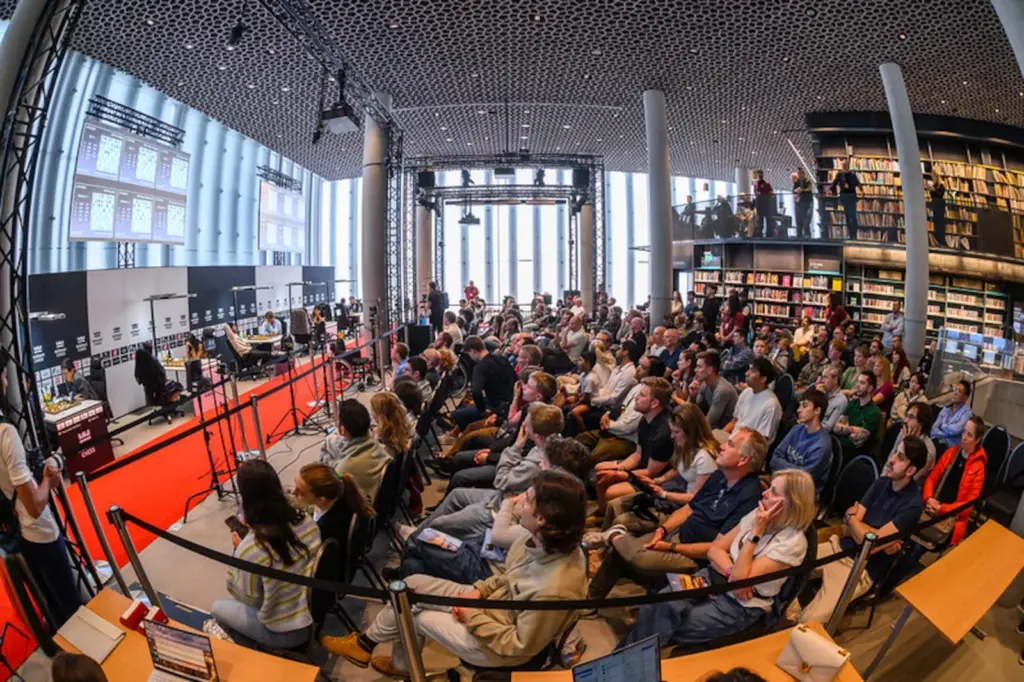
The change of venue for Norway Chess, whose first thirteen editions were held in Stavanger, is not limited to moving the tournament from the country’s fourth largest city to the capital, but to locating it in a very emblematic place: the five-story Deichman library, by the harbor, probably one of the most beautiful and used in the world, filled every day with people of all ages. When one of the most worrying problems of today’s society is the millions of people who delegate much of their intellectual activity to ChatGPT and its peers, the stars of a game that teaches you to think face off surrounded by thousands of books, and their games are broadcast live from three television studios (the official channel, Norwegian TV2, and Chess.com (250 million users).
Among the images from the first day of this neural binge (there are two leagues, men’s and women’s, double round-robin among six), one caught a lot of attention: Firouzja was facing the still undisputed number one and idol with his right leg horizontal, due to a recent and very annoying ankle injury.
Carlsen said very clearly in 2021 that Firouzja (then 18 years old) was the most capable of dethroning him. So much so that he announced something astonishing: “I will only defend the world title if Firouzja is the winner of the Candidates Tournament in Madrid because he is the only one who motivates me to prepare the match thoroughly for several months.” Firouzja did not win in Madrid and Carlsen gave up the crown. Since then, Firouzja has wasted his immense talent, dispersing it with other activities (such as fashion design), probably poorly advised by his brother and father, judging by the number of tournament organizers and influential people in elite chess who complain about the attitude of both relatives in negotiations.
It can therefore be assured that Carlsen respects the Franco-Iranian a lot as a rival because he knows he is capable of beating anyone, including himself, and in all formats, if he has a good day. But nothing indicated that this Saturday was going to be that day. An hour before the opening, based on the performance of a splendid violinist, Marie Klapbakken, Firouzja responded to this newspaper’s greeting: “It hurts, but I will try to forget it while I play.”
Everything indicates that he succeeded, at least during the first twenty moves because he came close to perfection. And he did so without spending much time (at that moment he had 68 minutes left, compared to the Norwegian’s 40) in a tournament played at a faster pace than usual (120 minutes for the entire game, and there is only a 10-second increment per move from move 41). Firouzja also has solid arguments not to fear Carlsen especially in time trouble or in sudden death or Armageddon (10 minutes for white, who must win, and 7 for black) if the game ended in a draw: the Franco-Iranian is 11th in the world in classical format, 5th in rapid, and 3rd in blitz.
In a position with a slight advantage but much play for both sides, Firouzja spent 27 minutes on move 16. While he was thinking, Carlsen went to the confessional (a booth where players can enter during games and record comments that are shortly broadcast online) and acknowledged that the position was “very complicated and interesting,” another implicit recognition of his opponent’s great talent.
There was another factor to increase the tension: one of Carlsen’s advantages over all his elite colleagues is that he almost always spends less time than them. But after his 17th move, he only had 26 minutes left. Even so, his deep understanding of chess allowed him to sacrifice a pawn to activate his pieces to the maximum. Everything pointed towards a draw, and the subsequent sudden death.
But no, because Firouzja rejected the more solid continuations to try to take advantage of his clock lead, and he did so with enormous effectiveness. The gestures of anguish from the number one, who failed to find the very narrow path to salvation—he should have seen a move that only computers see—and had to resign after 38 moves.
On his way to the hotel to ponder the defeat, Carlsen did not seem especially affected when he spoke to TV2 cameras: “Alireza has not always made the best possible move, but he has found a way to greatly increase the pressure, causing my error in time trouble.” Firouzja appeared before the cameras with his leg horizontal: “The trip from Bucharest [where a tournament ended on Saturday] with the leg like this was very hard. But today I felt good and played well. It is the best medicine.”
Results of the 1st round: Firouzja – Carlsen, white wins; Gukesh – Keymer, draw, white wins; Praggnanandhaa – So, draw, white wins. Women: Anna Muzychuk – Jiner Zhu, draw, draw; Koneru – Assaubayeva, black wins; Wenjun Ju – Divya Desmukh, draw, black wins.
Standings: 1st Firouzja 3 points; 2nd Gukesh and Praggnanandhaa 1.5; 3rd-4th So and Keymer 1; 6th Carlsen 0. Women: 1st Assaubayeva 3; 2nd-3rd Zhu and Desmukh 1.5; 4th-5th Anna Muzychuk and Wenjun Ju 1; 6th Koneru 0.