







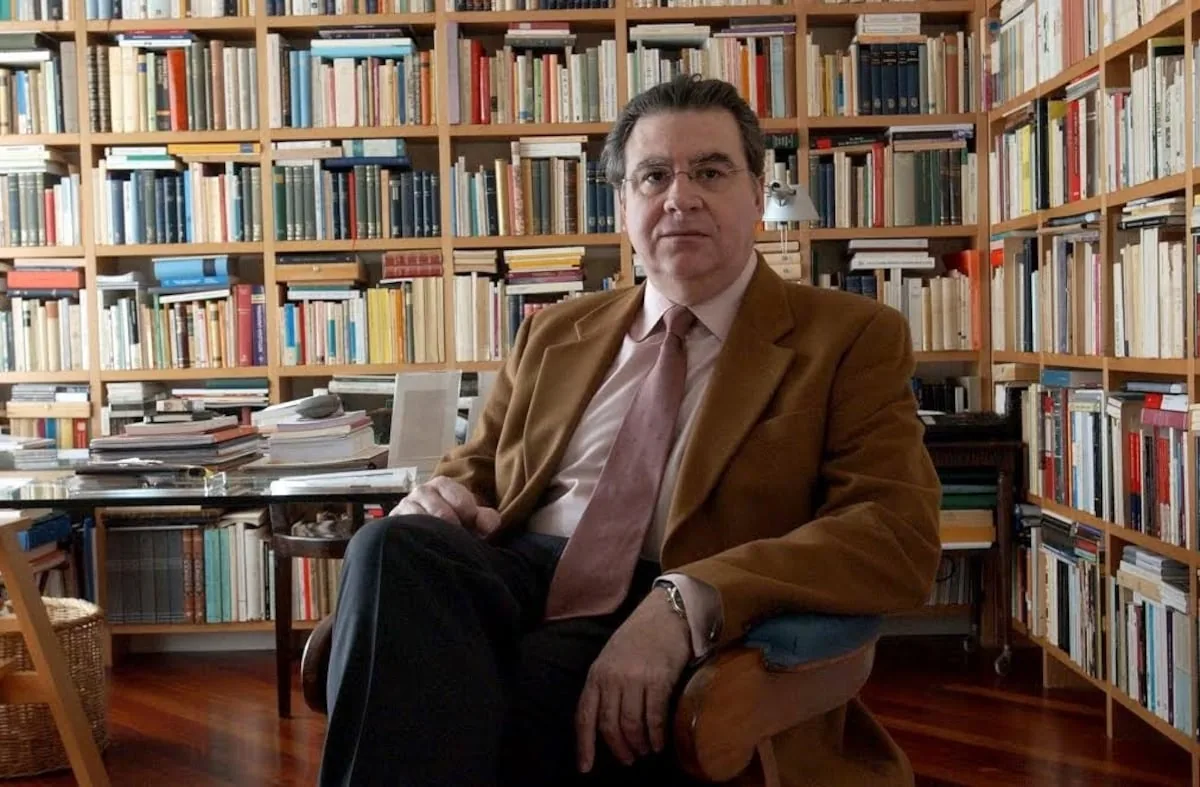
The poet Jaime Siles (Valencia, 75 years old) is the recipient of the 35th Reina Sofía Ibero-American Poetry Prize, the most prestigious in this genre, jointly organized by Patrimonio Nacional and the University of Salamanca. Siles, professor of Classical Philology, literary critic, and translator, belongs to the generation of the Novísimos, which emerged in the early seventies. The decision was announced this Thursday by the president of Patrimonio Nacional, Ana de la Cueva, who noted that the decision was by majority of the jury. De la Cueva highlighted that the award is given to Siles for “his ability to combine the abstract and the sensory, with an expression close to scientific discourse.”
Siles is a poet who “explores with words a fundamental problem: identity and its relationship with all aspects of human nature,” added De la Cueva. “One of the best representatives of poetry of critical thought, which places poetic experience on the margin of philosophical reflection. He fulfills the Renaissance ideal of the total artist.” Meanwhile, the rector of the University of Salamanca, Juan Manuel Corchado, emphasized that “Siles is one of the most outstanding poets of contemporary Spanish poetry.” The Reina Sofía Poetry Prize recognizes “the career of living poets whose work represents a significant contribution to the cultural heritage of Spain and Ibero-America,” the organizers report.
For this edition of the prize, proposals from 65 candidates were received. Queen Sofía will preside over the award ceremony, endowed with 42,100 euros, in the last quarter of this year. This recognition includes the publication of an anthology poetry book, the organization of academic conferences, and a study on the work of the awarded author.
Jaime Siles has spoken on occasion about what a poem means to him: “A conscious, rigorous, and responsible act, like architecture.” Poems are “voices, facts, acts, which we neither know nor can renounce, although sometimes we can postpone them.” In his evolution, marked by varied styles and tones, he has moved from very conceptual poetry to existentialist, delving into the post-avant-garde, but always with a predominance of abstract terms. His is a poetic thought that never stops evolving.
Siles began his university studies in Philosophy and Letters in Valencia in 1968, and two years later moved to the University of Salamanca, where in 1973 he graduated in Classical Philology. His research has focused on the pre-Roman languages of the Peninsula. He has taught at numerous European and Spanish universities.
A precocious poet, polyglot, he became known at only 18 years old with the poetry book Génesis de la luz (1969). Since then, he has accumulated numerous awards in his career, such as the Ocnos Prize in 1973 for Canon; the Critics’ Prize in 1984 with his work Música de agua; the Loewe International Poetry Prize for Semáforos, semáforos, in 1989; the International Poetry Prize Generación del 27 in 1998 with Himnos tardíos, and the Jaime Gil de Biedma Prize with Galería de rara antigüedad, published in 2019. Other notable works include Pasos en la nieve (Tusquets, 2004) and Doble fondo (Visor, 2022).
Read more The DHub reveals how ‘seny’ and ‘rauxa’ have also shaped Catalan architecture
The Valencian author is linked, although somewhat younger, to the Novísimos, a group of poets that includes, among others, Pere Gimferrer, Antonio Colinas, Vicente Molina Foix, Luis Alberto de Cuenca, Guillermo Carnero, and Félix de Azúa. Like other members of this generation, he cultivated a great friendship with Nobel laureate Vicente Aleixandre, with whom he maintained a long epistolary relationship.
A columnist and literary critic in various newspapers, Siles has also developed an important role as an essayist, with titles such as El barroco en la poesía española, Concienciación lingüística y tensión histórica and Léxico de las inscripciones ibéricas.
Since the first edition of the Reina Sofía Ibero-American Poetry Prize in 1992, when the Chilean Gonzalo Rojas was honored, the award has been given to authors in Spanish and Portuguese. Following Rojas were, among others, Claudio Rodríguez, the Brazilian Cabral de Melo Neto, José Hierro, Ángel González, José Ángel Valente, the Uruguayan Mario Benedetti, Pere Gimferrer, the Chilean Nicanor Parra, José Manuel Caballero Bonald, Antonio Gamoneda, Pablo García Baena, Francisco Brines, the Nicaraguan Ernesto Cardenal, María Victoria Atencia, the Uruguayan Ida Vitale, Antonio Colinas, Joan Margarit, the Chilean Raúl Zurita, the Nicaraguan Gioconda Belli, and in 2025, Luis Alberto de Cuenca.
The jury for this edition was composed of the president of Patrimonio Nacional, Ana de la Cueva; the rector of the University of Salamanca (USAL), Juan Manuel Corchado; the director of the Royal Spanish Academy (RAE), Santiago Muñoz Machado; the 2025 Reina Sofía Ibero-American Poetry Prize winner, Luis Alberto de Cuenca; the director of the Instituto Cervantes, Luis García Montero; the director of the National Library of Spain, Óscar Arroyo; the poet Raquel Lanseros; university professor and musicologist Ruy Vieira Nery; Daniel Escandell, PhD in Hispanic Philology from the University of Salamanca; María Isabel Toro Pascua, professor in the Department of Spanish and Ibero-American Literature at the University of Salamanca; Carmen Alemany Bay, professor of Hispanic American Literature at the University of Alicante; Román Álvarez, former dean of the Faculty of Philology at USAL; and María Ángeles Recio Ariza, current secretary.
Read more Indra appoints Recasens as CEO replacing De los Mozos