


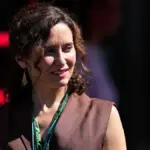
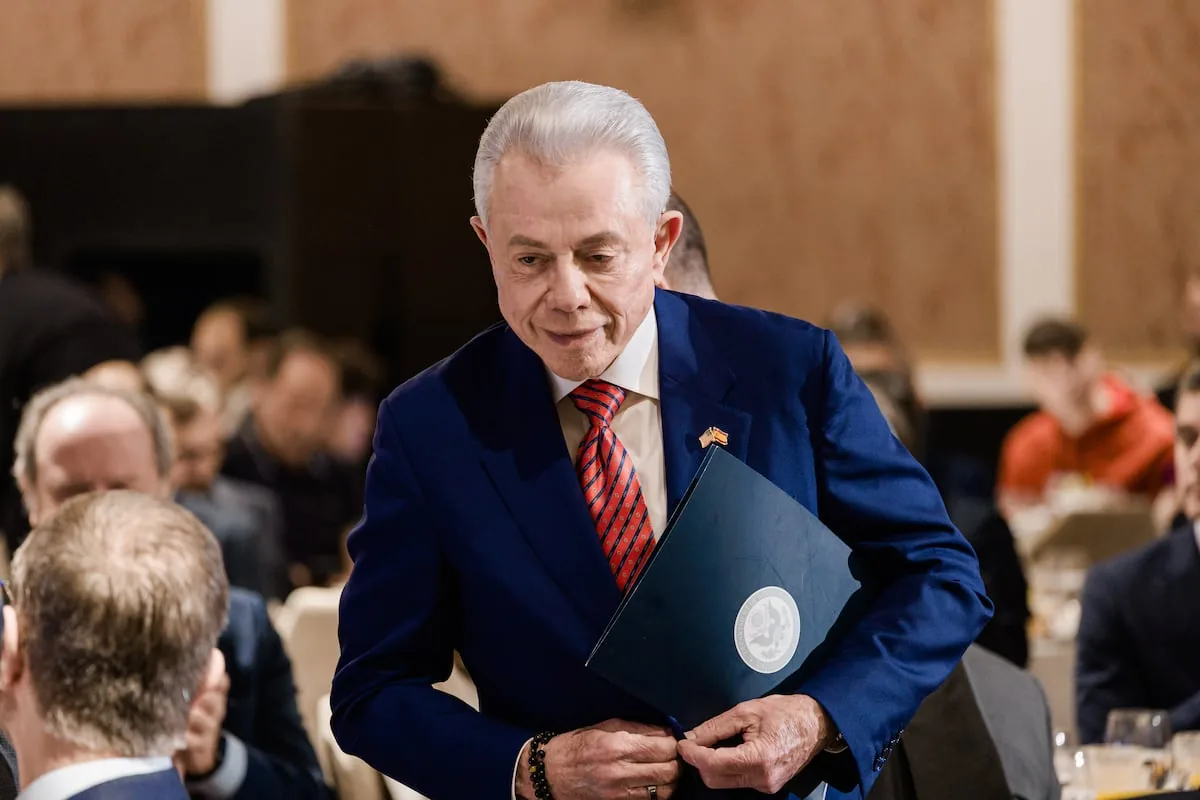
“If the president of Spain has not received me, I don’t think he is inviting President Trump.” With these words, the United States ambassador in Madrid, Benjamín León Jr., complained about not having met with President Pedro Sánchez yet, more than three months after taking office. The highest representative of the Trump Administration in Madrid has met with the leaders of the PP, Alberto Núñez Feijóo, and Vox, Santiago Abascal, as well as with the president of the Community of Madrid, Isabel Díaz Ayuso. On the Government side, he was received by the first vice president Carlos Cuerpo and the ministers of Foreign Affairs, Defense, Interior, and Agriculture, José Manuel Albares, Margarita Robles, Fernando Grande-Marlaska, and Luis Planas, in addition to presenting credentials to the King, with whom he had an extensive conversation.
Benjamín León Jr. took advantage of his first public appearance since arriving in Madrid last February 16 to express “the frustration of President [Donald] Trump” because “in 2025 in The Hague NATO committed, and 100% of the countries, including Spain, committed to raising defense spending from 2 to 5% of GDP and Spain is the only government that has said it will not fulfill what it said it would fulfill.”
At an informational breakfast organized by Nueva Economía Fórum, he insisted that the origin of the deterioration of bilateral relations lies in Pedro Sánchez’s refusal to increase military spending to 5%, although “subsequent things motivated that frustration a little more,” referring to the refusal to allow the use of Spanish bases and airspace for US and Israeli attacks against Iran. He did make clear that the “differences” are limited to the governments’ sphere. “It is nothing against the Spanish people, it is against the Government and I think he is right,” he said about Trump’s criticisms of Spain.
León acknowledged Spain’s effort to meet the 2% of GDP agreed at the Wales summit in 2014, but emphasized that safeguarding security currently faces “greater challenges” ― “we live in dangerous times,” he said ― and that requires “a new level of commitment.” Despite this, he recognized that Spain is “an indispensable NATO ally” and that the bases of Rota and Morón, where almost 7,000 US soldiers and their families are deployed, are “fundamental for collective defense.”
Read more China executes the murderer of Lin Qi, the billionaire producer of ‘The Three-Body Problem’
Asked about a hypothetical withdrawal of US troops from Spain, he responded that “the only person who has the power [to make this decision], as the top commander of the US Army, is President Trump.”
The Washington representative admitted that it is compatible to maintain a strategic relationship with the US and economically approach China, but added: “We must not confuse dialogue with naivety.” In his opinion, China “seeks to dominate critical technologies” and carries out “unfair trade practices,” as well as “economic coercion.” “Spain has to be very careful, because that is indeed dangerous,” he warned.
León, born in Cuba and with Canary Islands ancestors, was conciliatory throughout and began his speech by highlighting the Spanish contribution to the independence of the United States, which this year marks two and a half centuries. “We have been brothers for 250 years and we will continue to be brothers for 250 more years,” he proclaimed.
Read more Goodbye to detergent chaos: how this under-sink organizer makes use of the pipe space