







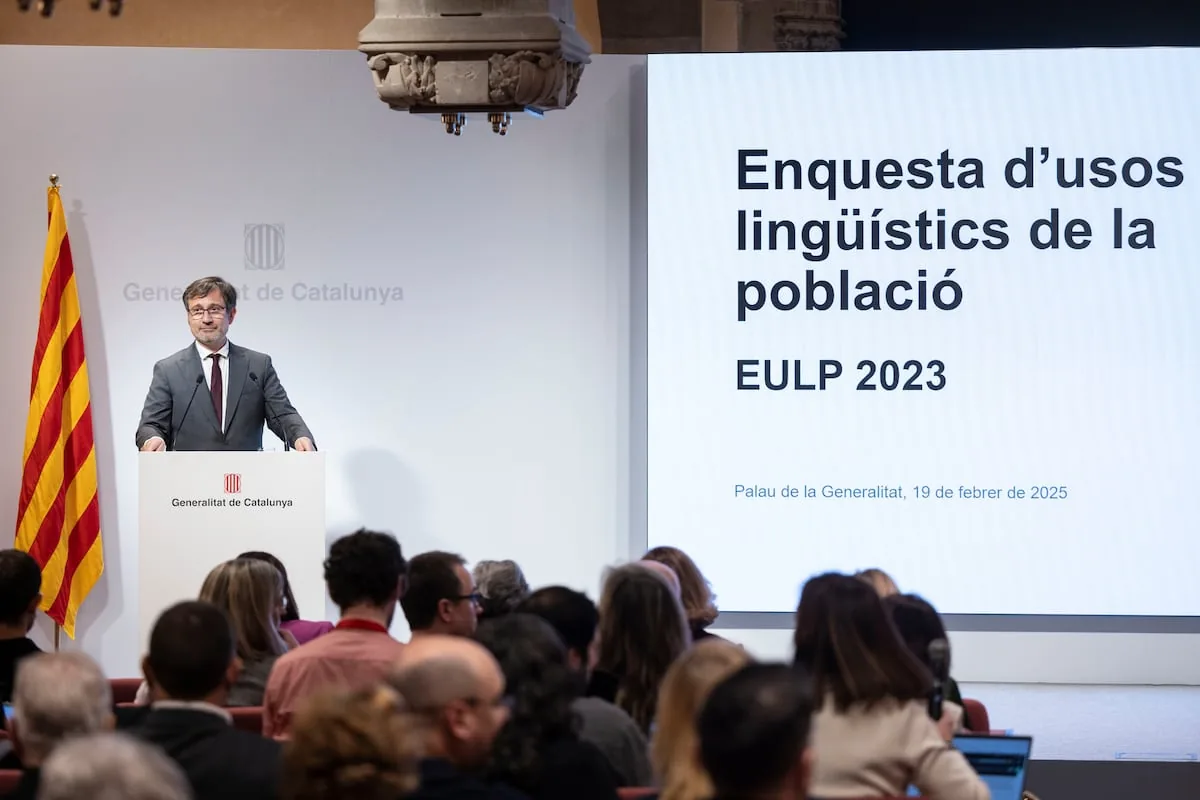
The Minister of Language Policy of the Generalitat, Francesc Xavier Vila, has described it as a “mistake” that the PSC councilor of Ripoll who took office yesterday and addressed the plenary did so in Spanish and not in Catalan. Despite being a socialist councilor and from the same party as the Government of which he is a part, Vila – asked about it on the program Aquí Catalunya of SER Catalunya – said that he “believes” it was a “mistake.”
Read more WHO calls for a ceasefire in the Democratic Republic of the Congo to stop the Ebola outbreak
Paco Morillo, a local resident, and Jorge Iglesias took office at the municipal plenary this Tuesday, after the PSC crisis in Ripoll. Morillo did not want to intervene, but Iglesias did, and he did so in Spanish, something that the mayor of Ripoll, Sílvia Orriols, criticized. In a later intervention, Iglesias responded that he “will do his best to learn Catalan.”
“It would have been a good moment to show that they can also make an effort; it would have been an ideal moment to show that they joined the Catalan language,” added the Minister of Language Policy about the Ripoll episode. Vila pointed out that he does not know the councilors “at all” and “apparently until now they have not spoken Catalan, perhaps out of embarrassment, perhaps because they do not feel confident.”
The PSC federation in Girona has had difficulty finding candidates to be councilors, after the party’s decision to expel the two previous councilors for abstaining, allowing Orriols to approve the City Council’s budgets. In protest against the decision made by the party’s high command, no name on the PSC list in Ripoll wanted to replace them.
The “delicate” health of Catalan
The Government, which on Tuesday reviewed the National Pact for the Language, has the support of the judiciary to require level C2 from teachers, but Vila stated in the interview on SER Catalunya that it will be “progressive” and will start with aspiring teachers. Asked if they will start requiring it as a condition next school year, he replied that this option “is under study.” For teachers already working, “formulas are being considered.”
The Minister of Language Policy indicated that only this year 13,000 people registered for the tests to certify this level of Catalan, mostly teachers, and more than 30,000 in the last five years. According to him, for workers in the education system it is a requirement “out of professionalism,” and he invited teachers to take the tests on their own initiative.
Vila acknowledged that Catalan has a “delicate” health because there are “negative trends” and the environment is “complex,” and admitted that the growth of speakers and knowledge of the language “is not enough to rebalance the people who come from outside.” “We are growing, but not enough; we must grow much more to guarantee the future of the language,” he stressed.
Regarding the Catalan requirement for regularized migrants, he says that the important thing is to address it “from the beginning,” but their legalization is “a priority.” For people who get jobs, there will be reports demonstrating integration efforts. For those who do not find work, training processes will be opened.
This Tuesday, at the presentation of the results of the first year of the National Pact for the Language, the Government announced the creation of the Office for the Protection of Linguistic Rights in response to the “growth” of violations with the use of Catalan, for example, in shop signage. The minister insisted that many files do not end in sanctions, because they do not have a revenue-raising aim and seek rectification from those investigated.
Read more The Spanish believe that there are now more limits to humor than ten years ago