


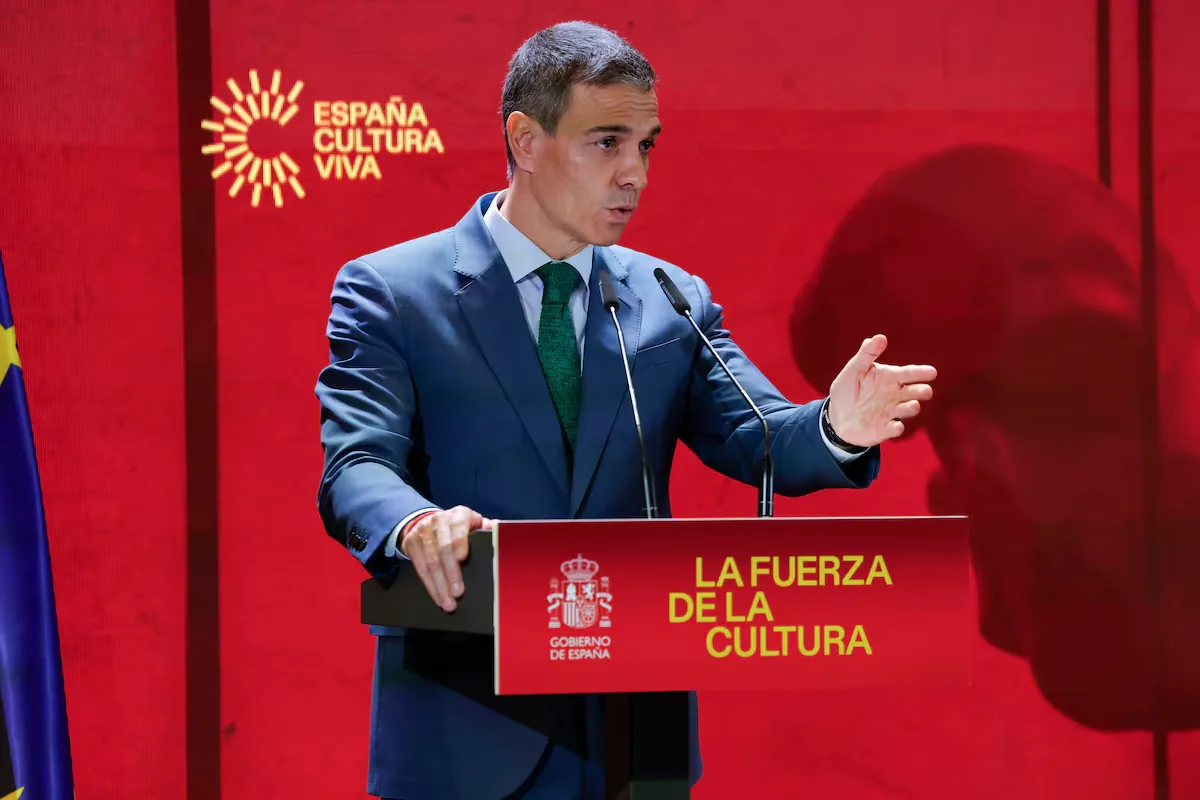
The arts know about staging. Just in case, a colossal screen stood out, in capital letters: “The power of culture.” But the message was already clear just by looking around. In the heart of Madrid, a large hall with high ceilings, dozens of familiar faces in the seats. Including the Prime Minister, Pedro Sánchez, whose speech closed, today Friday at the Instituto Cervantes, the presentation of the National Plan for Cultural Action Abroad 2026-2028, the strategy to boost Spanish creative sectors worldwide. Also present were the Ministers of Culture, Ernest Urtasun, and Foreign Affairs, José Manuel Albares, two of the up to six ministries involved in this “ambitious but achievable” project. On stage, a tasting was offered: cinema, video games, monuments, art, dance, comics, gastronomy were seen, music was heard. But the document includes hundreds of activities of all kinds. Just what its star novelty tries to summarize: the label Spain. Living Culture, a “seal of excellence” whose logo evokes a sun with many rays.
Read more Simone Biles: “I hate exercise, after so many years I think I deserve a break”
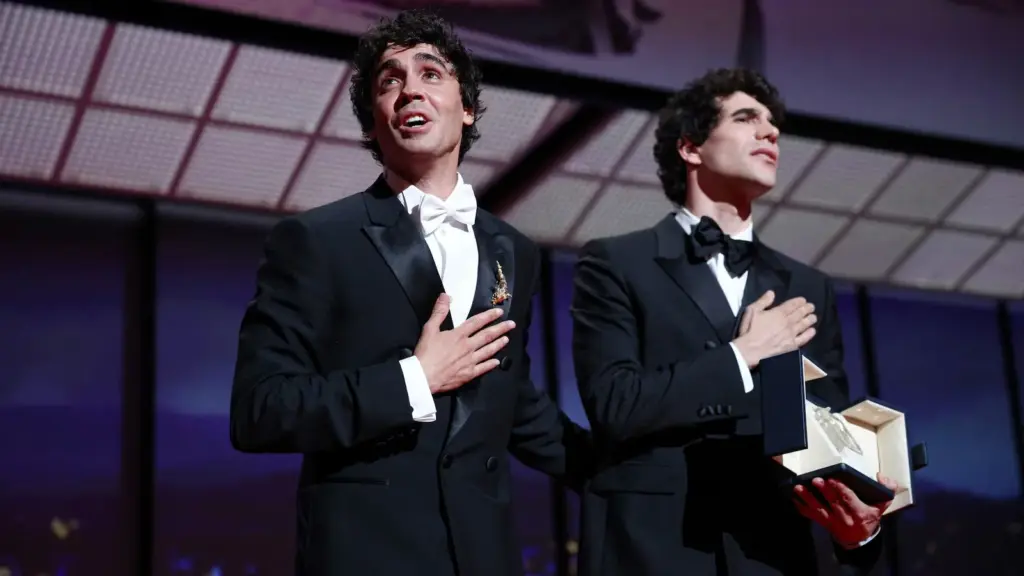
Throughout 125 pages the plan cites more actions, such as improving public coordination or creating a certification that turns creators, institutions, or works of certain value into flags of the country. “The great ambassadors of Spain are those who make culture, like Rosalía or the Javis [recent joint winners of the best directing award at Cannes, for La bola negra]”, Albares said. The document lists more names, such as Almodóvar, Mallo, Zambrano, or Lorca; it also highlights events, like the Spain-India dual year or the XXX Ibero-American Summit that Madrid will host in November; it displays record figures, such as 770,000 employees in 2024 or that up to a quarter of the highest tourist influx in history is due to the arts; and repeats words like multilateralism, diplomacy, coexistence, development, or cooperation. Although perhaps it all sums up in the expression coined by thinker Joseph Nye three decades ago and rescued by the plan: “Soft power.”
The best culture is often full of contradictions. And it was impossible not to see one in the event itself: promoting the splendor of the Spain brand abroad, just when it is going through one of its worst internal moments, amid multiple judicial scandals affecting the PSOE, the main governing party. The director of the Cervantes, Luis García Montero, gave his opinion: “There is a millionaire elite using their puppets to tarnish Spain’s image.” But not much more was said about it. Nor could that or other issues be raised: the appearance did not allow questions.
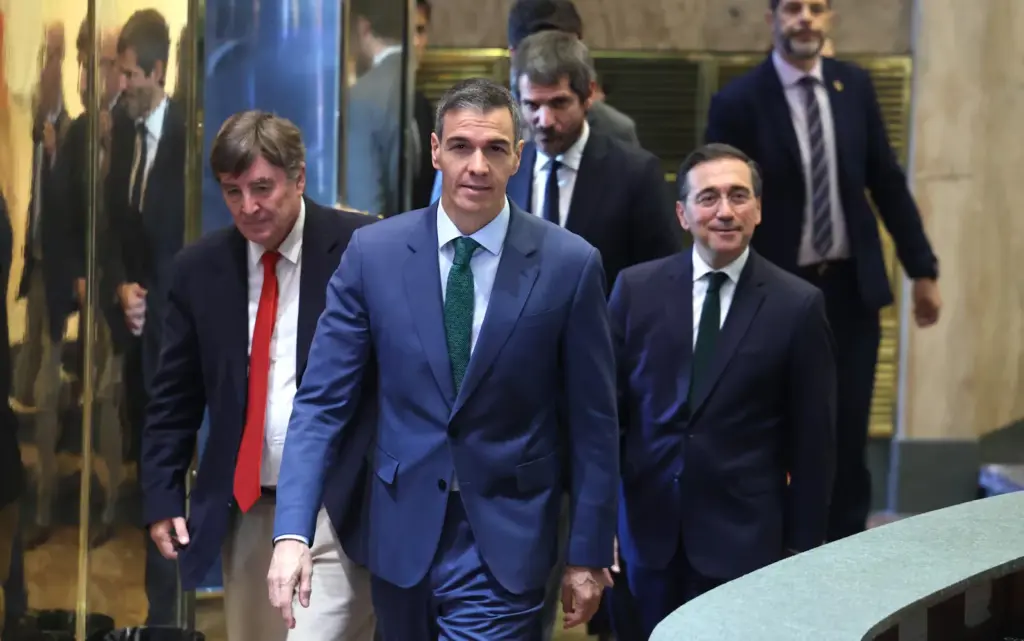
In his speech, Sánchez boasted of representing the fourth country by artistic influence, behind Italy, France, and Japan, according to the Global Soft Power Index 2026. The data refers to the “Culture and Heritage” section of the report: in the overall ranking, led by the USA, In any case, the president emphasized another key point: “In a world where some appeal to the culture of force, of war, we choose an alternative path, the power of culture.” Or, in Urtasun’s words: “At this moment, Spain has something to tell the world.” Sánchez also pointed out one of the areas where the Government has detected the greatest growth margin: “For too long we settled for exporting talent instead of building a true cultural power. That is the challenge this plan faces.” The report itself acknowledges: “The position of global leadership […] does not translate into the economic profitability of its exports.”
The truth is that revenue abroad has been growing in recent years, but it accounts for 0.6% of total exports, ranking seventh in the EU, far behind France’s 1.8% or Italy’s 2.7%. And that figure includes jewelry, one of the most relevant items after books or audiovisual. The net balance places Spain as a culture-importing country, and the plan for the next two years prioritizes changing that.
“Its objective is to design an identity or brand of Spanish culture that is internationally associated with the idea of quality, excellence, authenticity, originality, diversity, and richness,” the report reads, about Spain. Living Culture. The project promises to “consolidate the growth” of disciplines such as literature, comics, music, or audiovisual, and to “promote all those with international projection, such as dance or video games.” Also, “commercial agreements will be promoted with major companies and leading cultural companies in each field to increase investment in Spanish cultural goods and services, and their external dissemination.”
Cultural diplomacy or the economic development of the often very precarious sector are other axes of the plan. Sánchez repeated, as on other occasions, that for every euro invested in culture the return to the economy is 1.75 euros. And he defended: “One of the greatest successes of our foreign policy is that we do not inspire fear, but respect. That we inspire, period. Today many people outside our country see in us an open way of being in the world.” The Spanish language is increasingly spoken also in the literal sense. “It is official in more than 20 countries and is learned in 111 countries as a foreign language. […] Worldwide there are about 520 million native speakers (the third language by native demographics after Mandarin and Hindi),” the document summarizes. And it promises to reinforce it with the launch on RTVE of a new cultural channel in September and of The Great Adventure of the Spanish Language, an educational journey through the history of the language, presented by Iñaki Gabilondo.
Among the upcoming milestones, the opening of a new Cervantes headquarters in Seoul is also included, to strengthen ties with South Korea, another country with evident cultural momentum; or the celebration of the 250th anniversary of the founding of the USA, which places underwater heritage at the center of the relationship between the two countries, among other aspects. Perhaps culture will even bring Donald Trump and Sánchez together for once, who lately disagree much more than they agree. Later, already for 2027, the plan highlights the Belgrade International Exhibition, the centenary of the Generation of ’27, or the Goya Year in 2028, two centuries after the painter’s death. “He did not only portray the Spain of his time, but conflicts that continue. The tension between reason and extremism, between freedom and authoritarianism. And he embodied one of the great paradoxes of our history: a country capable of producing universal geniuses, which too often we have not known how to protect, even recognize. Goya died exiled in Bordeaux, far from the land he had painted better than anyone,” Sánchez stated.
Much less time will have to pass for another milestone of the plan, The World Map of Music in Spanish, whose presentation is scheduled for June 21. The report is cited within the section Music in Spanish, more universal than ever, which recalls the triumph of the cultural sector that has grown the most since the pandemic and the creation of tools such as the Music Export Office or the digital platform Sounds from Spain, which aims to gather information “from the main agents involved in internationalization.”
There was, in short, a lot. Although not everything. In the map of areas of interest of the plan, Chile or Peru are missing, and almost entirely Africa. And Artificial Intelligence is mostly cited for opportunities rather than threats. The event defended the economic power of culture, which accounts for up to 2.3% of gross value added and contributes more than the textile, pharmaceutical, or chemical industries. However, it was not explained why, then, in the General State Budgets it never exceeds 0.3% of spending. The birth of thousands of companies was highlighted, without specifying that the vast majority of what statistics call companies are self-employed workers, almost always intermittent. “Culture is not created by institutions, but by people,” García Montero reminded.
The plan also includes unprecedented figures of participation and attendance, such as 47.6% who attended museums, galleries, or exhibitions in the last year. But theaters and cinemas have been losing audiences and performances. And, above all, lower youth, education level, size of place of residence, or income almost always corresponds to lower involvement with the arts. So much so that some speak of “cultural exclusion.” Thus, a few shadows persist. Although the plan chooses to focus on the many lights. Sánchez stated: “Every Saturday I try to contribute my little grain of sand of cultural recommendations on some social network. I could spend years doing it. But today my recommendation is simple: Spain.” In the seats, there was applause. Now it is up to the plan to achieve it in the rest of the world.
Read more The 3-liter water dispenser that fits in any fridge and prevents refilling bottles all day long