






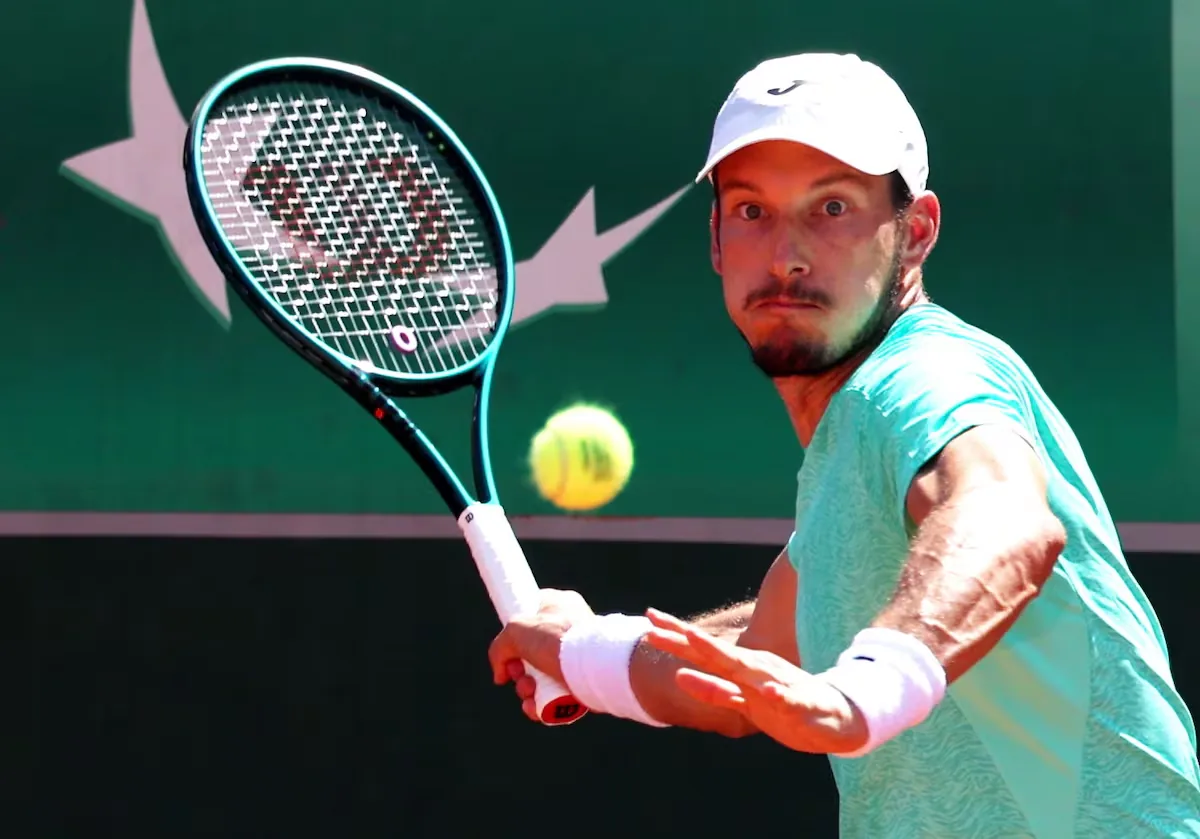
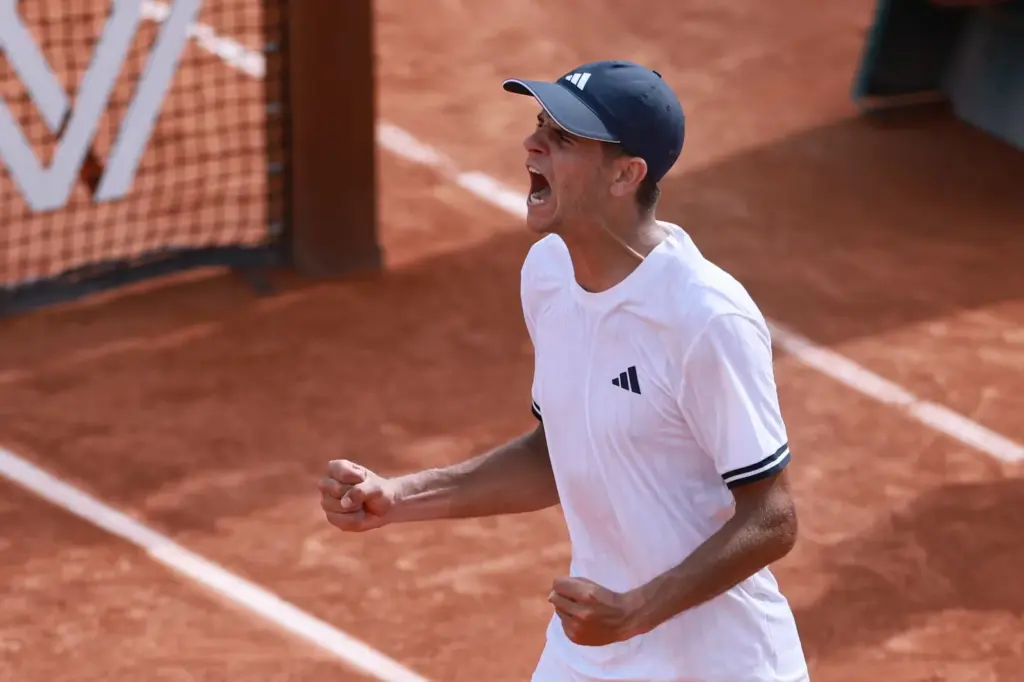
Under the leaden mantle of the Paris sky, the tennis players give their all and, in some cases, catch the sluggishness. On the Simonne Mathieu court, adjacent to the beautiful greenhouses of Auteuil, the duel between Rafael Jódar and Alex Michelsen translates into a difficult exercise in digestion: two or three shots and many errors. A little more. It is certainly not a day for flourishes, but for survival. And so does the young Madrilenian, who maintains his flight amid vertigo (7-6(2), 6-7(5), 4-6, 6-3, and 6-4, in 4h 16m) and gains access to the Roland Garros round of 16, where Pablo Carreño was already waiting for him. Indeed, Carreño. Four years later, at 34, the Asturian (7-6 (0), 7-5, 3-6, and 6-4 against Thiago Agustín Tirante) will return to the second week of a major tournament.
Read more Municipalities and the private sector address solutions to Chile’s water crisis
“I am very proud, I have to celebrate this. I have gone through very difficult moments,” he says after having showered and rehydrated, referring to the difficult circumstances in which he landed in Paris (“very tight”), to past times and also to others that are not so much. Until four days ago, Carreño suffered from his shoulder and a week before traveling to the French capital he had to withdraw from the Valencia challenger due to discomfort, although the treatment has been effective and he was finally able to compete. He first beat the world’s twelfth, Jiri Lehecka, and then benefited from the retirement of Australian Thanasi Kokkinakis; now, the Argentine Tirante ends up falling in a great match.
“It was practically perfect on my part. He is very good on this surface, so I knew I had to be very aggressive. The tactic worked from the start, then I lost a bit of energy, but then I came back well. I played [3h 33m] very, very well,” the Gijón native appreciates, surprised by the state of the court, full of contrasts: “They are very dry, but this one [the 14] looked like Luanco beach… They didn’t even water it after the first set.” In any case, Carreño sneaks back into the tournament’s free zone and values his reconstruction, after two years of hardships in which his elbow forced him to undergo surgery and then, upon returning, he had to redo the path he had made before.
“I got goosebumps because those were very tough moments. The effort you have to make to get back to this level and physically recover what you once had is not easy… I didn’t come thinking about reaching the second week, honestly, so this is very rewarding. The mere fact that my son can see me play makes it all worthwhile,” continues the Spanish tennis player, who once (2017) reached the top-10, celebrated an Olympic bronze (2021) and a Masters 1000 (Canada 2022), and played a couple of semifinals in New York and Paris, where he now recovers good vibes. Out of focus, he fell to position 1,052 (April 2024) and today he returns: he is among the top 70, 68th.
To do so, Carreño had no choice but to get down to the mud of the challengers and maneuver. He left Ferrero’s academy in Villena (Alicante) and enlisted at Carles Ferrer Salat’s TEC; he stopped working with Samuel López — the current coach of Carlos Alcaraz — and entrusted himself to Víctor López and Edu Esteve; and he moved from Barcelona to Madrid, where he usually trains at the Chamartín Tennis Club and works with trainer Vicente Calvo, who at one time helped Fernando Verdasco, Feliciano López, and Pato Clavet extend their careers. “Age no longer forgives,” he jokes. “But I have regained the enthusiasm and that extra,” he continues before referring to that new wave that has come strong, with name and surname.
Guerrilla Suit
One of them, Jódar, whom he will meet on Sunday. “I don’t know what they feed them, but they are coming with a lot of desire; with a lot of power and joy… Those of my generation are already asking for the hour.” “I coincided with him at the Valencia Davis [2024]. He was very skinny and still is, but his body has grown,” he clarifies; “then we already saw that he played very well, with those levers he has, and that he never loses track. He already showed promise. Having gone to university [Virginia, in 2025] he has grown very away from the spotlight and has arrived a little more hidden, but he has made a leap in confidence and level. His hand didn’t tremble. He made great tournaments in Barcelona, Madrid, and Rome, and now he is doing it here.”
That’s right, but in a different format. If on the first day (against Aleksandar Kovacevic) he maintained the dynamic of the preparatory tournaments, against James Duckworth (four sets and 3h 22) and this Friday against Michelsen (five and more than four hours) he had to wear the guerrilla suit: tension and more tension, cold and hard head, and courage to overcome a very tricky scenario because after having served to take the second set, which would have paved the way, everything went wrong. Strength fluctuates. The opponent counterattacks with a risky bet and at times puts him against the ropes. In the end, however, Jódar roars and makes an X with his arms, satisfied “for having given everything and being there.”
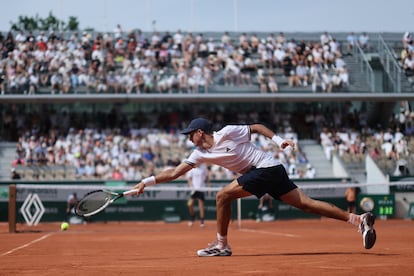
Again, a more than demanding atmosphere, with scorching 33° and not quite finding the good sensations. At times some see him eliminated, but he recovers — lowers the gear, more judgment — and gets up. Spanish tennis, therefore, will maintain its good work and as it has been happening since 1981, will have at least one representative in the Roland Garros quarterfinals. “It’s a dream come true. It was a tough match. The most important thing was to be mentally there, to have fought until the last point,” he says after a rough and imprecise duel, resolved with 59 unforced errors on one side and 48 and 11 double faults on his, all compensated by the 71 winning shots he signs and, above all, by that knowing how to hold on with everything to the tournament.
“I always fight, and that’s what I did today,” he concludes after achieving the second five-set victory of his career, after the one he got in January against the Japanese Rei Sakamoto. In two days, him and Carreño. The one who came and the one who, supposedly, had taken the exit door.