




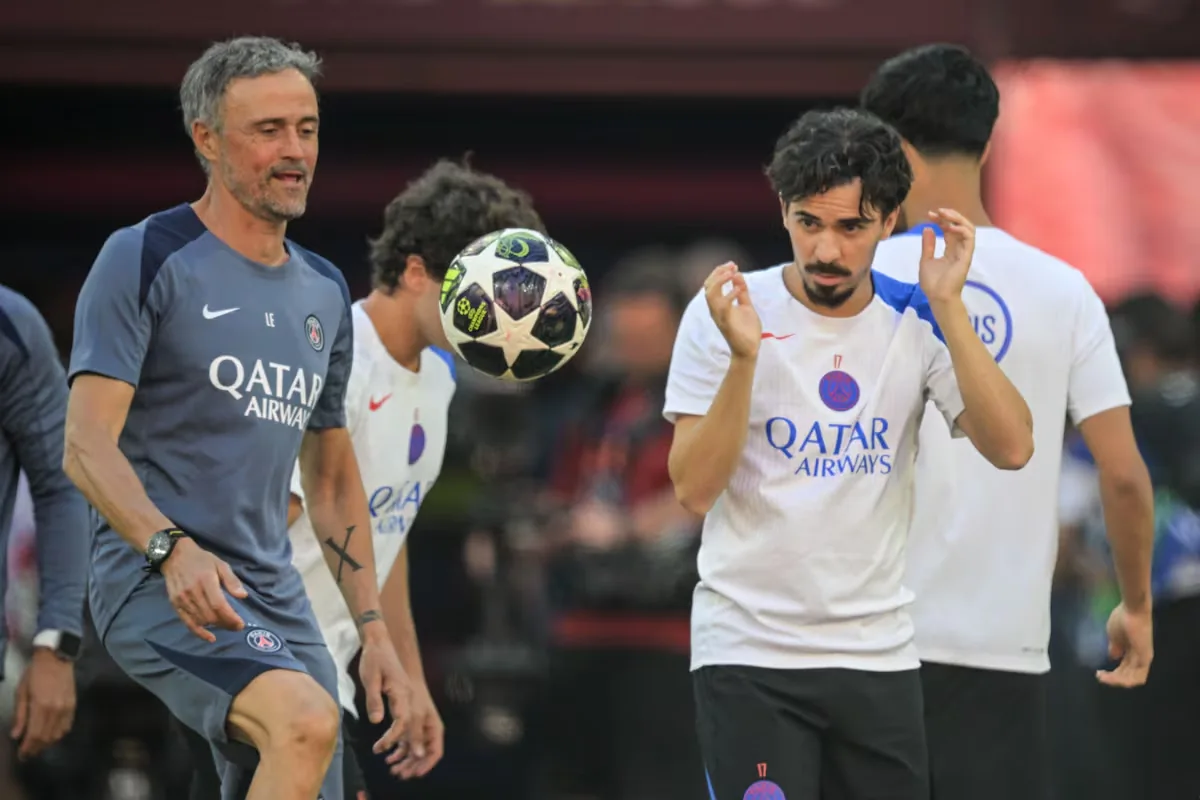
The sun penetrates through the crater of the Puskas Arena and sweetens the grass-scented air of Budapest. In the center circle, Luis Enrique, ruddy and excited, scans the landscape with fox-like eyes. He is supported by his staff, Joaquín Valdés and Rafa Pol, and together they follow the rondo. The Paris Saint-Germain players position themselves on the field like markers on the bezel of a clock and begin passing the ball. The ball moves and traces seemingly random trajectories until it reaches the foot of Vítor Machado, Vitinha. When the Maestro touches the ball, the inanimate sphere acquires something akin to intelligence and all teammates respond to the call of the little leader. The best midfielder in the world is the key man in the Champions final to be played this Saturday (18:00, Movistar and La1). If Mikel Arteta’s Arsenal wants to snatch the crown from Luis Enrique’s PSG, they will have to overcome Vitinha’s ingenuity.
Read more Ten nights, one stadium, and a single law: that of Bad Bunny and the business of residencies
The title brings together the 2024-25 Champions champion against the Premier champion. Rarely has the final of the most prestigious tournament faced two teams so powerful at their peak. Only sustained work over time has allowed Luis Enrique (three years since his hiring) and Arteta (six years) to train their players to integrate them into ways of functioning and feeling that border on telepathy. Each on opposite sides of the 4-3-3. While Arsenal is the empire of speculation and adaptation to the opponent, PSG shows a wilder vein, more decisively attacking, less calculating, less attentive to avoiding mistakes in their eagerness to generate danger.
“More than talking about two different ideas, I would say we are facing two ideas that are similar but follow different paths,” said Luis Enrique in his nascent French, yesterday during the Budapest conference. “They are the best team in the world at playing without the ball, but they also score many goals; and we score many goals and also defend very well.”
The idea that identifies them is man-to-man pressure in the opponent’s half. Both Arsenal and PSG have evolved this tool into a weapon capable of suffocating any rival. The midfield is the Hispanic hallmark of both and the springboard from which everything starts. Their own pressure and the escape from the opponent’s pressure. Thanks to their midfielders, Arsenal and PSG are in a position to try to take the initiative in any scenario. Rarely, perhaps never in the modern era of the tournament, has a Champions final pitted more qualified midfielders at the peak of their careers against each other. Vitinha, Neves, Fabián, and Zaïre Emery against Odegaard, Rice, Zubimendi, and the versatile Trossard will compose an unforgettable battle. It will be the gateway to the upcoming World Cup with a supertactical twist impossible to see in international football.
“We can’t wait to play this match,” said Martin Odegaard, Arsenal’s great strategist, before completing the last training session. If there is a footballer capable of surpassing Vitinha in organizational creativity, it is the 27-year-old Norwegian who yesterday appeared focused and serious, thin to the point of revealing the cheekbones’ bones, like athletes after a marathon. “Winning the Premier with Arsenal after 22 years has filled us with confidence and positive vibes,” said the player, “we fought for the league for so long that now that the background noise has died down, when we no longer hear people saying we would never win, we feel a positive relief. We keep the good experiences. With all the effort we have gone through as a group.”
Read more PNV and Junts pressure with elections without room to support the censorship of Sánchez
Arsenal, overloaded
After three frustrating seasons with no prize other than three consecutive second places, Arsenal conquered a Premier that threatens to turn into a Pyrrhic victory if Arteta fails to manage the emotional wear caused by the last months of competition. The squad is exhausted. No team has played more matches in Europe since the season began. The Champions final is the last challenge for players who have had to push themselves to get one more point from Manchester City. The minutes of competition accumulated in their legs reveal the scarcity of rotations. Raya (4,500), Rice (4,336), Zubimendi (4,269), Saliba (4,134), Gabriel (4,090), Gyokeres (3,429), Timber (3,309), Saka (3,173), and Eze (3,087) exceed 3,000 minutes of competition on all fronts, while at PSG the most used players show a completely revolutionary planning by Luis Enrique.
The Asturian coach responded to the saturation of the 2025 Club World Cup summer by resting half of his squad. He took advantage of the lack of demand in Ligue 1 to rotate and tried to preserve the structure of the starters in the Champions. This is reflected in the list of the 11 most used players of the year: Zaïre-Emery (4,199 minutes), Vitinha (3,951), Pacho (3,719), Barcola (2,934), Mendes (2,859), Kvaratskhelia (2,825), Joao Neves (2,581), Marquinhos (2,564), Hakimi (2,499), Doué (2,438), and Dembélé (2,110). All arrive at the final fresher than their opponents. Dembélé, the Ballon d’Or, barely started 11 matches in the French league but played 12 Champions matches in which he scored seven decisive goals.
Before organizing a training session with stationary bikes on the grass, a sign of his team’s condition, Arteta delivered a monotone speech: “It has been 20 years since Arsenal reached a Champions final. We are facing our chance to seize the moment. It is the second final in our history and we do not feel the pressure. The ambition is greater than the pressure!”
Arteta sounds like a behavioral psychologist. He has built a strong team, perhaps too strong. “Odegaard is a leader to whom I would entrust my life,” said the coach, pointing to his captain. The Norwegian knows he is facing the match of his life. Also that the only path to glory is to snatch the crown from the Maestro.