









A little over six months ago, Elon Musk took the stage euphoric, dancing and joking in front of several hundred investors at Tesla’s headquarters in Austin, Texas. Alongside him, half a dozen prototypes of the humanoid robot Optimus moved mechanically and syncopated. It resembled one of those dystopian Hollywood movies. “The magnitude of Optimus is going to be something truly extraordinary. I think it will be, by far, the biggest product of all time. Bigger than mobile phones, bigger than anything else,” he proclaimed in a state of ecstasy with a grandiose and disorganized speech. It was no surprise, he had just secured approval from Tesla shareholders to set a salary of one trillion (with a t) dollars to lead the company in the next decade.
“Things get quite complicated from an economic point of view, because with AI and robotics, the global economy can multiply by ten or even a hundred. There is no clear limit. Optimus is like an inexhaustible source of money. And maybe in the future, money won’t even exist. Maybe it will be measured in watts, that is, how much electrical power can be generated,” he concluded, feverish from the success he imagined.
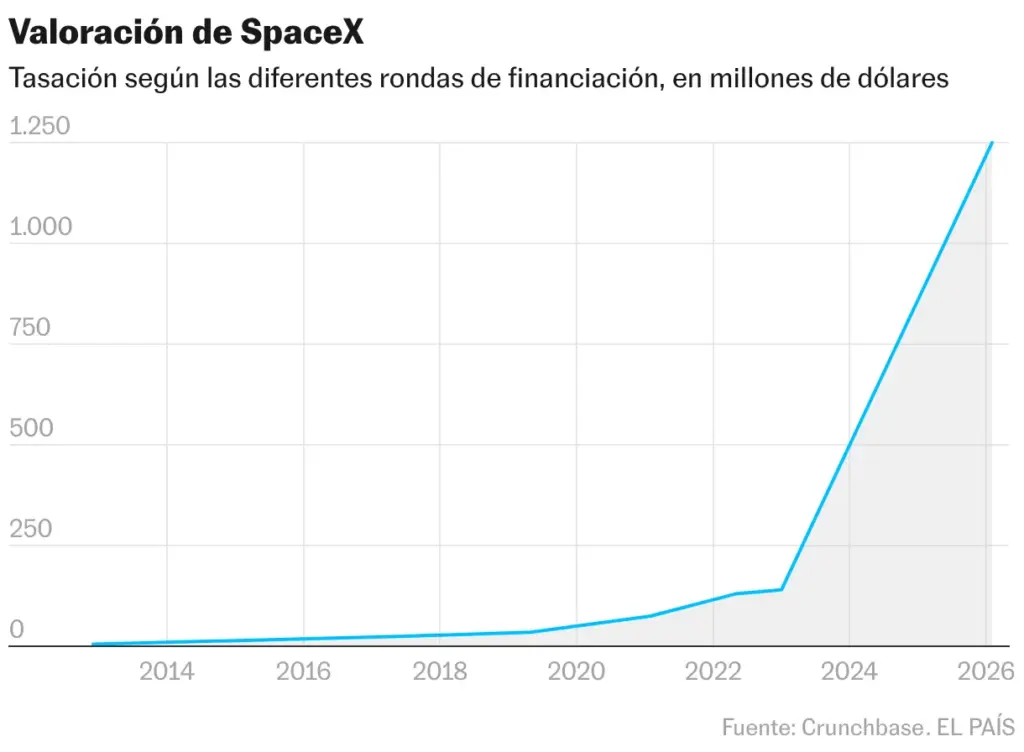
The near future, however, does not lie with Tesla, it leads to SpaceX, which in the coming weeks will face what has been dubbed the biggest stock market debut in history. The company founded by Elon Musk in 2002 as a project to carry out manned flights to Mars is preparing for its most important launch. A debut on the stock market with which it hopes to raise up to 75 billion dollars and obtain a valuation between 1.5 and two trillion dollars, instantly becoming one of the three largest companies in the world.
If successfully completed, the valuation of the magnate’s business empire approaches three trillion dollars (about 2.53 trillion euros). To get an idea of the size of that amount, it would be almost double Spain’s GDP for a year. The workers and investors who participated in previous funding rounds to grow the company will also become (more) wealthy overnight.
It will surpass the market debut of Aramco, the colossal Saudi oil company that harvested nearly 26 billion dollars in its whirlwind stock market debut at the end of 2019, considered at that time a global financial milestone.
SpaceX, officially known as Space Exploration Technologies Corp, is not just a rocket launch company, although it was born as such. It is also the largest satellite internet provider, thanks to the service provided by Starlink, the company that owns the network of transmitters orbiting the Earth to connect remote and isolated areas. This company became strategic after the Russian invasion of Ukraine; when Moscow cut the terrestrial network, Starlink managed to supply critical communications for the Ukrainian army.
Last February, SpaceX absorbed xAI, the artificial intelligence company of the conglomerate led by Elon Musk. xAI created the chatbot Grok, used on X, the former Twitter, known for its blunders and poor ethical control. It has accumulated complaints for generating sexualized images of well-known characters and for spreading hate speech. All these businesses, rockets, internet services through Starlink, the social network X, and the xAI platform, are under the same umbrella of SpaceX.
Moreover, Elon Musk has always had a symbiotic relationship with the companies he leads. The connection between Tesla and SpaceX is evident. The company that was born as an electric car manufacturer provides infrastructure, energy, and microprocessors to the company about to go public. Both form a complex web of relationships dependent on each other.
Since August 1602, when the first stock market debut in history took place, with the distribution of capital of the Dutch East India Company to raise funds to finance commercial expeditions in Asia, the goal of all Initial Public Offerings (IPOs) has been precisely that: to obtain resources to finance a business or operation. IPOs became popular in the 1980s when interest rates were so high that it was more profitable to go public than to borrow money from banks. That is not the case now, but the capital needs of companies like SpaceX are so high that it is difficult to find financiers for those volumes.
In fact, SpaceX competes with companies like OpenAI or Anthropic for investor funds. Elon Musk plans for SpaceX’s definitive launch on Wall Street, where it will be listed on the Nasdaq tech index, to be on June 12. But the other two AI startups also hope to go public this fall with multimillion-dollar fundraisings that will rival SpaceX and with trillion-dollar valuations that will place them among the largest tech companies in the world. This joint move by the three companies threatens to cause a tsunami in financial markets. Never in history have movements of this magnitude occurred with such little time difference and requiring so much money to be mobilized. If investors bet on these companies, they will stop having funds elsewhere, which has investors and analysts on high alert.
In this race, there is a competition to see which of these AI companies can hold out the longest without going public. They believe that the later they do it, the higher valuation they can obtain due to the speed of technological innovations, but at the same time, none wants to be the last and risk finding drier markets after the harvest of the other two.
The race is curious. The destinies of the three companies are intertwined. Elon Musk, Sam Altman (OpenAI), and Anthropic (Dario Amodei) were part of the founding team of the first non-profit artificial intelligence lab (OpenAI). Then problems arose. Musk accused Altman of prostituting the company’s purpose to give it a commercial goal to make money; Amodei accused him of not following ethical principles in developing the AI tool. Many of these disputes ended up in court. In fact, last week, Musk lost the lawsuit against Sam Altman for turning OpenAI into a company against its founding principles. The decision paves the way for OpenAI to also go public.
The timing of SpaceX’s stock market debut is complex. After the US war against Iran and the blockade of the Strait of Hormuz, markets are epidermic, with growing distrust, subject to much volatility, and scrutinizing any new event. The operation coincided with a rebound in bond markets. The 30-year US Treasury bond has recently reached its highest value since the 2008 financial crisis, with increasing yields that are beginning to attract some investors’ attention. So Elon Musk’s conglomerate will face the market in a context where investors are expectant and in a tense market.
Read more From the ‘Operation Kitchen’ to Leire Díez: the sewers feed back into themselves
So, what does SpaceX want the money for? Last week, Elon Musk’s rocket company filed its IPO application with the US market regulator (SEC). The 54-year-old South African-born magnate has always been quite opaque with his companies’ accounts. He is stingy with the information he transmits to the market and distrusts them. In 2018, he claimed to have raised the money to take Tesla private, which never happened. Later, when he bought Twitter and renamed it X, he privatized it to avoid having to report to investors every three months. “Unfortunately, the parasitic burden of being a public company has increased,” Musk recently said to express his dissatisfaction with the reporting requirements of a listed company. When it goes public, SpaceX will have to undergo market scrutiny every three months.
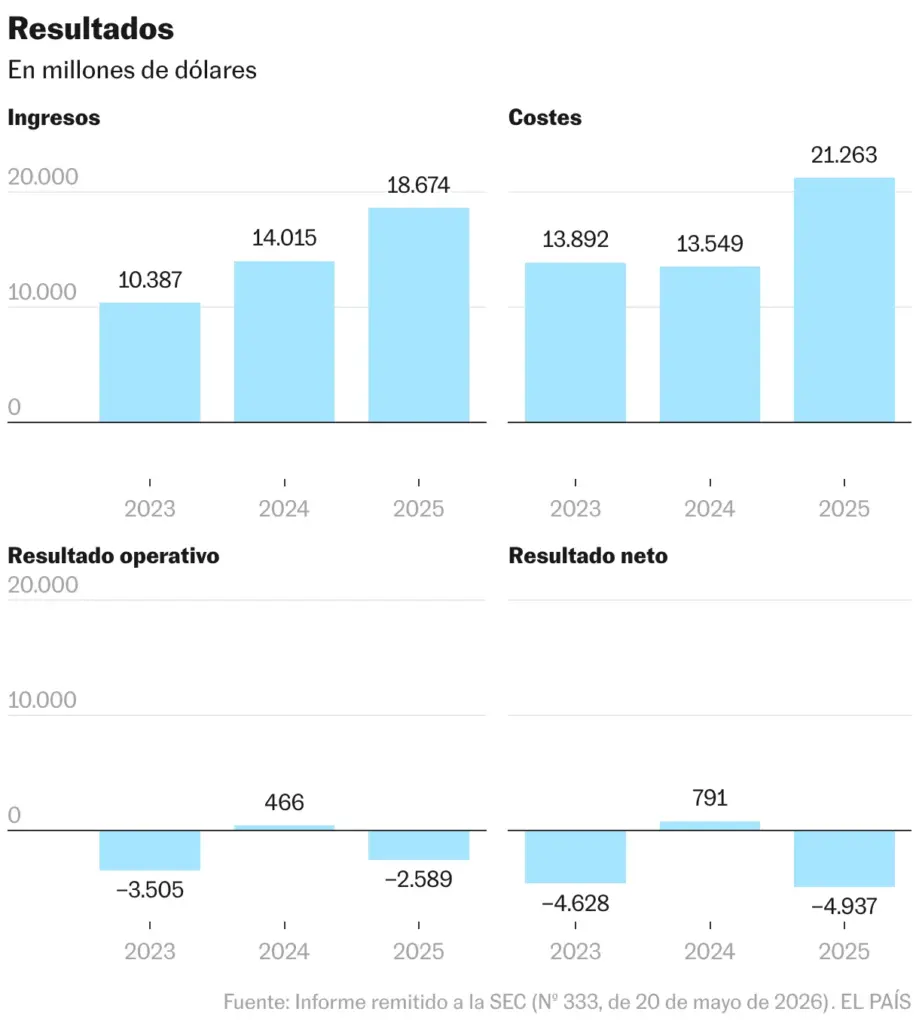
The application SpaceX submitted last week to the SEC, the stock market regulator, contained the most detailed financial information of the company in years. What the financial statements say is that the company has a growing business but is not profitable. Last year it billed 18.674 billion dollars (about 16 billion euros), which is 33% more than the previous year. But it still hasn’t taken off: in 2025 it recorded losses of 4.937 billion dollars, compared to a profit of 791 million the previous year. The issue is that the results do not look like improving in the short term. Only during the first quarter, it recorded red numbers of 4.947 billion due to the high capital consumption (investment) to develop its artificial intelligence business, framed in its subsidiary xAI.
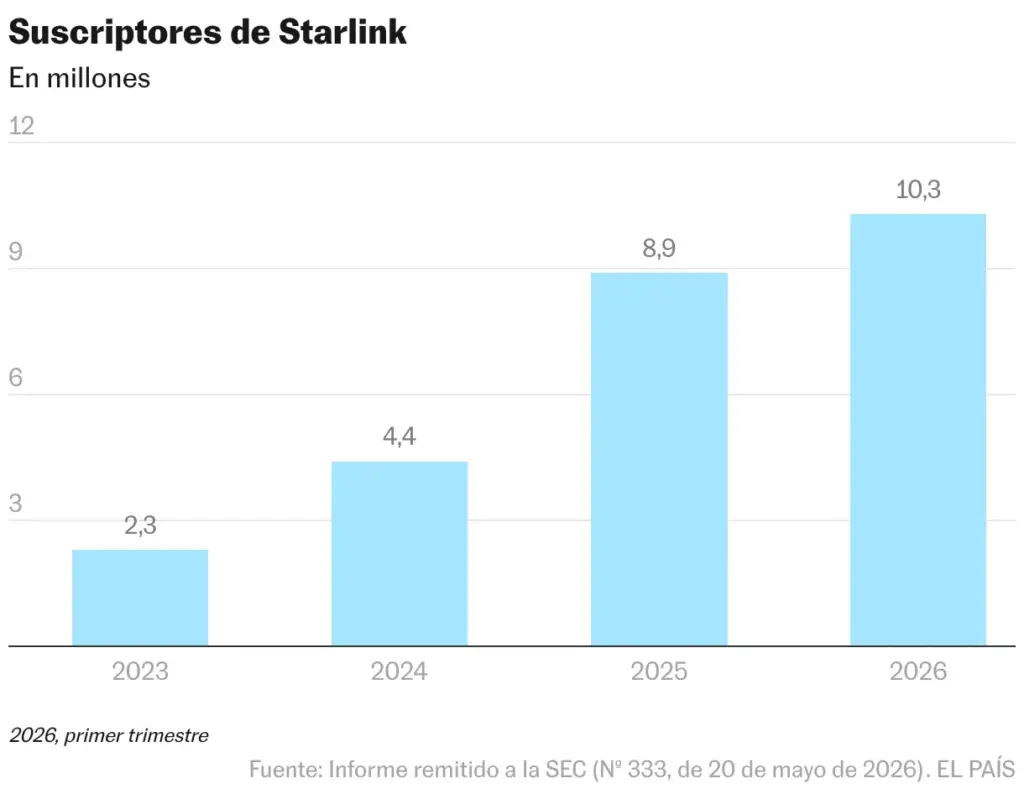
The figures describe the story of a company with good prospects but that fails to make money. It won’t be for the apparently prosperous connectivity business of Starlink, with which it earned more than 11.3 billion dollars in 2025, almost 50% more. The company already has a constellation of nearly 10,000 satellites in low Earth orbit to weave a network of connections that reaches practically every corner of the world. Thanks to that reach, it has 10.3 million customers in 164 countries worldwide, which allowed it to obtain a profit of 4.423 million last year. Although SpaceX presents the number of customers as a success, it remains a medium-sized company in the sector in terms of customers. It is overshadowed by traditional operators: for example, US telecoms AT&T, Verizon, or Comcast (Xfinity) comfortably double the customer numbers of Elon Musk’s company. So, although Starlink is doing well and has differential strengths, it alone does not justify SpaceX’s enormous valuation.
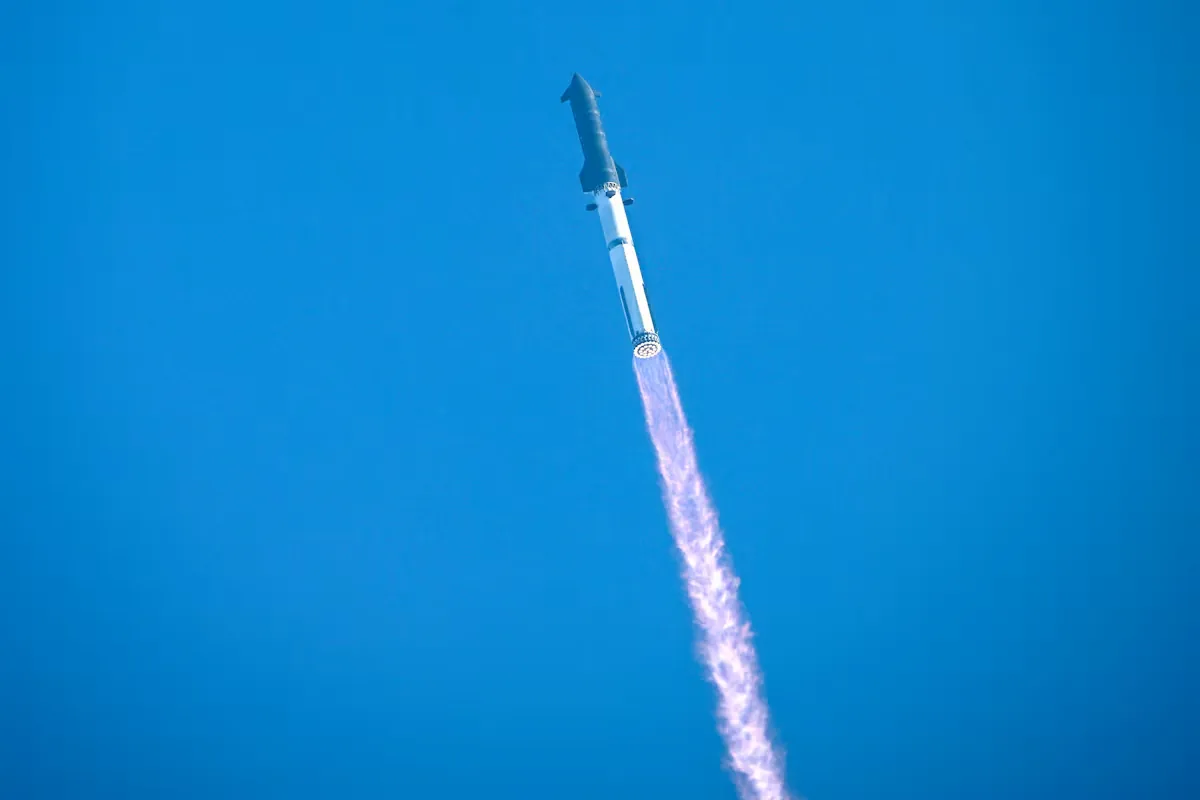
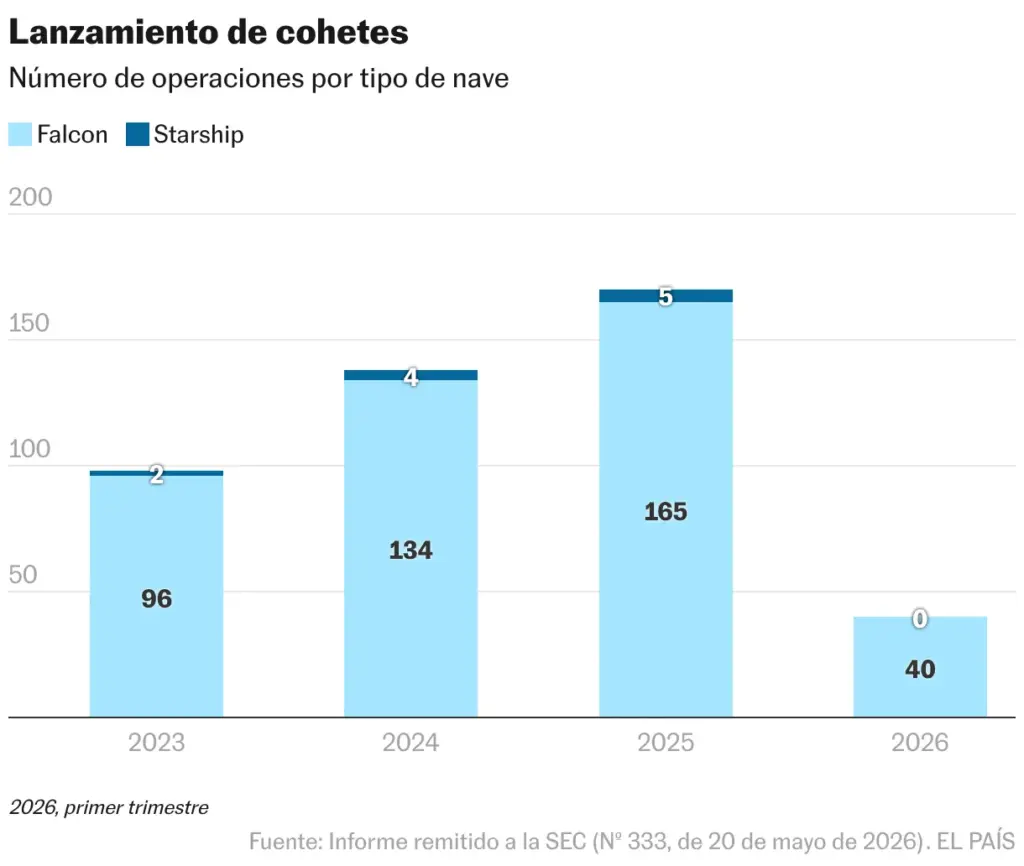
Its space business is what gives it reputation and projection. This very week, coinciding with the group’s IPO announcement, SpaceX has launched with great fanfare from its space base in southern Texas its mega rocket, Starship, intended to make space travel. It is the largest and most powerful booster ever built, with which the richest man in the world hopes to take the lead in the race to take man to the Moon. The truth is that SpaceX has transformed space travel and has secured lucrative contracts with NASA and the US Department of Defense. It promotes projects so that many launch parts are reused in a cost-reduction strategy that makes it very competitive. In addition, it has taken advantage of launches to deploy hundreds of Starlink satellites in orbit. Thanks to those contracts, it obtained revenues of 4.086 billion dollars, many of them from the Donald Trump administration, with whom Elon maintains a close relationship. Still, they were insufficient for this business unit to yield results. The rocket company’s losses last year amounted to 657 million.
SpaceX’s problem lies in the gigantic amount of money xAI requires to keep pace in the artificial intelligence race in a desperate competition with OpenAI, Anthropic, or Google, among others. The sector is experiencing a frantic period, allocating huge resources to develop its AI models. Although SpaceX is developing its own chatbot, known as Grok, its real business is in building data centers. Developing AI requires many computing resources, thousands of servers in gigantic industrial warehouses processing information to train the model. To reduce that process’s cost, Musk plans to build some of these data centers on the moon or in space.
Elon Musk needs a river of liquidity to finance his costly projects: he has a plan to develop a data center in space; he also plans to build a microprocessor manufacturing plant. These projects are for the future and do not yet generate sufficient income. So just last year, this subsidiary suffered losses of 6.355 billion. And in the first quarter of this year, it has already left a very similar hole. According to the group’s public records, last year alone it allocated more than 20 billion to capital expenditures or investments in developing its most ambitious technological projects (almost all related to AI); in the first quarter of this year, it has already consumed more than 10 billion.
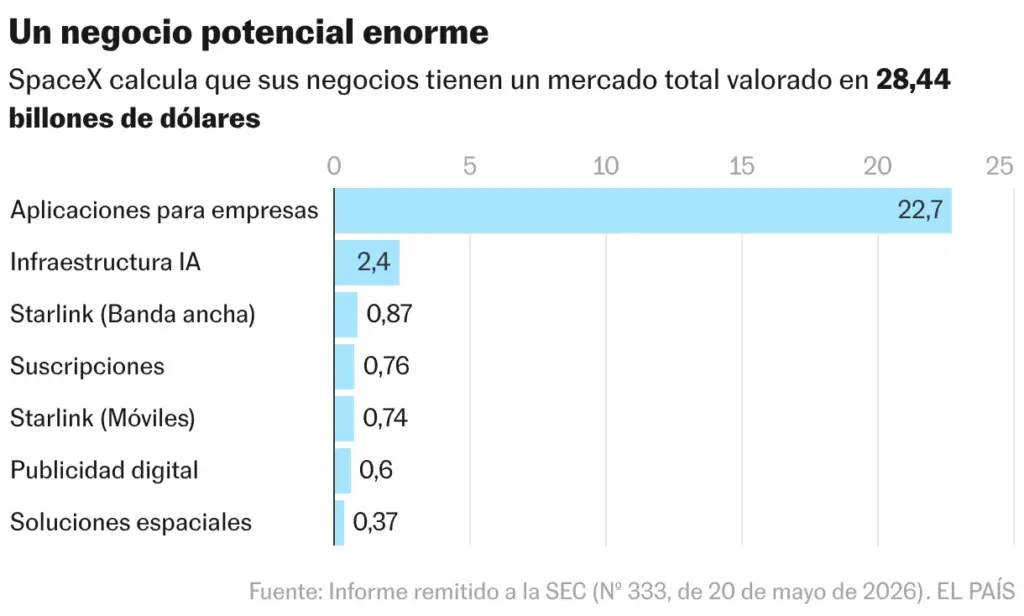
Elon Musk tries to convince investors by explaining that there is “a potential market of 28.5 trillion dollars” in artificial intelligence development, as reflected in official documents. SpaceX believes it has an opportunity to capture 93% of that market with enterprise AI applications that will transform the world as we know it. “We believe we have identified the largest total addressable market (‘TAM’) in human history,” the company said in its preliminary IPO prospectus. “We leverage our leading-edge models and computing infrastructure to deliver applications for consumers and businesses,” it added.
SpaceX’s mission is “to make life multiplanetary, understand the true nature of the universe, and extend the light of consciousness to the stars,” the company wrote in the stock brochure. That vision is behind all of Musk’s thinking. An interplanetary world, where his companies provide communications and transportation. With an integrated industry behind, with AI, chips, energy, etc., that he would also control. Every step he takes seeks to bring his goal closer. If he needs money to finance space travel, he creates a car company; if it is to develop AI, he takes the crown jewel public.
SpaceX needs to go public to raise funds to finance that crazy pace of burning money to keep advancing in AI. Although it has already built some gigantic data centers, like Colossus 1 and 2 built in Tennessee, it uses Tesla’s huge data center in Mississippi and has signed a lucrative agreement with Anthropic whereby the creator of Claude, the AI tool, will pay it about 15 billion a year for the next three years, revenues are still insufficient to cover that capital expenditure need.
SpaceX’s stock market launch comes as voices warning of a bubble in the artificial intelligence sector grow louder. The sector’s startups, which barely gathered a few thousand dollars just five years ago, are now cyclopes ruthlessly fighting each other to attract investors, and have reached a valuation of more than a trillion dollars, placing them among the most powerful in the world.
To achieve that meteoric growth, these companies are allocating huge amounts of money to build data centers and train their AI models with planned investments of more than 750 billion dollars just this year. There is no economic sector in history that consumed so much capital in such a short time. While these companies burn money as if there were no tomorrow, investors remain feverish in the stock market bet, in a move that is beginning to raise doubts among more and more analysts due to similarities with a bubble.
You know, bubbles are only known when they burst. Meanwhile, the world has placed its hopes on AI. “In the long term, I think AI will be in charge, to be totally honest, not humans. If artificial intelligence far surpasses the sum of human intelligence, it is hard to imagine any human being in charge. So we just have to make sure AI is friendly,” Musk said a few months ago to investors while the humanoid robots Optimus danced hopefully. Or not.