




Pope Leo XIV will be in Spain for six days, from Saturday, June 6 to Friday, June 12. He will visit Madrid, Catalonia, and the Canary Islands, and no place will be unaffected by the repercussions for traffic and public transport. We compile, in maps, the road closures and service suspensions. Even so, it is useful to follow the accounts of the Madrid City Council and the Barcelona City Council because, depending on the needs, restrictions may be extended or modified.
Read more When the United States loved Obama: the first black president inaugurates his presidential library
Madrid: traffic closures and metro stations out of service
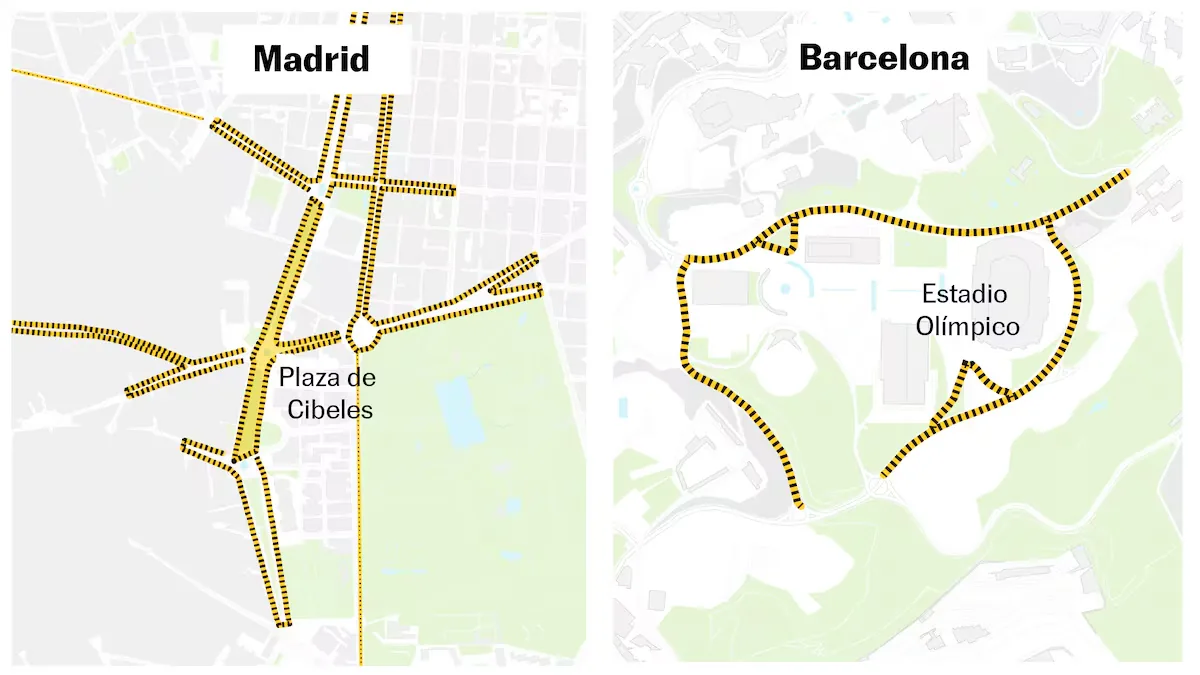
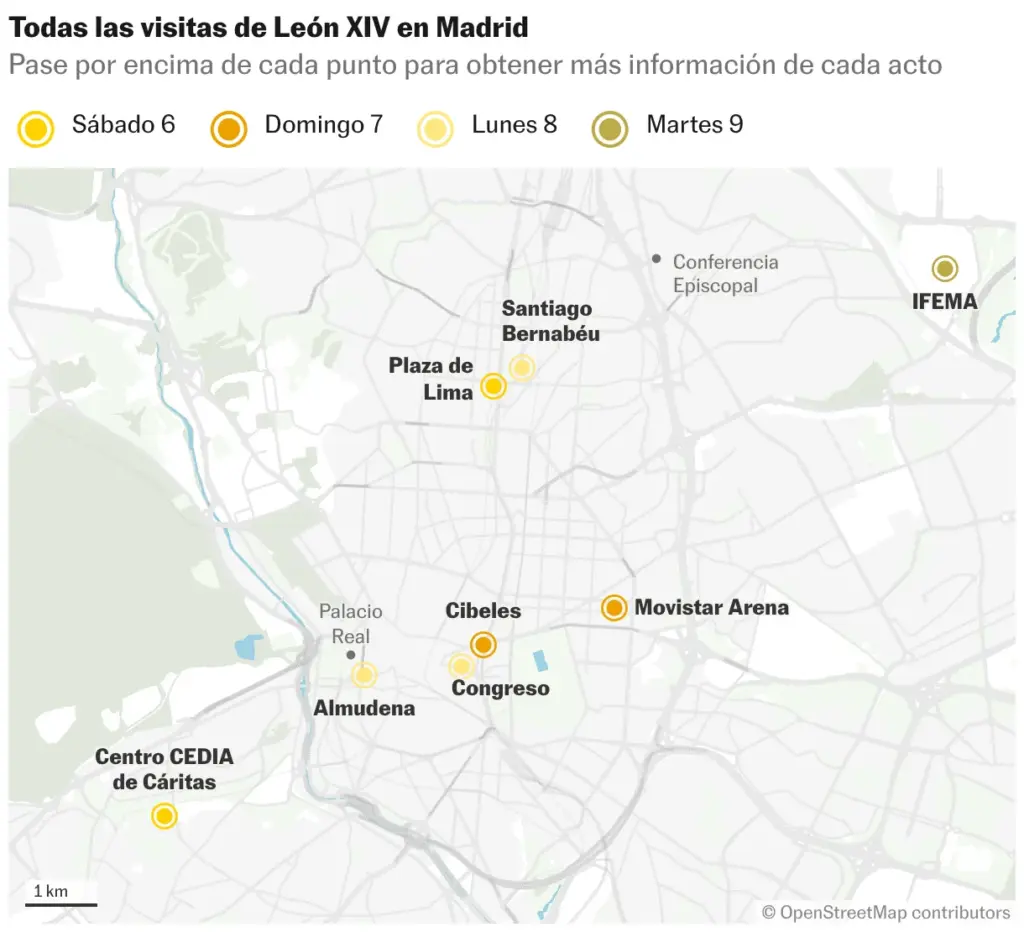
Plaza de Lima is completely closed to traffic from this Thursday, June 4, and Plaza de Cibeles, from Friday. These are the two chosen locations for the most crowded events: the vigil with young people, on Saturday 6 from 8:30 PM (500,000 attendees are expected) and the mass, on Sunday 7 at 10 AM (up to one and a half million people).
Plaza de Lima. From midnight on Thursday 4, the central lanes of Castellana will be closed between Plaza de Cuzco (which will not be closed except for the southern section) and San Juan de la Cruz (which will be closed up to Plaza de Gregorio Marañón), and those running from Raimundo Fernández Villaverde bridge to Bernabéu. Concha Espina street will also be closed. Residents will have access facilities that can be consulted at this link.
There will also be interruptions in the EMT and Metro de Madrid services. Specifically, in the Plaza de Lima area, up to 11 bus lines (14, 27, 40, 43, 120, 126, 147, 150, N22, N24, and S10) will be affected, and some stops will be suppressed. Accessing the area will also not be easy by Metro, as Santiago Bernabéu and Cuzco stations are currently not operational due to works; and the closest station, Nuevos Ministerios, will close its accesses near the vigil area. The area will also be affected on Monday 8, when at 7:00 PM, a meeting with the diocesan community will take place at Santiago Bernabéu.
Plaza de Cibeles. It will also be complicated to circulate in the vicinity of Plaza de Cibeles, closed since this Friday. On Sunday 7 at 10:00 AM, the Corpus Christi mass will be celebrated there, the most crowded event of the trip, and a subsequent procession in which Leo XIV will travel in the popemobile along Alcalá street to Parroquia de San José. Due to traffic closures, access to about 40 public car parks in the areas between Cibeles and Lima will also be affected. You can consult them at this link.
Regarding public transport, on Sunday morning from 7:00 AM to 2:00 PM, stations near Plaza de Cibeles will be closed. Likewise, the routes of 54 EMT bus lines (001, 002, 1, 2, 3, 5, 6, 7, 9, 10, 14, 15, 19, 20, 21, 26, 27, 28, 29, 32, 34, 37, 40, 43, 44, 45, 46, 50, 51, 52, 53, 59, 61, 63, 65, 74, 75, 85, 86, 102, 133, 146, 147, 148, 149, 150, 152, C03, C1, C2, E1, M1, M3 and Exprés Aeropuerto) will be affected.
Occasionally, other traffic closures may occur depending on the movements made until Tuesday morning when the Pope leaves Madrid for Barcelona. On this map, we mark the places Leo XIV will visit in Madrid.
Barcelona: four “complex” days for mobility with complete traffic closures
Leo XIV will land in Barcelona on Tuesday 9 at noon, and the areas around his agenda’s venues will be completely closed to traffic. The most delicate day will be the 10th, when the Pope will hold events in El Raval and at the Sagrada Familia
Cathedral and Episcopal Palace. The Pope’s first act in the Catalan capital will be a prayer at the Cathedral, which will entail complete traffic restrictions in the vicinity, and restrictions in the area will extend until Thursday 11, when Leo XIV is scheduled to fly to the Canary Islands.
The area around the Cathedral and the Episcopal Palace will experience complete traffic and parking restrictions from 7:00 AM on Monday 8 until 10:00 AM on Thursday 11.
Access to car parks will also be affected: residents will not be able to use private vehicles, except in emergency cases. Restrictions include motorcycles, mopeds, and bicycles in three usual parking spots such as Avenida de la Catedral and Plazas Nova and Antoni Maura.
Read more Tom Holland reveals the reason why he doesn’t want to host ‘SNL’: his severe dyslexia
Olympic Stadium. On Tuesday afternoon, a massive event will take place at the Olympic Stadium of Montjuïc, a vigil expected to be attended by 40,000 people. Traffic will be restricted in the vicinity of the Olympic ring from Monday morning until 2 AM on Wednesday.
Traffic will be closed to private vehicles, including car parks. The closures also affect motorcycles, mopeds, and bicycles. Residents will be able to reach home, and the area restricted to invited or accredited persons will be limited to the stadium’s surroundings.
Brians, punctual and total traffic closures. On Wednesday morning, the Pope will travel outside the city. He will make a private visit to the Brians 1 Penitentiary Center (in Sant Esteve Sesrovires): it will be an event without public, so the papal entourage will travel by road. The Mossos d’Esquadra have warned that punctual closures may occur as the encapsulated papal entourage passes (with security forces escorting vehicles in front and behind).
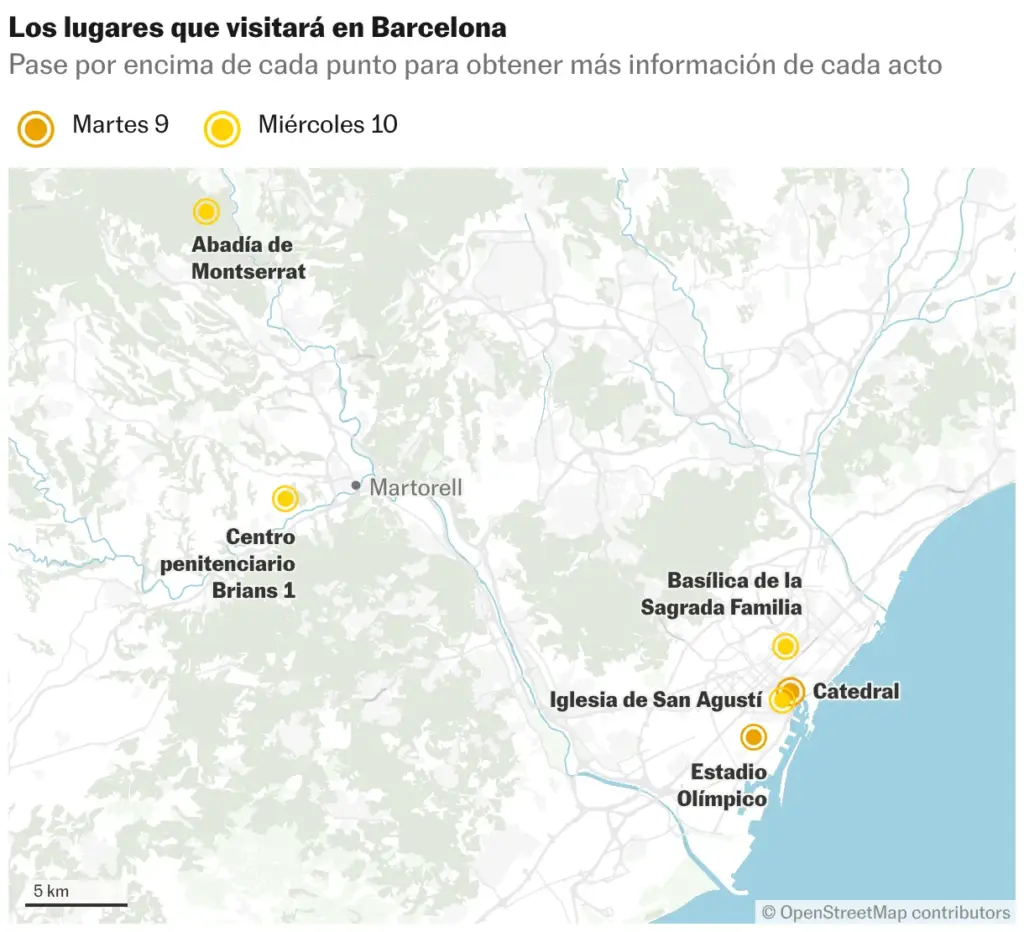
Montserrat, reservation for the Cremallera or Aeri. After the lightning visit to Brians, the Pope will visit the monks of the Montserrat mountain abbey (Monistrol de Montserrat) and attend a public Rosary prayer. More than 8,000 people are expected to attend, who will only be able to access by special coaches or public transport: from Monistrol on the Cremallera of Ferrocarriles de la Generalitat or by Aeri, a cable car. In both cases, it is necessary to make a nominative ticket reservation, which on this day will have a flat rate of 7.5 euros round trip.
Parroquia de Sant Agustí, El Raval. On Wednesday afternoon, the bulk of the activities in the city center will take place, causing severe closures in various areas. The closures will begin in El Raval, where the church of Sant Agustí is located, where the first act of the afternoon takes place, a meeting of Leo XIV with entities that assist vulnerable people.
The streets around the church of Sant Agustí and Plaza de la Gardunya will be completely closed on days 9 and 10, with access controls (only residents or participants in the event and press will be allowed to enter) and pedestrian regulation during peak times. The prohibition of driving and parking will affect Hospital street (from Rambla to Rambla del Raval), the entire Plaza de la Gardunya, the entire Plaza de Sant Agustí, Jerusalem street up to Hospital street, and Arc de Sant Agustí street, from Hospital to Sant Pau.
Sagrada Familia: traffic closure, bus diversions, and closed metro station. The most intense impact on mobility will be suffered by the Eixample district on Wednesday afternoon, with the mass for the centenary of Gaudí’s death at the Sagrada Familia and the blessing of the Jesus Christ tower.
On his way to the basilica, the Pope will make a journey in the popemobile from the confluence of Diagonal with Rosselló street until entering the Sagrada Familia via Sardenya street. During day 10 and the early morning of the 11th, the entire area will have a wide security perimeter with a total closure of circulation and parking, including the chamfers: the route will entail general traffic diversions and a notable impact on the bus network and the closure of Bicing stations. Furthermore, on day 10, the Sagrada Familia metro station will be closed: trains on lines 2 and 5 will circulate normally but will not stop. Passengers will have to alight at the previous or next station: Verdaguer or Dos de Maig.
In the streets, the closure will affect Diagonal, from Cinc d’Oros to Bruc. Rosselló, from Pau Claris to Lepant. And all streets adjacent to the papal route (Pau Claris, Llúria, Bruc, Girona, Bailen, Paseo de Sant Joan, and Roger de Flor) between Còrsega and Rosselló. The prohibition of street parking will be even more extensive and will affect vertical streets in almost all cases from Còrsega to València.
To improve mobility, TMB plans to increase the frequency of metro and buses in areas where official events are held. For example, lines 1, 3, and 5 will increase the frequency of their trains arriving at Montjuïc, and there will be shuttle services from Plaza de Espanya to go up to the Olympic Ring.
Read more Florentino or Riquelme? Vote for your ideal candidate for the presidency of Real Madrid
With information from Beatriz Olaizola and Clara Blanchar