









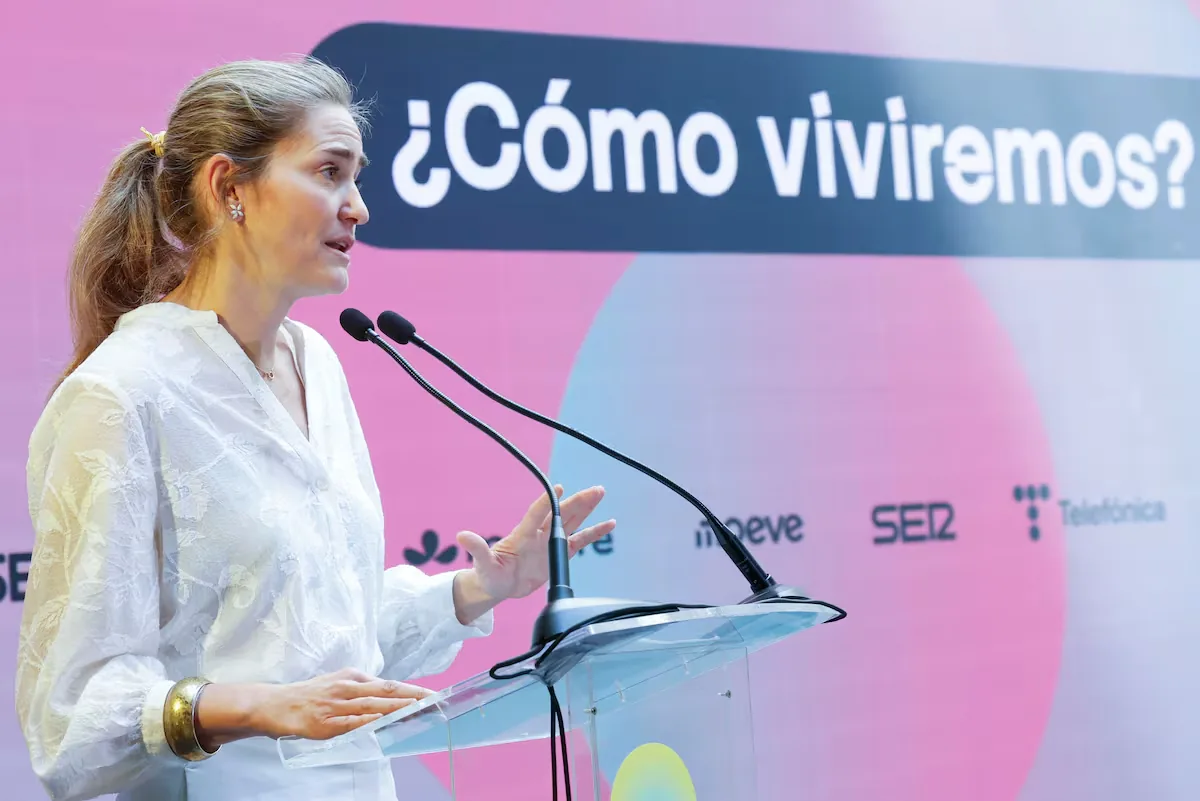
The Government is accelerating its social agenda just over a year before the legislature concludes. The third vice-president and head of environmental policies, Sara Aagesen, announced this Thursday that the Executive is preparing a package of aid of almost 400 million euros for the energy rehabilitation of hospitals and schools.
The Minister for Ecological Transition and the Demographic Challenge revealed at the Seremos forum, organized by Cadena SER, that the next Council of Ministers will approve a first package of measures endowed with 168 million euros for the improvement of air conditioning, lighting, and insulation in hospitals and other health centers. To this first package, “in the coming weeks,” other lines aimed at the rehabilitation of schools and other educational centers will be added, Aagesen added.
The third vice-president of the Government stressed that “making hospitals more efficient means saving resources and using those resources to improve services, improve the comfort of patients and professionals, and reinforce the quality of an essential service.” “In total, almost 400 million euros to improve that energy efficiency in these very important services, schools and hospitals,” concluded the head of Pedro Sánchez’s Executive from Madrid.
Specifically, it will be 368 million, divided into two lines of aid. The first, of 168 million euros, to improve air conditioning, insulation, cooling and heating systems in hospitals and health centers, to which a second, for 200 million, will be added for energy efficiency in schools and educational centers.
Aagesen pointed out that these measures are part of a vision of progress that seeks for the ecological transition to have a real impact on daily life, transforming public services into more modern, efficient, and human spaces.
The vice-president highlighted the solidity of the Spanish economy, emphasizing that Spain has consolidated itself as the only country in the European Union whose growth forecasts have recently been revised upwards by both the European Commission and the OECD. Aagesen linked the performance of the economy with historical milestones in the labor market: the country has for the first time exceeded 22.3 million affiliates to Social Security, also reaching its lowest unemployment rate since 2007. According to the minister, these figures reflect the “good progress” of an economy that has managed to remain resilient despite an international context marked by geopolitical instability and successive crises.
Beyond macroeconomic metrics, Aagesen defended a model of “good growth,” which she defines as innovative, inclusive, sustainable, and resilient. In this sense, the ecological transition is presented as the backbone of this expansion, with renewable energies already contributing 57% of electricity generation, which allows offering competitive prices to households and industries. This approach has allowed Spain to regain its attractiveness for large technological and industrial projects, positioning itself not as a nation that arrives late to global transformations, but as a leading actor capable of decarbonizing and establishing fair rules in the new economic landscape.
Redeia believes there is no network collapse
Before Aagesen’s intervention, the Seremos forum featured the participation of the Director of Operations of Red Eléctrica, Concha Sánchez, who assured that there is no network collapse as some promoters and large electricity companies have denounced.
Sánchez clarified that there has been a certain phenomenon of hoarding network access points, but believes that work is being done to organize this avalanche of requests from new consumers, such as industries that want to electrify, new housing, hydrogen production plants, or data centers.
The director of operations of Red Eléctrica also lamented that the Iberian Peninsula continues to be an energy island and highlighted the support that the new interconnection with France and other projects will provide to electrically connect Spain with the neighboring country and also with Ireland.
Moeve bets on the green molecule
The CEO of Moeve, Maarten Wetselaar, for his part, presented a report this Thursday in Brussels to evaluate the impact that renewable fuels can have in Europe. In a previous intervention with Cadena SER, Wetselaar assured that the use of hydrogen, biomethane, and other fuels from waste will have a very relevant impact on the strategic autonomy of Spain and the rest of the continent. “We can reduce half of the energy dependence on fossil fuels by 2050 through green molecules,” Wetselaar pointed out.
The forum also included Belén Linares, innovation director of Moeve, along with Joan Batalla, president of Sedigas, and Santiago Ramos, president of APPA Renovables. The three sector executives highlighted the benefits of betting on green and indigenous technologies as a source of wealth and well-being in depopulated territories, in addition to the strategic improvement of no longer depending on fossil fuels, especially in times like the current one of geopolitical instability with conflicts such as those in Ukraine or the Middle East.