







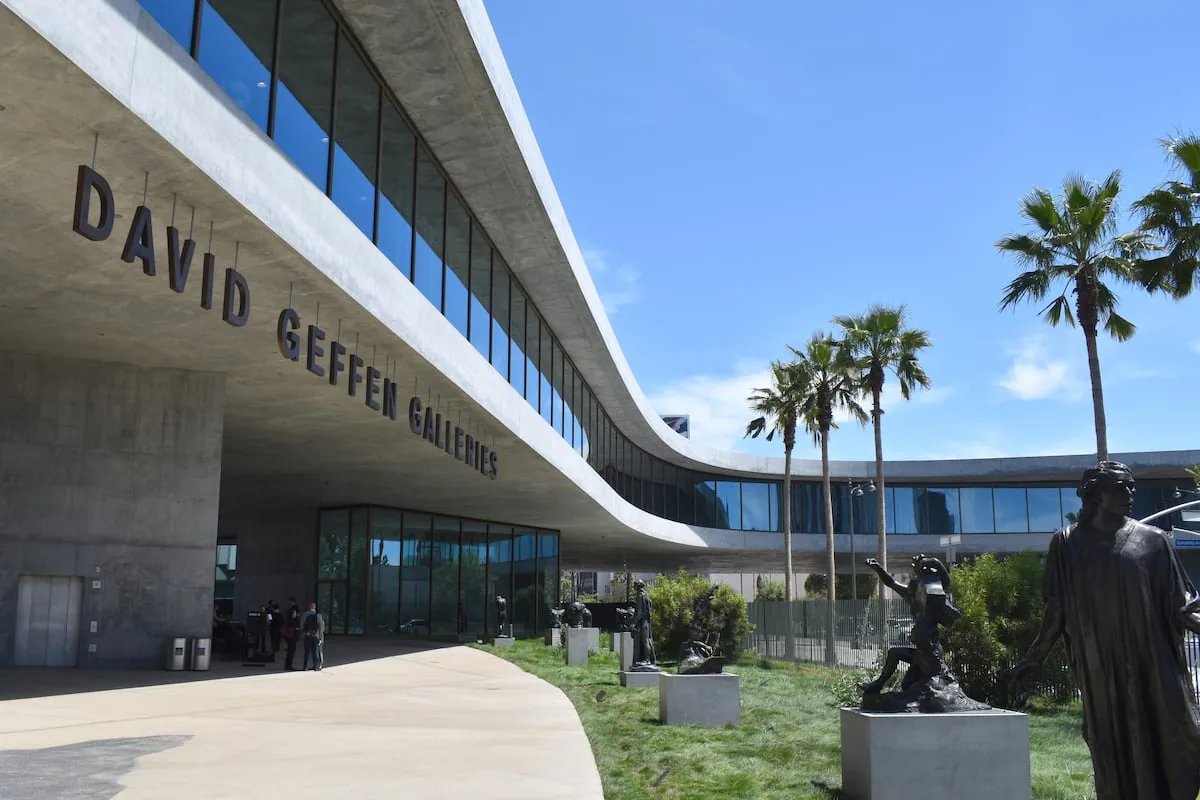
It has taken almost 20 years of effort, tons of cement, 724 million dollars, tearing down buildings and changing the urban landscape of a city to finally inaugurate the largest and most ambitious cultural work in Los Angeles in recent years: the expansion of LACMA, the Los Angeles County Museum of Art, the main art museum in the western United States, the largest collection on this side of the Mississippi. A huge concrete mass, a herculean amoeba, now winds through the heart of the country’s second-largest city to house part of the immense permanent collection, previously stored in warehouses, which will now be enjoyed by its one million annual visitors, probably multiplied.
Read more Looking for good delicatessens and cheese shops? These six places are a must-visit
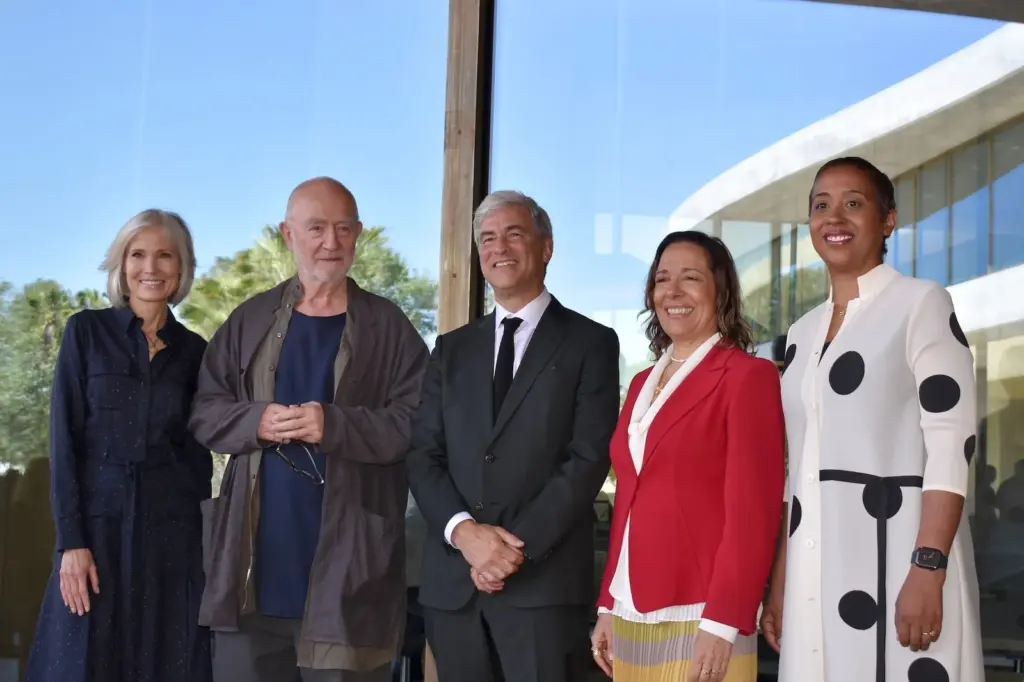
The opening of this expansion, under the name David Geffen Galleries — the music, film, and theater producer, co-creator of DreamWorks, great patron of the city who has donated 150 million for the project — is the city’s major cultural event this year and finally takes place on Sunday, April 19, after a great crusade by its director, Michael Govan, to carry it out over the last 20 years. He personally chose (not without criticism) the architect of the work, Swiss Peter Zumthor, Pritzker Prize winner, who had never built anything of such magnitude before.
But now, the building is not only part of the museum but perhaps its main attraction for visitors. Located on Wilshire Boulevard, the city’s artery, it is perfectly flanked by La Brea Park, which shows the geological origins of the settlement, and by the Academy of Motion Picture Arts and Sciences Museum, which is its economic, social, and cultural heart. Now, the new LACMA and its 32,000 square meters will share space with them.
At the press presentation on Wednesday, in a crowded event under the shadow of the concrete mass, Govan appeared emotional and talkative. He knows that what he has achieved is a milestone in the city’s artistic history. Not only because of the content, where almost 3,000 works of art can be seen, but because of the container. Zumthor’s building — winner of the Pritzker in 2009 — dialogues with the city and is designed by and for it: it is capable of moving up to one and a half meters, in case of an earthquake (or rather, for when there is one).
In a place lacking public and recreational spaces, the new LACMA completes that museum and garden mile, where Angelenos often picnic, play with their children, or listen to live jazz. The brand-new Galleries will be part of it, with sculptures by Alexander Calder, Ai Weiwei, and Jeff Koons (made with native Californian plants); with their Rodin on the lawn; with their free educational center for children and families; their café (sponsored by Erewhon, one of the most expensive supermarkets in the county); with the concept that the building, with two very long staircases leading to the open gallery on the upper floor, has no main door or back: no one will ever be behind it.
“The idea was to make a museum without hierarchies, with the transparency to see Los Angeles,” explained Govan, who began to launch the project in 2007. If the immense gallery is concrete at its base, its upper part is transparent, glazed, although in certain areas covered by grayish polyester curtains, not only unaesthetic but, although they protect certain works, they cloud that view of palm trees and light, so Californian. Govan stated that part of the plan was that, “space to roam over the park, among the forest.”
Zumthor has carried out the project together with the prestigious Chicago firm SOM (Skidmore, Owings & Merrill) in a work lasting almost six years for which other buildings in the area have been removed, not without controversy. The finishing touches are still being completed. In addition, the neighboring La Brea Park will soon close for renovation ahead of the 2028 Olympic Games. The galleries, although they still seem under construction due to the cement walls from which hang works from Rubens to Matisse, from Persian rugs to French abbey arches, are already ready. The works mix, join, in a space with hardly any walls, more thematically, or as it used to be called, in an “encyclopedic museum.” The intention: thought, dialogue, asking questions.
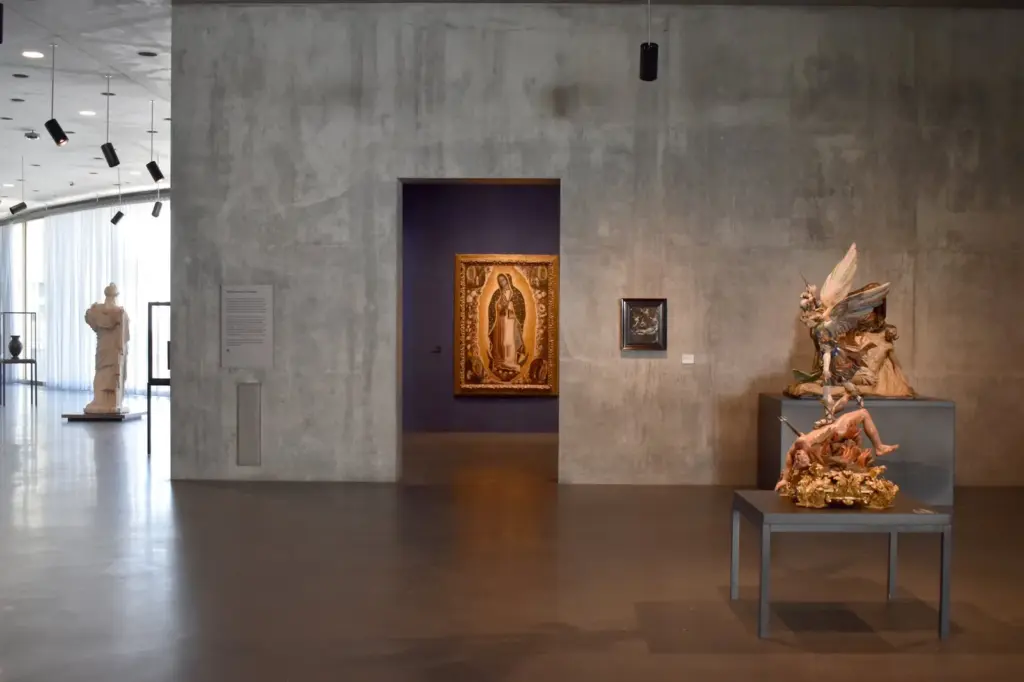
“That term encyclopedic museum is particular to North America. There are no encyclopedic museums in Spain, nor in Mexico, not even the British Museum, with art from many regions,” explains Diana Magaloni, deputy director of LACMA and head of conservation, to this newspaper. The Mexican, former director of the National Museum of Anthropology, says that “encyclopedic museums are born with an ambition to contain the knowledge of the world, to contain the world’s collections for a North American audience, who do not live in Europe, and to be able to look at the world from here with the ambition to educate.” Therefore, this museum is a mix of everything, from ancient Greek art almost next to contemporary African art; from 21st-century Kyoto vases shaking hands with Dutch paintings over 800 years old, with large-format photographs or with Egyptian mummies from the 1st century.
Read more Sheinbaum seeks a dramatic move against a Trump with a thousand open fronts
“It is rather a museum of cultures,” she reflects. “A global museum. And this is a city, I believe, the most multicultural that exists, and the fifth economy in the world,” she points out, referring to California. “And we owe ourselves to that city.” For her, the arrival of the David Geffen Galleries, Zumthor’s museum, the new 3,000 pieces, their union with the city, refresh and improve Los Angeles as a new artistic hub. “This makes it rise as a very important cultural power. It is true that many contemporary artists have moved from New York; there is a lot of new and very, very daring contemporary art.”
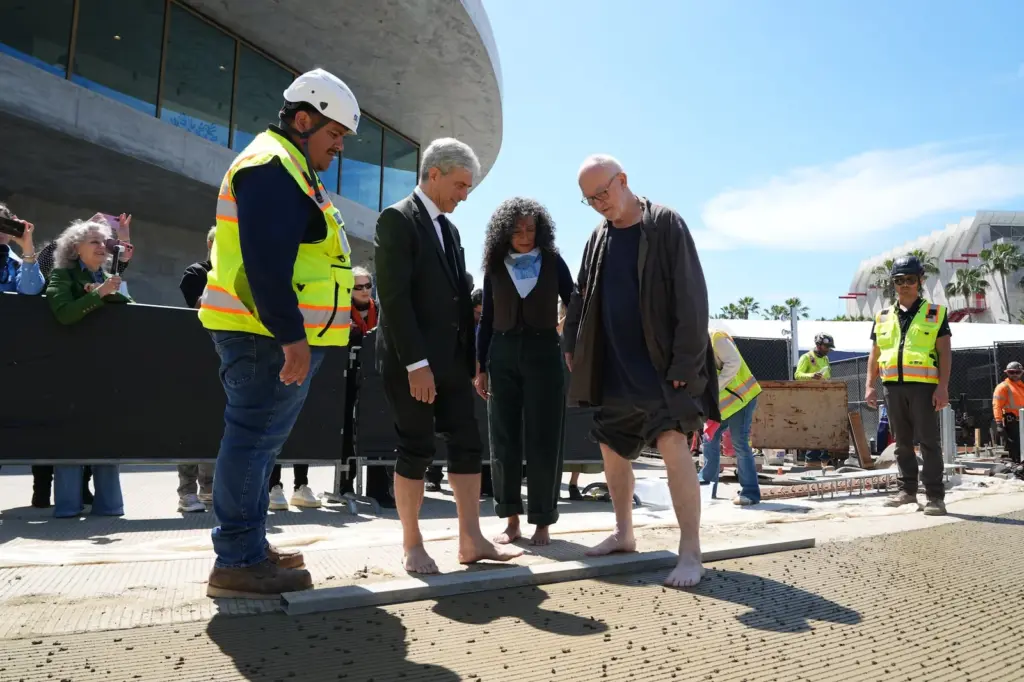
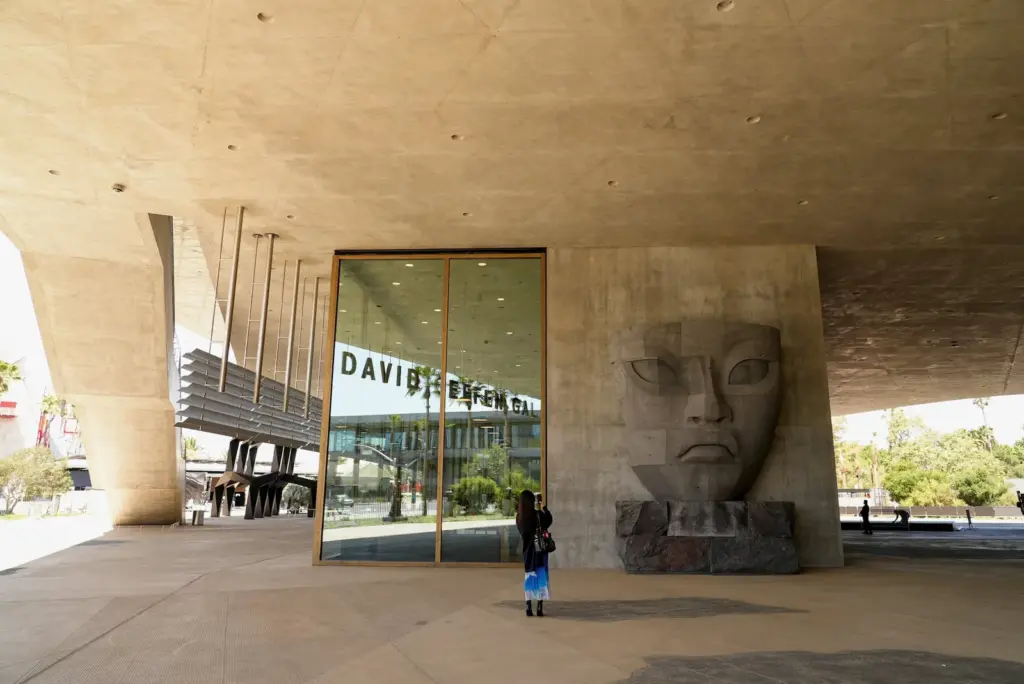
As the multicultural urban mass that it is, and with almost 50% Latino population, there is a strong presence of migrants. Two Mexican artists have two powerful works in the building, in the public plaza surrounding it. Sculptor Pedro Reyes has brought from his workshop in Coyoacán a huge volcanic stone head, Tlali, weighing 80 tons. Meanwhile, Mariana Castillo has been responsible for shaping the floor of the entire complex. A work of art of more than 19,200 square meters called Feathered Changes that she has created over two years together with more than a hundred Mexican workers from Los Angeles. With shapes created with rakes and animal footprints from the county imprinted, from coyotes to roadrunners, it can be enjoyed by all who come to LACMA, whether paying admission or not.
“At this political moment when we talk so much about territory, migration, origins, I think it has even more meaning that I was able to make this piece together with a Swiss architect in a museum in Los Angeles, and with Mexican brothers,” Castillo recounts during a meeting with EL PAÍS and several arts patrons sponsored by the Mexican consul in Los Angeles in honor of both artists, in what he called “a very important day for Mexican culture.”
For Castillo, the work is something personal, the largest of her career, and speaks of passage, of the importance of what we step on, of those who arrive before and after us. “Also of our bodies, of how we leave marks in the places we inhabit. They can be subtle, they can be definitive, but they are there,” she explains to this newspaper, with which she also reflects on her role as an artist: if for centuries many artists have created murals and tapestries on walls and frescoes on ceilings, she now intervenes on the floor. “Now I say I am a floor artist, or something like that, like a new category,” she laughs. “I am interested in showing that horizontal surface we walk on.”
As deputy director Magaloni explained about the museum, whose collection is mostly composed of private donations, the works, their arrangement, and their approach are very different from more classical museums, whether European or American, such as the Philadelphia Museum of Art, the Art Institute of Chicago, or the New York Met. “We do not have a collection comparable to the Prado. We will never have it,” admits the head. “It is not a national museum, nor an imperialist museum, like the Louvre or the British. We have a collection that has many gaps, we don’t have everything. We have two Rembrandts.”
Here everything joins and intersperses, sometimes in a conversation that feels natural; other times, with difficulties understanding each other, seeking to unsettle. But as the curator says, art also implies not only that old encyclopedia denomination, with entries to knowledge, but asking questions. “I think you have to trust art for itself. Its presence has the power of communication. The questions are mitigated by the beauty of the place. It is an experience that produces admiration.”
Read more Jorge Campos, the most football-loving fashion icon