





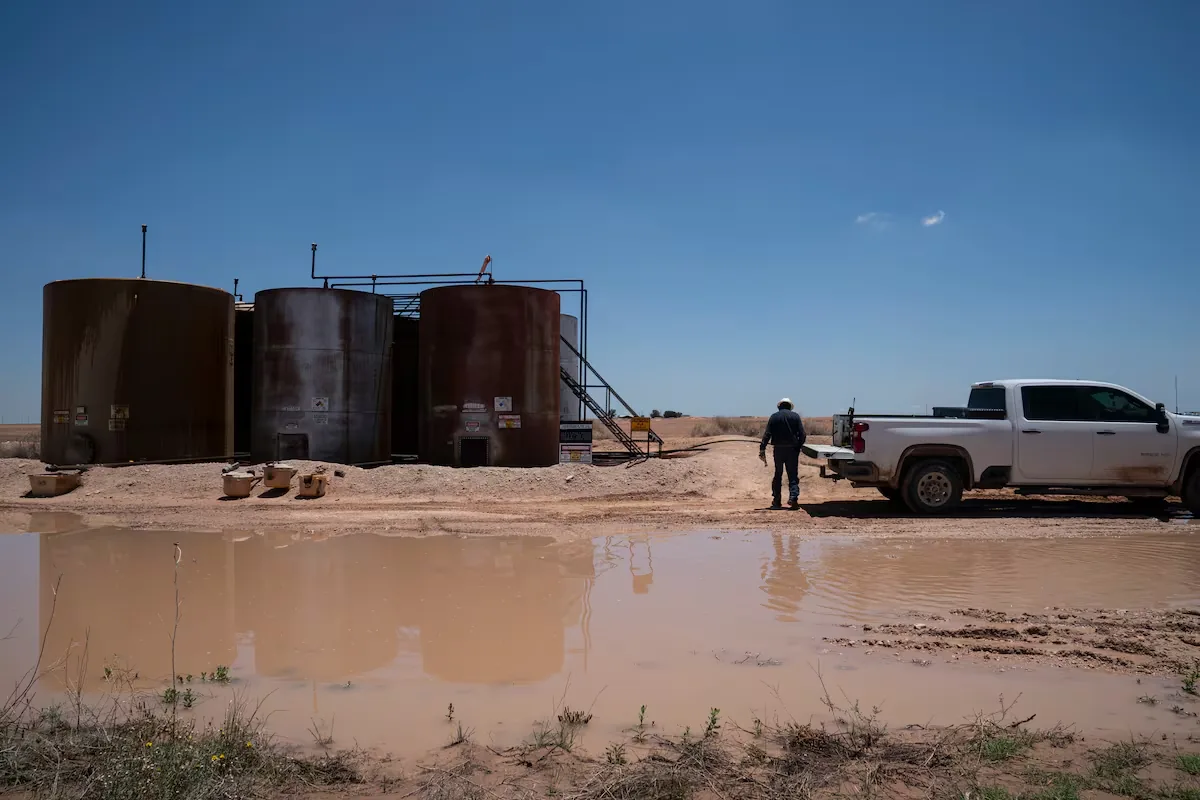
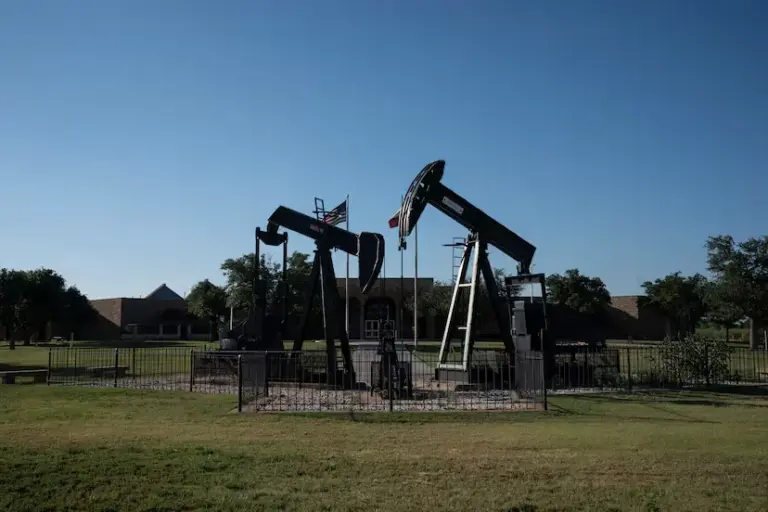
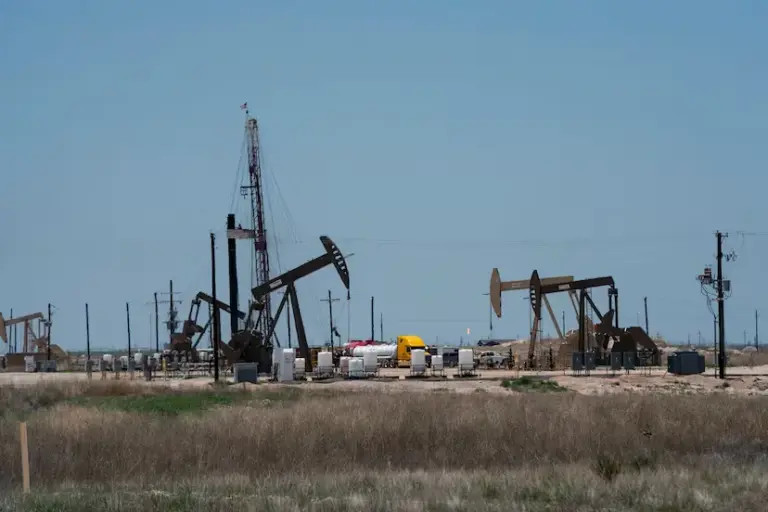
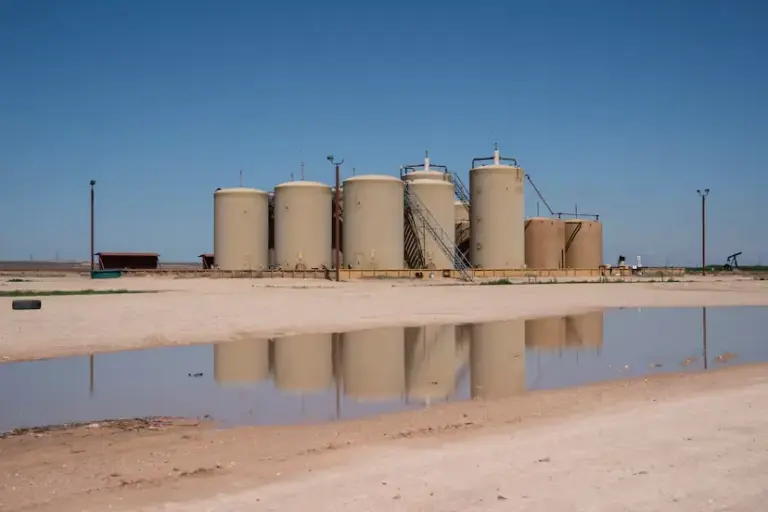
Without a single mountain for miles, the landscape blends vast, freshly plowed fields of cereal and fodder with the “infrastructure.” Every few hundred meters, amidst the crops and enormous hay bales, there are oil derricks, pumpjacks, injection wells, production sites, storage tanks, gas compressors, enormous flares, pools overflowing with blackish, gas-smelling water. Most of these facilities were built from 2015 to date, when the Barack Obama Administration allowed the United States to sell crude oil to foreign countries. In the Permian Basin, the technical name for this area, an expanse of 194,000 square kilometers, west of Texas and southeast of New Mexico, hydraulic fracturing unleashed a black gold rush that has left, along with more money than can be counted, a string of environmental problems led by air pollution and wastewater.
Read more ‘We’, by Compañía Mal Pelo: dance that overwhelms and reveals
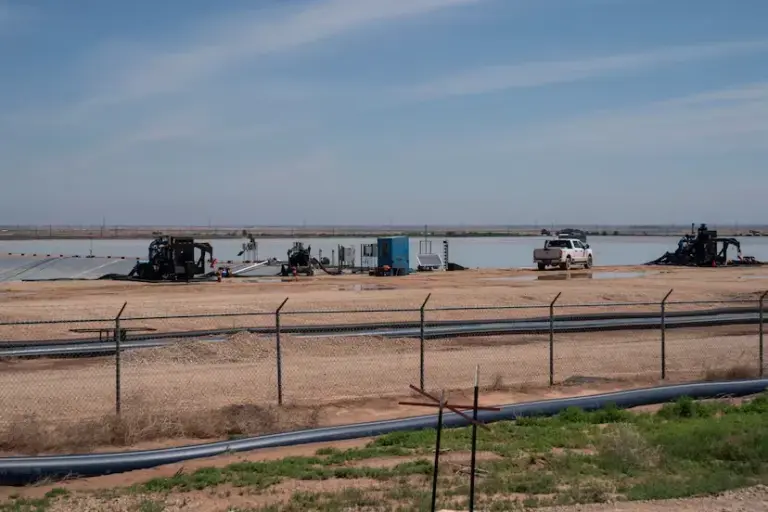
The heart of this industry is in the city of Midland, which, along with its neighbor Odessa, is the nerve and financial center of one of the world’s most polluting oil regions: 410 tons of methane per hour, equivalent to about 100 million tons of CO2 per year, the same as an entire country like Colombia. A few kilometers to the south, there is a facility where they try to recycle a portion of the enormous volumes of toxic water left by the industry: for every barrel of oil extracted, three to five barrels of contaminated water are generated. With a production of six million barrels daily in this basin, that’s at least 270,000 Olympic swimming pools full of contaminated water each year.
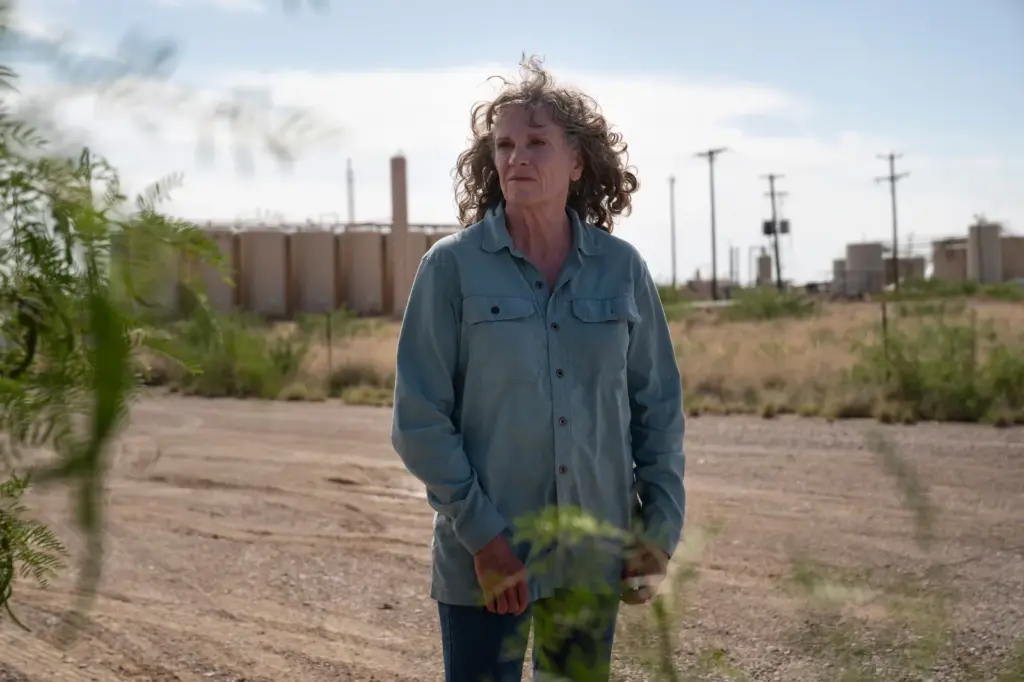
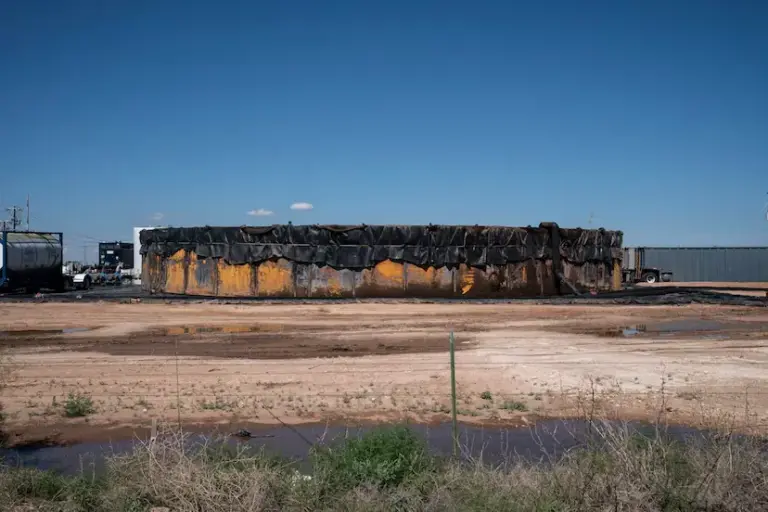
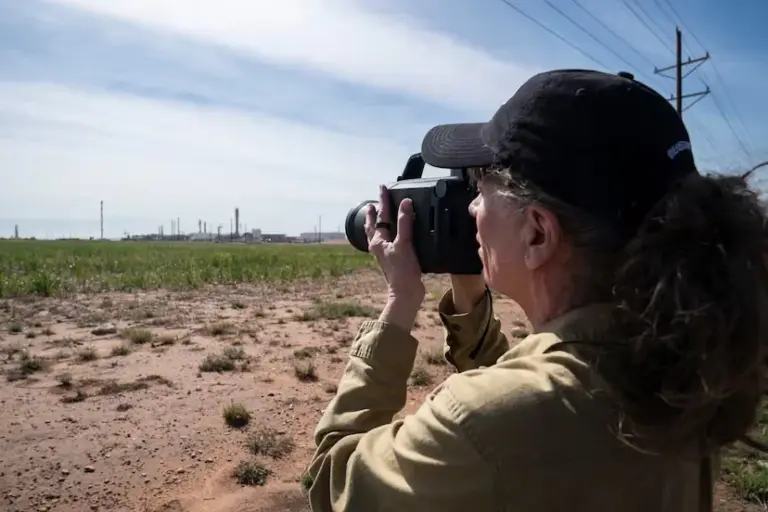
This recycling facility is difficult to describe. It looks like an inflatable pool, but on steroids. Circular, it is 35 meters in diameter and three meters high and is covered by black plastic, surrounded by tanker trucks and tanks holding thousands of liters, with an endless number of black hoses going in and out. Activist Sharon Wilson, who describes herself as a “methane hunter,” points the weapon she has used for decades to document the industry’s environmental failures: a Flir camera, which records gas images with optics that allow visual detection of both heat and chemical compounds with infrared absorption. Basically, it allows one to see invisible pollution.
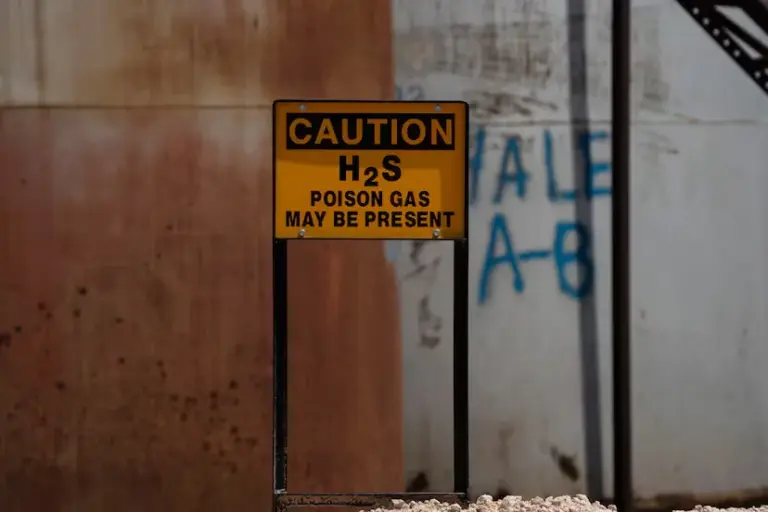
To the naked eye, nothing happens, but when you look through the Flir lens, you see constant emissions every second, methane gas ceaselessly escaping from thousands of liters of contaminated water; and, depending on where the wind comes from, the air smells of sulfur. “They’ve been trying to clean the water for a decade, but they haven’t succeeded,” says Wilson. Although tired at 73, she continues to lead the Oilfield Witness organization, where they use gas imaging technology to “expose the dirty secrets of the oil and gas industry.” She worked for this industry for 12 years and became an activist when, after moving to a farm in North Texas to raise her children, the first fracking boom in the late 1990s contaminated her well water. “They took away my peace,” she says with a wry expression.
Water is the biggest ecological cost brought by hydraulic fracturing, a group of techniques for extracting hydrocarbons contained in rocks that cannot be conventionally exploited, and which uses a mixture of water with sand and highly toxic chemical additives to break rocks containing gas and oil. Freshwater is preferred because it is cheaper and delays equipment corrosion. Along the roads in this area, there are enormous water depots where countless tanker trucks, seen traveling throughout the basin, load up.
To fracture a well in the Permian Basin, an average of 80 million liters of fresh water are used, about 30 Olympic swimming pools, a volume that in practice irreversibly disappears from the natural cycle, which can never again be used to irrigate a field, much less for a living being to drink. Furthermore, throughout its productive life, for every liter of gas or crude, an average of four liters of water contaminated with salts, traces of oil, natural heavy metals, radioactive materials, and chemicals will emerge. The industry argues that this water, as long as it is treated, can be reused for a few more fractures before it becomes too expensive to clean. In the Permian Basin, according to , there is a 50% reuse rate, but it is still water that remains unusable for any non-industrial purpose and, moreover, at a certain point will have to be disposed of.
“They generate so much contaminated water that they don’t know what to do with it,” explains Wilson. “They inject it back into the earth, but now it has started coming out in geysers or contaminating freshwater wells, they also dump it into rivers… and now they want to convince the public that they can clean it and use it to irrigate crops or water livestock,” she adds. “And let me say something else: if Chevron, BP, or Exxon have been trying to recycle water for years and haven’t succeeded, it’s absolutely impossible for Pemex to achieve it in Mexico,” she warns.
In the Permian Basin, the main business is oil sales, and gas overproduction is such that, at certain times, prices have fallen to negative levels, meaning producers pay to dispose of the gas. This is where most of the 70% of natural gas that Mexico imports for its combined cycle power plants comes from. The Mexican government, with the idea of reducing this dependence, is proposing the massive use of fracking in the Tampico-Misantla basin, in the north of the country, which experiences water scarcity, a geological formation equivalent to the Permian. To avoid saying fracking, a taboo word due to the opposition maintained against this practice by the spiritual leader of the Fourth Transformation, Andrés Manuel López Obrador, they speak of working on mixed investment schemes “for gas extraction in unconventional deposits.”
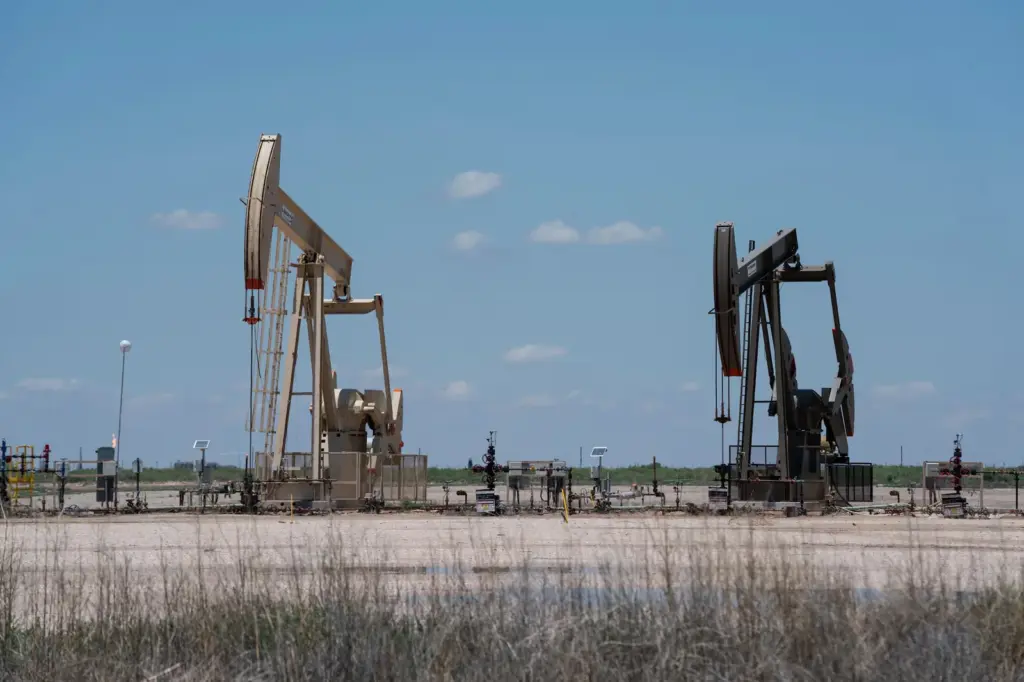
In this industry, the well is only the first step. After drilling and fracturing the ground, tanks must be installed to store crude oil and other liquids. Crude oil is collected by trucks or sent via pipelines to a refinery. In the production phase, the gas, which comes out with the oil, is introduced into a gas pipeline or burned in a flare. The next phase involves separating and processing the gas to clean it of impurities and contaminants. Then, the gas is compressed in a compressor plant, where its pressure is increased to allow for efficient transport through pipelines. As this pressure decreases along the way, it must pass through several compressor stations again.
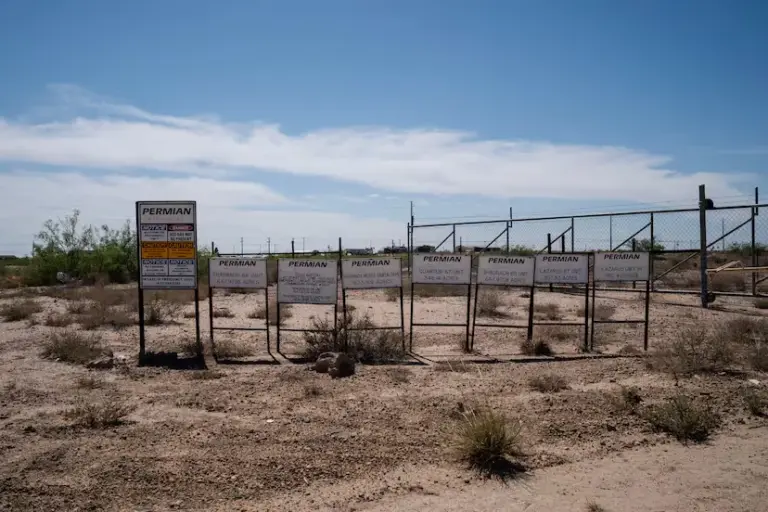
There is no official record of how much oil infrastructure exists in the Permian Basin, although it is known that there are more than 80,000 active production wells, the vast majority of which are fracking wells, operated by some 400 companies. Then, in the transformation and transport segment, for example, only one of the six main operators, Targa, has its own pipelines totaling 25,000 kilometers in length, with 44 processing plants. The rest, such as Brazos Midstream, Enterprise Products Partners, or Energy Transfer, manage similar inventories.
EL PAÍS visited several of these facilities with Oilfield Witness. In all of them, activist Sharon Wilson points her camera and sees how in a processing plant there are several towers emitting methane when they shouldn’t be. Also, that in one of the dozens of compression batteries, gas is escaping from tanks that should be closed. She takes notes and prepares to report the infractions she finds to the Texas Railroad Commission, which, by twists of fate, is responsible for regulating the oil industry in the state. She laments that they often don’t pay much attention to her.
Read more Gorillaz steal the show at Primavera Sound where everyone danced
The Oilfield Mafia
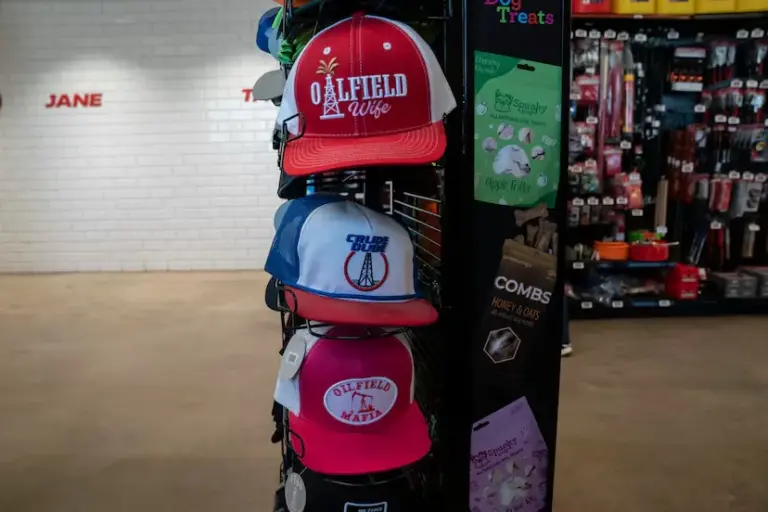
There is a culture, a pride, in being native to the Permian Basin. There are souvenir magnets with a pumpjack under a yellow sun, and you can also get your child a breakfast mug with an oil rig. Upon arriving at Midland airport, a huge sign announces that you are arriving “where America’s energy vibrates,” next to an aerial photo of a well, accompanied by three smaller images: free event tickets for military personnel, two cowboys in a gorge, and an advertisement for a business service of “unlimited automated fracturing.” At gas stations, caps are sold with the legends Oilfield Mafia and Crude Dude, and only one for Oilfield Wife. Oil pride, like the vast majority of jobs in the industry, is more masculine.
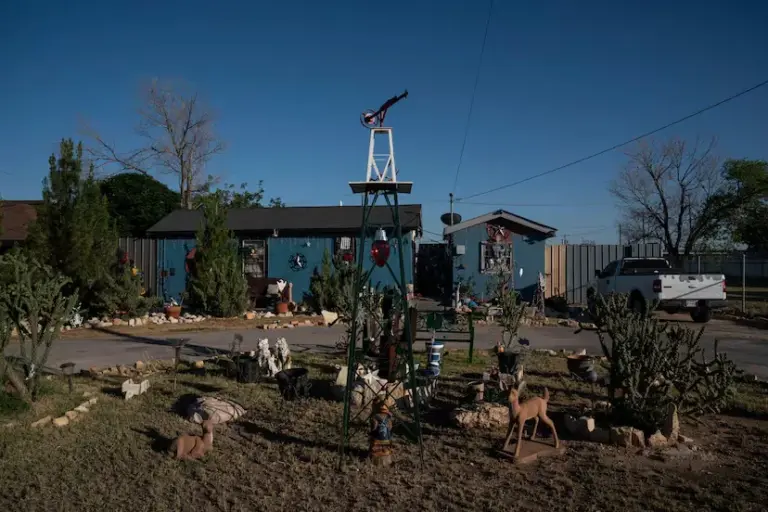
Outside the Angry Armadillo, a whiskey bar in Midway with patrons wearing cowboy hats, there is an endless line of trucks with enormous muddy wheels from driving on the roads leading to the “infrastructure.” Upon entering, a buffalo’s rear end greets the visitor. At the pool table, Joel Rodríguez—wearing a red cap instead of a hat and a long goatee instead of a Texan mustache—plays with his girlfriend and a friend. Like many here, his family is from the Mexican state of Chihuahua. At 34, he has been working in the oil and gas industry since he was 16. His four older brothers do the same. Around 500,000 people live in the entire Permian Basin, and according to a 2020 estimate, 90,000 of them work directly in the sector.
“My older brother rents machinery, the second one fixes the fracking trees, and the others are dedicated to drilling the hole for what he calls the first strike,” he says. In his case, he works on the flares, the burners that surround the city and release flames throughout the day and night. Is it very dangerous? Joel shows several scars on his arms as an answer. Do they pay well? He smiles. What do your school friends do for work? “Well, almost all of us work in the same thing,” he reflects. The napkin holders at the Angry Armadillo have a sticker from a local biker group: Rig Riders Oilfield, the Oilfield Platform Riders. Their logo is three wells crossed by a bull’s skull with motorcycle brakes on its horns.
Pecos is almost 145 kilometers west of the Angry Armadillo. It’s a small town, with about 9,000 people, where a significant portion of the population identifies as Latina. Alicia was born here, also a descendant of Mexican migrants, just as the 1980 oil crisis turned Pecos into a ghost town. She emigrated to the capital of Texas, Austin, and returned in 2020, when the fracking boom had already been going on for a few years, and she recognized nothing.
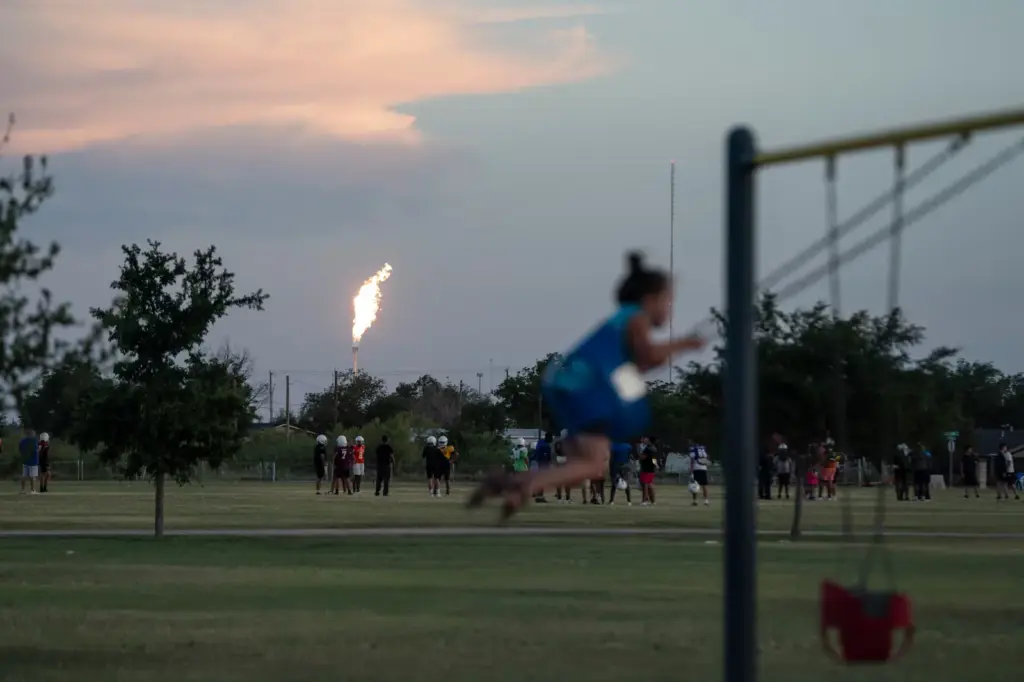
“Before, we didn’t even have a McDonald’s, but now everything is focused on the oil and gas industry, and I feel that those of us in the community who are not part of it are being left behind,” she says. She explains that now male teenagers, as the industry offers them starting salaries of between 80,000 and 90,000 dollars a year, have no incentive to continue in school. After starting the interview, Alicia asks to conceal her identity. “These companies make millions of dollars poisoning us, and I feel that if I speak with my name, I’m afraid this community, which is conservative and Republican, will say I’m a crazy anti-oil leftist.”
On the outskirts of Pecos, where construction houses give way to prefabricated homes and RV parks, there are seven oil wells that were fractured less than a decade ago, sending their production to a facility half a block from the last houses. This facility has tanks for storing crude oil, an enormous pool for its toxic waters, and several injection wells to return extraction contamination to the earth.
The Texas Living Waters Position study explains that “the vast majority of wastewater”— let’s remember, at least 270,000 Olympic swimming pools per year— “is reinjected into disposal wells,” which are deep injection wells used to dispose of toxic extraction waste. Throughout the state, there are 52,000 wells for this purpose, and the volume is so great that it has caused an operational and environmental crisis, contaminating freshwater reserves and increasing underground pressure, which has led to seismicity, toxic geysers in abandoned wells, and damage to oil production. The Railroad Commission, after recognizing that contaminated waters and their injection “has resulted in widespread increases in reservoir pressure that may not be in the public interest and may damage mineral and freshwater resources in Texas,” enacted new legislation last May that sets limits on how much wastewater and at what pressure can be injected into these wells.
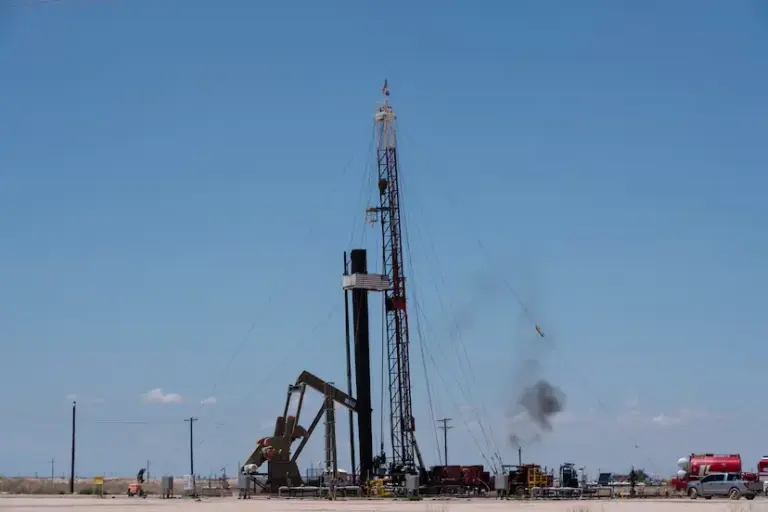
The situation has led some farmers to dare to sue oil companies for environmental damage. The latest case to become public is that of Billy Wayne Jr., in Crane County, halfway between Midland and Pecos. In December 2025, some of the most important companies in the region, such as Blackbeard or Conoco, were sued because the disposal wells and improperly sealed production wells that these companies have on and around his property contaminated his soil and groundwater. The lawsuit states that, one day in January 2022, one of the abandoned wells on the property “emitted a 60-meter-high geyser of contaminated water for a week,” with a constant flow afterward that lasted until June 2023, when Chevron sealed the well. But, six months later, the farm’s soil began to crack, and pools of toxic water emerged from the earth.
Wayne Jr seeks a court order for the companies to clean up his land and seal the wells, plus financial compensation exceeding one million dollars and a formal declaration of corporate responsibility for the degradation of the local ecosystem. A similar case, also in Crane County, was that of the Antina farm, which Ashley Watt had inherited from her parents. In 2022, Watt sued Chevron and other companies, accusing them of not having properly sealed 90 of the 330 wells they had exploited on her property. This allegedly caused wastewater leaks that contaminated water reserves and agricultural land. Finally, after several years of litigation, the case was closed last February, just before going to trial. Simply, Chevron solved the problem by removing its source. It bought the farm and signed a confidential agreement with the owner.
Read more At least one dead and five injured in several shootings inside Israel